Decentralisation Without Real Power
Even as India debates cooperative federalism, local governments remain ignored, weakening democracy, limiting grassroots empowerment and exposing structural imbalances in governance practice
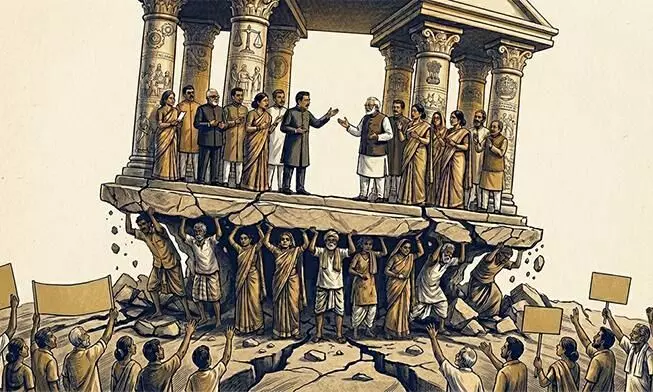


When the whole of Tamil Nadu is gearing up to choose a government for another five years, an academic deliberation on a hot topic was planned and conducted in the south of Madurai. It was jointly organised by a research institution, the Academy of Development Affairs, located in the remote village of Usilampatti, and Madurai Kamaraj University, on March 21–22. The discourse focused on the functioning of cooperative federalism in India and its future prospects. Experts were drawn from various universities across Northern India, North East India, and South India. It was interesting to note that a large number of participants from the student community, mostly from Law, Political Science, and Public Administration faculties, actively took part in the deliberation. When it was inaugurated by a vice-chancellor from a central university in Tamil Nadu, he made a fervent plea: whatever the discourse on this topic may be, the key concern should be how a common man can derive maximum benefit from the government, whether it is fully federal or quasi-federal, as he himself comes from a remote village and a rustic family.
The conditions of the poor in villages remain deplorable, even as we achieve 7 per cent economic growth and implement hundreds of development schemes and programmes by governments at both the Union and state levels. An acclaimed expert on federalism, in his inaugural address, analytically traced the historical evolution of federalism in the world, particularly in India, and highlighted the current scenario of relationships among governments globally and within India. The author of this article was invited to deliver a keynote address at this national event. In the keynote address, I highlighted the missing dimension in the discourse on federalism—both in political and academic platforms—namely, the role of local governments in the federal arrangement. While passing the 73rd and 74th Amendments to the Constitution of India in Parliament, and subsequently enacting conformity legislation in all state legislatures, it was argued that a new dimension had been added to Indian federalism and democracy. However, when federalism is taken up for deliberation, academics and researchers usually focus on the challenges in maintaining harmonious relations between the Union and state governments. Very little attention has been paid to the role of local governments in Indian federalism. It is ironic that the same old framework of analysis continues even after amending the Constitution of India to create a local government system by incorporating Parts IX and IXA. These provisions unequivocally refer to “local government” and not “local bodies.” Federalism remains the basic framework of the Constitution of India.
When we talk about federalism in India, it is necessary to discuss not only the relationship between the Union and the states but also that between the states and local governments. Barring the Union government, the term “local government” is often conveniently avoided, with people continuing to use the outdated phrase “local bodies.” Political parties, both national and regional—barring the Left—have avoided this shift in terminology, aware of its implications: empowering local governments could reduce the relative importance of state governments and elected representatives in Parliament and state legislatures. On many occasions, those in positions of power at the state level feel that strengthening local governments, especially in the context of centralisation of powers amid globalisation, could make state governments vulnerable and marginalised. This explains the reluctance of state governments to genuinely empower local governments. In Tamil Nadu, it has long been argued that decentralisation in India remains incomplete, as powers have not been sufficiently devolved from the Centre to the states, even as the Centre expects states to devolve more powers to local governments. Since Independence, Dravidian parties have consistently demanded greater autonomy for states.
In the Indian context, symmetrical federalism and pluralist tendencies require strong local governments at the grassroots to address the basic needs of the poor and the marginalised. For a long time, it has been argued that empowering the unreached sections at the grassroots is possible only through vibrant local governments that enable meaningful participation in governance and development. This can be achieved only through strong local institutions. To realise the objectives of the 73rd and 74th Amendments, state governments must take a series of steps to stabilise local governments by conducting regular, free, and fair elections, and by providing adequate powers, finances, and functionaries so that they can function as self-governing institutions. In terms of stability, local governments must be treated on par with the two other tiers—Union and state governments—and not as mere appendages of state administrations.
Yet another glaring omission in the discourse on federalism is the absence of discussion on the legitimate share of local governments in the divisible pool under GST. What local governments ought to receive from this pool remains largely unaddressed. The lack of discourse on the relationship between states and local governments in federal discussions appears to be a deliberate neglect, weakening the position of the already marginalised and, in turn, undermining democracy at the grassroots. A vibrant federation and democracy require strong local governments. Hence, a new discourse on this subject is urgently needed.
Following the keynote address, there were presentations by academics, researchers, and students. Significantly, the most compelling aspects of the seminar were the questions raised by students during their presentations and discussions, often more thought-provoking than the academic papers themselves. Some of the pressing questions raised by graduate students were: Do we have a politics with civility to deepen democracy? Do political leaders possess the maturity needed to elevate democratic standards? Have we used our liberal democracy honestly and effectively? Do our representatives truly represent their constituents? Contemporary politics appears to lack the decency and decorum essential for a functioning democracy. In the absence of honesty, integrity, and maturity, how can we expect cooperation, coordination, and synergy among governments and political parties to serve the people? Increasingly, political decisions seem to be influenced by market forces. In such a market-driven political environment, can we expect people-centric governance? It is evident that political representatives often serve market interests more than societal ones. Today’s federal politics is marked by authoritarian tendencies rather than genuine governance, leaving little room for the voices of the people. Unless citizens are consciously prepared and empowered, market-driven politics will continue to dominate, benefiting political elites and entrenched interests. Throughout the deliberations, one could sense the anger among the youth over the malfunctioning of India’s federal parliamentary democracy, for which political parties bear significant responsibility. The political space appears to be monopolised by parties, leaving little room for public voice. Vox populi, suprema lex—the voice of the people is the supreme law—yet today, market forces often drown out that voice. It is imperative to revive public participation, which calls for a different kind of politics—one that goes beyond party politics.
Views expressed are personal. The writer is a former Professor and Rajiv Gandhi Chair for Panchayati Raj Studies, Gandhigram Rural Institute