
Chagos Dispute and World Order
From ICJ rulings to power politics, the Chagos dispute exposes contradictions in the global rules-based order and reshapes strategic dynamics in the Indian Ocean
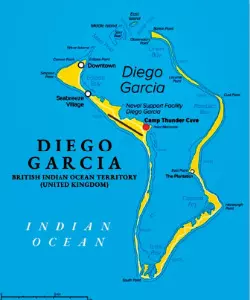


Diego Garcia, the largest island in the Chagos Archipelago, sits astride crucial sea-lanes in the central Indian Ocean and hosts one of Washington’s most important overseas bases. The struggle over its sovereignty is not just a local decolonisation dispute; it goes to the heart of who sets and who obeys the “rules-based order,” and it now offers a precedent for other colonial-era boundary questions. This article outlines the historical background, the 2019 International Court of Justice (ICJ) advisory opinion, the subsequent binding maritime ruling in favour of Mauritius, the recent UK–Mauritius–US triangular diplomacy, the Trump–Starmer controversy, the West’s double standards, and an India-centred assessment.
From Detachment to Dispossession
In 1965, as Britain prepared to grant Mauritius independence, it unilaterally detached the Chagos Archipelago from the colony and created the British Indian Ocean Territory (BIOT). Soon after, London agreed to lease Diego Garcia to the United States, leading to the construction of a major air and naval facility. Between 1968–1973, the indigenous Chagossian population was forcibly removed to Mauritius and the Seychelles to clear the islands for the American military base. This combination of partition, strategic leasing and expulsion laid the seeds of a sovereignty and human-rights dispute that would last decades.
The 2019 ICJ Advisory Opinion and UNGA Resolution 73/295
On 25 February 2019, the ICJ issued its advisory opinion in the case “Legal Consequences of the Separation of the Chagos Archipelago from Mauritius in 1965.” The Court held, by 13 votes to 1, that the detachment of Chagos meant “the decolonisation of Mauritius was not lawfully completed.” It concluded that the UK is “under an obligation to bring to an end its administration of the Chagos Archipelago as rapidly as possible.”
Because this was an advisory opinion requested by the UN General Assembly (UNGA), it was not a binding judgment in a contentious case. Under the ICJ Statute, only judgments in disputes between consenting states are binding between the parties, and even then only under Article 59. Advisory opinions are formally non-binding, though they carry considerable legal weight and are often treated as authoritative statements of international law.
On 22 May 2019, the UNGA adopted Resolution 73/295 by 116 votes to 6. It affirmed that “the Chagos Archipelago forms an integral part of the territory of Mauritius” and demanded that the United Kingdom withdraw its colonial administration from the archipelago within six months of the resolution’s adoption. The six-month deadline implied a date of 22 November 2019 for ending British administration. London rejected both the advisory opinion and the resolution’s implications, insisting that it retained sovereignty and that the ICJ’s view was merely advisory.
From Advisory Logic to Binding Law: The ITLOS Special Chamber
After the UK dismissed the ICJ opinion as non-binding, Mauritius sought a forum where the legal logic of Chagos could crystallise into a binding decision. The opportunity came via a maritime boundary dispute with the Maldives in the same region. The case was brought under the UN Convention on the Law of the Sea (UNCLOS) and submitted to a Special Chamber of the International Tribunal for the Law of the Sea (ITLOS).
In its judgment on preliminary objections on 28 January 2021, the Special Chamber rejected the Maldives’ argument that it lacked jurisdiction because of an unresolved sovereignty dispute between Mauritius and the UK. Relying heavily on the ICJ advisory opinion and UNGA Resolution 73/295, the Special Chamber held that it had a sufficient basis to treat Mauritius as the coastal State in respect of the Chagos Archipelago. In effect, it accepted that the United Kingdom could not rely on a claim to sovereignty over Chagos for maritime delimitation.
On 28 April 2023, in its judgment on the merits, the Special Chamber went on to delimit the maritime boundary between Mauritius and the Maldives. In doing so, it drew a binding line premised on Mauritius being the sole coastal State for Chagos. Under Article 296 of UNCLOS and the ITLOS Statute, these decisions are final and binding between Mauritius and the Maldives. They are not formally binding on the UK, which was not a party, but they transformed the ICJ’s “non-binding” opinion into an applied, binding outcome in a concrete case and sharply undermined Britain’s legal position.
The 2024–25 UK-Mauritius Agreement and the Trump-Starmer Row
Cumulatively, the 2019 ICJ advisory opinion, UNGA Resolution 73/295, and the 2021/2023 ITLOS judgments created intense legal and diplomatic pressure on the UK. By late 2022, the UK entered negotiations with Mauritius on the future of the archipelago. These talks culminated in a 2025 agreement under which sovereignty over the Chagos Archipelago, including Diego Garcia, is to be transferred to Mauritius. In parallel, Mauritius undertakes to grant a long-term (reportedly 99-year) arrangement preserving the UK–US military presence on Diego Garcia. The deal also sets a framework for acknowledging past wrongs and enabling some form of Chagossian return.
This legal and diplomatic trajectory recently intersected with domestic politics in both London and Washington. The US base on Diego Garcia is crucial for its power projection and operations. In 2026, the agreement became the focus of a public row between US President Donald Trump and UK PM Keir Starmer, with Trump oscillating between tacit support and strong criticism. At various points, he has described the arrangement as a mistake that might weaken a vital strategic asset and hinted he could withhold or complicate US assent to the deal.
Supporters of the agreement argue that it finally completes the decolonisation of Mauritius in line with ICJ and UNGA guidance, restores legal credibility to the UK, preserves the operational value of Diego Garcia under Mauritian sovereignty, and creates space for a more just treatment of the Chagossians. Critics, especially in some US and UK security circles, respond that advisory opinions and Assembly resolutions are not binding, that surrendering British sovereignty under pressure sets a bad precedent, and that relying on a long lease from Mauritius could inject uncertainty if domestic politics in Mauritius change or if external powers (read China) gain influence.
Confusion Compounded by Maldives
On 4-5 February 2026, Maldives defied the ITLOS ruling against Mauritius (not the UK) through rhetoric and limited EEZ patrols. On 5 February 2026, President Mohamed Muizzu addressed Parliament, formally rejecting the 28 April 2023 ITLOS maritime boundary ruling and asserting Maldives’ superior historical and geographical claim, citing 16th-century documents and traditional fishing rights.
Rules-Based Order and Western Credibility
Chagos has become a case study in Western inconsistency on the “rules-based order.” The UK and its allies have been vocal in condemning other states for ignoring international courts and UN resolutions, yet London initially shrugged off a near-unanimous ICJ advisory opinion and blatantly ignored the UN-imposed deadline of 22 November 2019. It then took binding UNCLOS litigation and mounting diplomatic isolation before Britain moved decisively towards implementing the Court’s view through negotiations. This gap between rhetoric and practice weakens Western claims to normative leadership, especially in the Global South.
An India-Centric Conclusion
For India, the Diego Garcia and Chagos settlement sits at the intersection of decolonisation, Indian Ocean security and major-power competition. New Delhi has backed Mauritius’ claim as part of a broader anti-colonial and Global South posture, while also quietly valuing a strong US presence on Diego Garcia as a counterweight to China’s expanding footprint in the region. A Mauritian-sovereign Chagos under a long, secure security arrangement with the US and UK potentially aligns these interests: it vindicates decolonisation while maintaining a stabilising military presence in the central Indian Ocean. The main risk for India lies not in the settlement itself, but in prolonged political wrangling in London and Washington that could erode Western cohesion and open fresh space for extra-regional actors in the Indian Ocean.
Views expressed are personal. The writer is Former Security Advisor, Ministry of Home Affairs, GoI



