Burning Ananda Math
The agitation against Ananda Math was not merely a dispute over literature. It represented a deeper clash over cultural nationalism, linguistic identity and the direction of India’s freedom movement
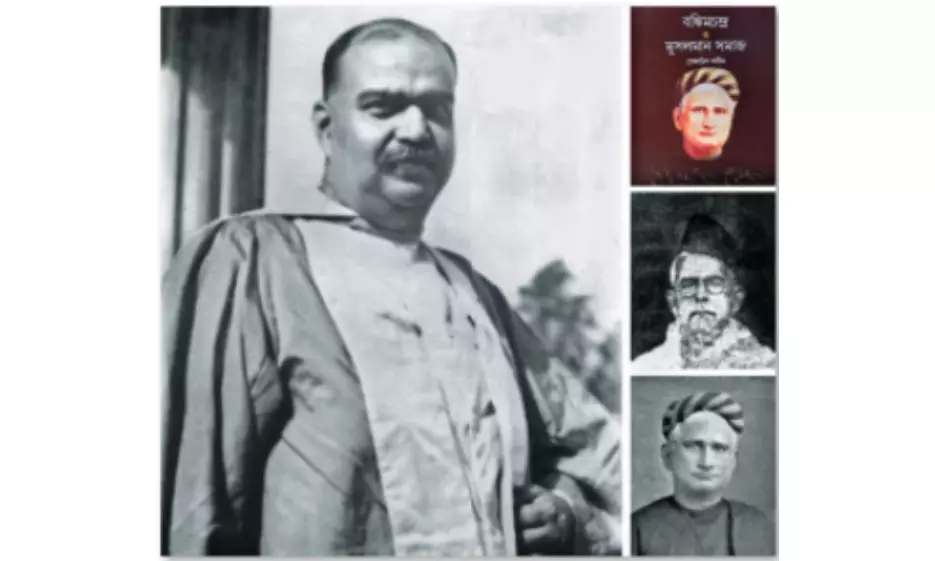


The University of Calcutta, under Syama Prasad Mookerjee, had decided to commemorate “Sahitya Samrat” Bankim Chandra Chattopadhyay’s centenary in a grand manner in 1938. The Muslim League, on the other hand, had already generated heat against the song, calling it “anti-Muslim” and “idolatrous.” It was essentially a political ruse to communally vitiate the atmosphere in Bengal.
Urdu-speaking leaders dominated the Bengal Muslim League. Historian Harun-or-Rashid reminds us that, with the exception of Maulana Mohammed Akram Khan (1868–1968), “none of the prominent leaders” of the Muslim League in Bengal “felt at home in a predominantly Bengali-speaking gathering, as they were mainly Urdu-speaking.” Akram Khan, a former Krishak Praja Party leader, had become an avid Muslim Leaguer and promoted the League’s communal politics in Bengal through his Bengali daily Azad. Ironically, the Muslim League, with support from the government it dominated, deputed Akram Khan, a Bengali-speaking Muslim, to organise and lead the burning of copies of Ananda Math on the streets of Calcutta in 1937. The League termed it the “Bonfire Festival of Ananda Math.”
Leading thinker, author, and journalist Rezaul Karim (1902–1993), one of the staunchest voices of protest against the Muslim League’s politics, spoke out against this deliberate act of vandalising India’s national song. Writing in the Ananda Bazar Patrika of September 19, 1937, Karim argued that the burning of Bankim Chandra’s famous novel Ananda Math by League Muslims, with great fanfare on the streets of a great Indian city, in front of a number of literary figures and with their consent, rivalled the atrocities committed by the anti-knowledge brigades of the medieval era.
Karim castigated the degenerative mindset that this act exposed and cautioned that it was pushing the Muslim community backwards, destroying its capacity for free thinking, and delivering a blow to its self-respect. Karim also warned that the movement against Ananda Math had not been launched with the intention of solving the problems and challenges faced by the Muslim community. The real reason behind engineering the protests was to prevent Muslims from participating in the freedom movement. The motives behind the protests against the University of Calcutta’s emblem of “Lotus-Sri” were the same as those behind the burning of Ananda Math.
In his Bengali opus Bankim Chandra O Mussalman Samaj, Rezaul Karim took on the League’s communalism. Karim questioned the League Muslims on whether they would tolerate Hindus burning books by Muslim scholars that criticised idolatry and the Hindu faith. Had Hindus burnt these books publicly, and if this hurt and agitated the Muslim community, would the League Muslims take responsibility? Karim also reminded his readers of the irony that Akram Khan, during the Swadeshi days of 1906–1911, had been a great admirer and devotee of “Vande Mataram” and had not then discovered anything against it in the Quran or the Hadith.
Karim further pointed out that in his famous book Mostafa Charit (1938), Akram Khan, while describing the geographical spread of Arabia, quoted a Muslim poet who referred to the region as “humanity’s ancient motherland.” Why, Karim asked, was a different yardstick being applied to Bankim Chandra’s “Vande Mataram”?
There was perhaps another reason behind the Muslim League’s hostility towards Bankim Chandra. Was it because of Bankim’s relentless championing of the Bengali language? Karim writes how Bankim Chandra consistently advocated the use of Bengali and appealed to those elite Muslims who had lived for generations in Bengal to give up their obsession with Urdu and Persian and return to Bengali as their linguistic identity. Bankim’s appeal was published in the Bangadarshan issue of 1290 of the Bengali era (1883–84). Such a call was anathema to the Muslim League and to Jinnah, as it ran counter to their core ideology and politics.
Syama Prasad, as Vice Chancellor of the University of Calcutta, embodied the intellectual and literary ideals of Bankim Chandra and promoted them through the university system. It was therefore natural that a Muslim League–dominated government would want him removed from the scene.
Historian Dinesh Chandra Sinha highlights the situation in Bengal in 1939 through Syama Prasad’s own words. “1939 continued to be a year of Hindu oppression at the hands of a communal ministry with Fazlul Huq at its head,” wrote Syama Prasad. “Legislative and administrative measures were either adopted or advocated, which aimed at deliberate curtailment of Hindu rights.” This led to Syama Prasad gravitating towards the political sphere. “My sphere of work has expanded beyond my expectation,” he observed, “and I have often been thrown into the midst of crises affecting people’s rights and liberties by a strange combination of circumstances beyond my control.”
It must also be remembered that all this while, from 1929 to 1937, and when he was once again elected to the Bengal Legislative Assembly, Syama Prasad Mookerjee, besides being an educationist, was also an active elected member of the legislature. Unaffiliated to any political party, he robustly took up the cause of education and spoke for the rights of the Hindus of Bengal. His election did not depend on the support of any political party.
In 1939, Syama Prasad participated in the Hindu Mahasabha Conference held in Calcutta and met Veer Savarkar. By 1940, he was elected Working President of the All India Hindu Mahasabha and President of the Bengal Hindu Mahasabha. His life had taken another decisive turn. It was as a rising star on the political firmament that he reached Nagpur and called on an ailing Doctorji.
In his biography of Doctorji, H. V. Seshadri writes that Doctorji, running a temperature of 103°F, insisted on standing up and receiving Dr Mookerjee at 9:00 pm when the latter, having visited the Sangh’s training camp, reached his house. “Why did you get up from the bed, Doctor? I heard you were extremely sick and bedridden,” Syama Prasad exclaimed on seeing him. Despite his severe health condition, observers recall that Doctorji “looked calm and tranquil throughout the meeting,” in which Sri Guruji was also present.
The condition of Bengal and the increasingly difficult situation for Hindus in the province weighed heavily on Syama Prasad Mookerjee’s mind when he arrived for his meeting with Doctorji. He best described the situation in a diary entry: “The ratio of communal representation in respect of services, the defilement of Hindu idols, the suppression and supersession of better qualification in respect of Hindus, preferential treatment of Moslems in educational and other technical spheres, the passing of laws specially jeopardising Hindus, the encouragement of riots, attacks on Hindu women — were some of the glaring instances of our suffering.”
In 1938, the Bengal Assembly recommended the reservation of 60 per cent of all government appointments for Muslims. By 1939, the Muslim League–dominated government decided, records Anil Chandra Banerjee, “that the basic percentage of reservation for the Muslims in all cases of direct recruitment would be 50 per cent.” In 1940, “a special officer, called the Communal Ratio Officer, was appointed to implement this decision.” A Muslim League member in the Assembly even asserted that the “interests of Bengali Muslims could be better served if Muslims from outside Bengal,” even from outside India, including Egypt, were brought over and employed in the province.
Such was the condition of Hindus in Bengal when Syama Prasad Mookerjee reached Nagpur to seek direction and guidance from Doctorji.
Views expressed are personal. The writer is a member of the National Executive Committee (NEC), BJP, and the Chairman of Dr Syama Prasad Mookerjee Research Foundation