Beyond IPS vs CAPFs
The CAPF leadership debate must move beyond binaries and focus on operational efficiency, institutional balance and the strategic demands of India’s evolving internal security landscape
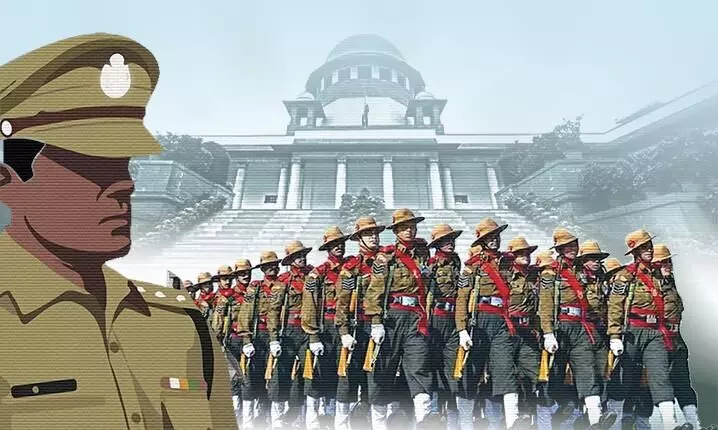


The ongoing debate on leadership within the Central Armed Police Forces (CAPFs), and the introduction of the Central Armed Police Forces (General Administration) Bill, 2026, by the Central Government, have once again brought into focus the delicate balance between cadre aspirations and operational imperatives. Framed narrowly, the issue appears to be about the “dominance” of Indian Police Service (IPS) officers on deputation. But in reality, it is far more fundamental. It is about ensuring that forces entrusted with some of the most complex internal security responsibilities in the world are led with the depth, perspective, and coordination such challenges demand. In this context, the proposed legislative framework, seeking to bring clarity and stability to leadership structures in CAPFs, is a timely and necessary step in the right direction.
CAPFs today are not conventional forces operating in static environments. They are deployed across an extraordinary spectrum of duties—counter-insurgency in Left Wing Extremism-affected areas, counter-terror operations, border guarding, election security, disaster response, and the maintenance of public order in volatile situations. Each of these roles requires not just tactical proficiency, but also a nuanced understanding of law, governance, intelligence, and federal dynamics.
It is in this context that the leadership of IPS officers assumes critical importance.
IPS officers are uniquely trained and positioned within India’s policing architecture. Their careers are rooted in district policing, where they confront the full spectrum of law and order challenges—crime control, intelligence gathering, riot management, and community engagement. Over time, they rise to positions where they handle state-level administration, policy implementation, and inter-agency coordination. This journey equips them with a rare ability to connect ground realities with strategic objectives.
When such officers are placed in leadership roles within CAPFs, they bring with them invaluable institutional memory and operational versatility. CAPFs, by their very nature, must work closely with state police forces. Operations in insurgency-affected areas, for instance, cannot succeed without seamless coordination with local intelligence units and civil administration. IPS officers, having spent years in these very systems, act as natural bridges between the Centre and the states. They understand the language, constraints, and expectations on both sides.
My own experiences reinforce this reality. Having had the opportunity to serve with forces such as the CRPF and CISF, I have witnessed firsthand the complexities of operations that demand both tactical firmness and administrative sensitivity. In conflict-prone areas, success often depended not merely on force deployment, but on the ability to synchronise efforts with district police, intelligence agencies, and civil authorities—an area where IPS leadership proved invaluable.
Equally instructive was my association with the National Disaster Response Force (NDRF), where personnel drawn from the BSF, ITBP, SSB, CRPF, and CISF come together for humanitarian operations. In disaster situations—earthquakes, floods, industrial accidents—there is no room for institutional silos. Coordination, clarity of command, and a shared sense of purpose become the defining factors. IPS leadership in such settings ensures cohesion among diverse units, enabling them to function as a unified, compassionate, and highly effective response force. It is here that one truly appreciates the blend of professionalism and empathy that such leadership can foster.
There is also a strategic dimension that cannot be ignored. CAPFs are not just operational entities; they are instruments of national policy. Decisions taken in the field can influence public perception, impact Centre-state relations, and carry broader implications. Leadership must, therefore, align field actions with national priorities. IPS officers, by virtue of their integration into the governance framework, are well-suited to provide this alignment.
The recent legislative initiative by the Central Government, in the form of the Central Armed Police Forces (General Administration) Bill, 2026, to formalise and clarify the role of IPS officers in CAPFs, deserves support in this context. Rather than viewing it as an attempt to assert dominance, it should be seen as an effort to bring legislative clarity, ensure stability in leadership, and harmonise operational requirements with administrative structures. In a domain as sensitive as internal security, ambiguity in command and control can be costly. A clear legal framework strengthens institutional confidence and operational effectiveness.
At the same time, concerns raised by cadre officers within CAPFs cannot be dismissed. Issues of career progression, recognition, and morale are real and deserve thoughtful redress. A professional force must ensure that its own officers see a fair and transparent path to leadership. Structural reforms, capacity-building, and well-defined promotional avenues are essential. However, addressing these concerns should not come at the cost of weakening the leadership architecture that ensures operational success.
The argument, therefore, should not be framed as IPS versus CAPFs. Such binaries are misleading and counterproductive. The real question is: what kind of leadership best serves the operational and strategic needs of the nation?
Experience shows that, in complex security environments, success depends on unity of command, clarity of purpose, and effective coordination across multiple agencies. IPS leadership, with its blend of field experience, administrative insight, and federal understanding, provides precisely this integrative capacity.
In the final analysis, CAPFs are too critical to India’s security framework to be shaped by narrow institutional considerations. They require leadership that can operate across boundaries—geographical, administrative, and conceptual. The presence of IPS officers in leadership roles is not about asserting control; it is about ensuring coherence in a system where fragmentation can be costly.
The way forward lies not in contestation, but in collaboration—where the strengths of both IPS officers and CAPF cadres are harnessed to build a more robust, responsive, and professional internal security apparatus. Leadership must ultimately be judged not by its origin, but by its effectiveness. And by that measure, the continued role of IPS officers in CAPFs, supported by a sound legislative framework, remains not only relevant but essential.
Views expressed are personal. The writer is President & CEO, Indian Police Foundation