A War the Gulf Didn’t Choose
While the conflict’s strategic drivers lie elsewhere, the Gulf states are bearing the immediate costs — from disrupted energy infrastructure and aviation to a shaken reputation for stability
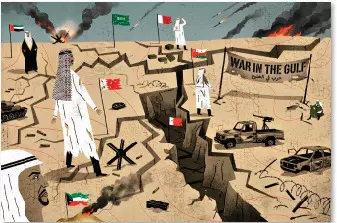


Even if we set aside the controversial argument advanced by Tucker Carlson—that the war with Iran is primarily driven by Israel rather than the strategic interests of the United States—the consequences for the Gulf states are already unmistakable.
Carlson has argued that the conflict “happened because Israel wanted it to happen,” describing it as a struggle for regional hegemony rather than a war fought primarily for American national security. He also suggested that Israeli Prime Minister Benjamin Netanyahu seeks to weaken several Gulf states, even though some of them now maintain diplomatic relations with Israel.
Whether one accepts or dismisses that interpretation, the broader reality is clear: the countries of the Gulf Cooperation Council are paying a heavy price for a war they neither started nor control. And the costs extend beyond economic disruption. The conflict has also damaged the carefully cultivated image of the Gulf as a sanctuary of stability for tourism, investment and global commerce.
Across Saudi Arabia, the United Arab Emirates, Qatar, Kuwait and Bahrain, the war has exposed how vulnerable the Gulf’s economic model is to regional escalation. Energy infrastructure, aviation hubs and tourism centres have all been disrupted, while attacks on ports and shipping lanes threaten the flow of oil and gas through the Strait of Hormuz. In effect, regardless of whose strategic goals triggered the conflict, the Gulf states have become the frontline economies of the war.
For decades, the Gulf has transformed itself from a sparsely populated desert into one of the world’s most interconnected economic regions. Its cities are global aviation crossroads. Its ports connect energy markets across continents. Its financial centres attract investors from every corner of the world.
Yet this prosperity rested on a fragile assumption: that regional wars would remain somewhere else.
That assumption is now under strain.
Iranian missile and drone attacks have targeted economic infrastructure across the region. Energy facilities operated by QatarEnergy at Ras Laffan and Mesaieed Industrial City were damaged, forcing the world’s largest liquefied natural gas producer to halt operations. Saudi Arabia’s Ras Tanura refinery—one of the most important oil processing centres in the world—has also been struck, alongside oil infrastructure in the UAE.
The war has also dealt a severe blow to the Gulf’s aviation and tourism sectors—two pillars of its economic diversification strategy.
Dubai International Airport, the world’s busiest hub for international passengers, suspended operations following strikes near the Jebel Ali port complex. Abu Dhabi’s airport experienced a fatal incident, while drone strikes damaged Kuwait International Airport’s passenger terminal. Qatar closed its airspace and grounded the fleet of Qatar Airways.
For the first time in recent memory, all GCC states experienced simultaneous airspace closures. Tourism during the Ramadan season—normally one of the region’s most lucrative periods—collapsed almost overnight, with losses expected to exceed $40 billion.
But the reputational damage may prove even greater.
Videos of explosions in Dubai, Doha and Manama—and scenes of stranded tourists attempting to flee overland—have punctured the Gulf’s carefully cultivated image as a haven of stability in an otherwise turbulent region. Iranian strikes on luxury hotels in Dubai and residential towers in Bahrain carried a powerful message: even the Gulf’s most prestigious economic symbols are not immune from regional conflict.
Beyond tourism and energy, the war has also exposed deeper structural vulnerabilities. In an arid region with few natural resources, daily life depends on fragile networks of pipelines, ports and desalination plants that provide water and electricity to tens of millions of residents.
The Arabian Peninsula has no major rivers or lakes. Nearly all drinking water comes from desalination plants connected to coastal power stations. These facilities—responsible for roughly half of the world’s desalination capacity—are highly exposed to missile or drone attacks.
Even if the war ends soon, its consequences will linger long after the missiles stop flying.
The conflict has revealed how easily advanced infrastructure can be threatened by relatively inexpensive drones and missile systems. It has also raised uncomfortable questions about the limits of existing air-defence systems and the reliability of external security guarantees.
As a result, military spending across the Gulf is almost certain to surge. Governments will likely invest billions more in missile defence, drone interception technologies, cybersecurity and hardened infrastructure protection.
But those investments will come at a cost.
For years, Gulf governments have poured resources into ambitious diversification projects—technology hubs, tourism megaprojects and financial centres designed to prepare their economies for a post-oil future. Now, some of those resources may increasingly be redirected toward security.
The war has also exposed another vulnerability: the Gulf’s dependence on foreign labour and international investors. Millions of expatriates work across the region, and many have already begun leaving as the conflict intensifies. If security concerns persist, the Gulf’s economic model—built on global mobility and investor confidence—could face long-term strain.
For decades, the Gulf states built their prosperity on a powerful narrative: stability in an unstable region.
This war has shaken that narrative.
And when the conflict finally ends, the Gulf will face a daunting task—not only rebuilding infrastructure and restoring investor confidence, but also reclaiming the reputation for safety and stability that made it one of the world’s most successful economic hubs in the first place.
Views expressed are personal. The writer has worked in senior editorial positions for many renowned international publications