
A Border Too Important
As Bangladesh goes to the polls amid instability and shifting alliances, India confronts the strategic consequences of uncertainty along its longest and most sensitive border
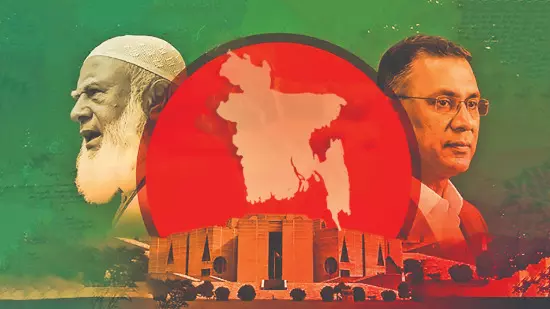


Bangladesh polls have begun. This is an election of immense importance to India. Why so? India shares a border of over 4,000 km with Bangladesh, and it matters whether India has a friendly government in that country—especially in view of the fact that on the western border India is surrounded by the enemy state of Pakistan; on the northern border it faces the hegemonistic superpower China, against whom it has already lost a war in 1962 and which is forever trying to slice away portions of Indian territory; and it does not help when even the Hindu-majority nation Nepal can no longer be called a friend. On the northeastern borders, Myanmar is a strife-torn state plagued by civil war; only the tiny Bhutan continues to be a friendly neighbour.
When Sheikh Hasina, the Prime Minister of Bangladesh, had to flee the country in the wake of large-scale violence and the so-called “July Revolution” in 2024, she sought refuge in India. The Indian government gave her shelter. The new dispensation carried out a sham trial, convicted her, declared a death sentence, and demanded that the deposed leader be extradited to Bangladesh. The government of India naturally refused to do so. This turned out to be a sore point with the interim government of Muhammad Yunus and his advisers.
If we go back to the genesis of the recent developments in Bangladesh, we should look at the birth of the new country in 1971 and the role of India in the War of Independence of Bangladesh. It was the pride of the Bengali Muslim community, which considered itself a distinct entity, breaking the two-nation theory to smithereens, that led to the formation of the state of Bangladesh. But there was a section of people in Bangladesh who did not support Sheikh Mujibur Rahman or the birth of the new nation on the basis of language or regional pride. These people are called “Rajakars” by Bangladeshis. These Rajakars were active collaborators of the Pakistanis during the War of Independence of Bangladesh. After 1971, they lay low and gradually increased their influence. The Bangladesh Jamaat-e-Islami party represents these right-wing Islamic forces. It has changed its mode and manner of operation and joined a coalition government led by Begum Khaleda Zia’s party, the BNP, in 2001.
After it came to power, the Awami League government began prosecuting Jamaat leaders for the war crimes committed during the 1971 war under the International Crimes Tribunal from 2010. Many Jamaat leaders were charged, and some were convicted of war crimes. In August 2013, the Bangladesh Supreme Court cancelled the registration of the party. In early August 2024, following the July Revolution, the party was again banned by the Awami League. This ban was reversed by the interim government after it came to power.
The Jamaat is a right-wing to far-right Islamist party which believes in Sharia law and has been involved in anti-Hindu activities for a long time. It has carried out atrocities against Hindu and Buddhist minorities in Bangladesh from time to time. Assaults on Hindus, killings, and the torching of their properties have been hallmarks of Jamaat’s politics. The party has, however, sought to project a more liberal stance on women’s issues, such as education and the right to work. Jamaat has also expressed support for the rights of religious minorities and the protection of their properties. It has retracted from its stated goal of establishing a Sharia-based administration. But Jamaat is also known for double-speak and frequent flip-flops in its political stance depending on its strength. Therefore, liberal citizens of Bangladesh do not have much faith in the party’s current liberal face.
The interim government of Bangladesh has supported Jamaat in various ways. Its “Babalog” advisers, who have started a new political party called the NPS, are also blatantly anti-India. In fact, as a person who has roots in Bangladesh and closely follows its politics, I can say with some authority that anti-India rhetoric sells in Bangladesh. Against this backdrop, the February 12, 2026 elections are of crucial importance to our country.
With the Awami League out of the scene, the main political parties in the fray are the BNP, under the leadership of Tarique Rahman, who has returned to Bangladesh politics after 17 years; the Jamaat, under the leadership of Shafiqur Rahman; and the NPS, the newly minted party of the Babalog, who were at the forefront of the so-called July Revolution. Although the BNP is a popular mainstream political party, there is doubt among its followers about whether Tarique Rahman will turn out to be an able leader after such a long exile. Jamaat is the party India should watch out for. In fact, there is a widespread belief among political observers and citizens that Jamaat is a strong contender and has been gaining ground surreptitiously over the last few years, emerging as a force to be reckoned with during the interim government’s rule. It is also widely discussed in Bangladesh how foreign countries are courting Jamaat. The NPS has some support among students and the youth. Muhammad Yunus, the chief adviser, has high ambitions of remaining in power in some capacity.
There is a possibility of large-scale violence and rigging in the upcoming elections, and nobody knows who will ultimately rule the beleaguered Bangladesh. Unfortunately, encircled by mostly enemy or non-friendly countries, India is not in a position to say, “May the best party win.”
Views expressed are personal. The writer is a former senior bureaucrat



