Middle East crisis ‘highly unusual’, could hit global economy: Rajnath
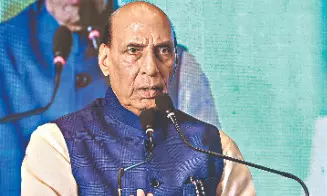


New Delhi: In this era of changing geopolitics, oceans have once again come to the centre of the world’s power balance and it is India’s responsibility to provide leadership with confidence and capability, Defence minister Rajnath Singh said on Friday, referring to the escalating conflict in the Middle East.
The unfolding developments in the Middle East is “highly unusual” and the situation in the region could adversely impact the global economy, he said addressing an event in Kolkata.
“What is happening there is quite unusual. It is difficult to make concrete comments about the future course of events in the Middle East or in our neighbourhood. The Strait of Hormuz or the entire Persian Gulf region is crucial for global energy security,” Singh said.
“When there is disturbance in the region, it directly impacts the supply of oil and gas. Moreover, we’re witnessing supply chain disruptions in other sectors as well. These uncertainties have a direct impact on the economy and global trade,” he said.
“The global scenario is an abnormal situation. What is more worrying is the fact that this abnormality is becoming the new normal,” he added.
Global oil and gas prices have surged after Iran has virtually blocked the Strait of Hormuz, a narrow shipping lane between the Persian Gulf and the Gulf of Oman, that handles roughly 20 per cent of global oil and LNG (Liquefied Natural Gas). Singh said the current situation in the Middle East has once again reflected the importance of oceans.
“In this era of changing global geopolitics, oceans have once again come to the center of the world’s power balance. At such a time, as a major maritime nation, it is India’s responsibility to provide leadership with confidence, capability, and a clear vision,” he said.
The defence minister, however, did not make any direct or indirect reference to the US sinking an Iranian warship off the coast of Sri Lanka two days ago.
The Iranian frigate, IRIS Dena, was returning home after participating in the Milan multilateral naval exercise hosted by India. At least 87 Iranian sailors were killed in the attack, which marked a major escalation in the conflict between the US and Iran outside of the Persian Gulf.
The US launched military strikes on Iran on February 28, killing Iranian Supreme Leader Ayatollah Ali Khamenei.
Following the military offensive, Iran carried out a wave of attacks mainly targeting Israel and American military bases in several Gulf countries including the UAE, Bahrain, Kuwait, Jordan and Saudi Arabia.
In the last three days, the conflict has widened significantly with attacks and counter-attacks by both the sides.
In his remarks, Singh said that India’s maritime domain will be safe, prosperous, and strong if the nation moves forward with coordinated planning, technology adoption, and institutional synergy.
“The Indian Navy’s readiness, the success of operations like Operation Sindoor, and the steps towards self-reliance indicate that India’s defence sector is moving in the right direction,” he said.