Lok Sabha clears Manipur GST Amendment Bill amidst uproar
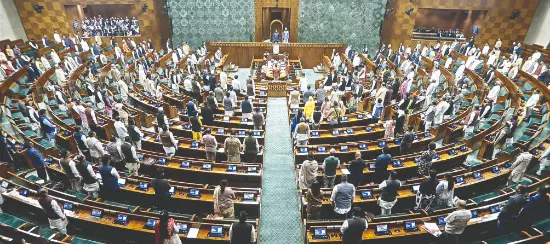


New Delhi: The Lok Sabha on Monday passed the Manipur Goods and Services Tax (Second Amendment) Bill, 2025, amid sustained Opposition protests over the ongoing Special Intensive Revision (SIR) of electoral rolls in 12 states and Union Territories.
The Bill, which seeks to overhaul key provisions of Manipur’s GST law, was introduced earlier in the day by Finance minister Nirmala Sitharaman to replace an ordinance promulgated on October 7.
With the northeastern state currently under President’s Rule, Parliament is empowered to enact legislation on its behalf.
Opposition MPs trooped into the Well, demanding an immediate discussion on voter roll discrepancies, and chaotic scenes gripped the House. However, Sitharaman managed to introduce three financial Bills and table supplementary demands for grants for 2025–26 during the 12–minute Zero Hour. She also introduced two more Bills relating to excise duty on tobacco products and a new cess on pan masala.
RSP member NK Premachandran moved a statutory resolution opposing the Manipur GST Ordinance, but the Chair—TDP’s Krishna Prasad Tenneti—proceeded with legislative business after Premachandran insisted the House was not in order.
BJP MP Shashank Mani spoke briefly in favour of the Bill, after which it was passed by a voice vote, overruling the Opposition’s objections.
Explaining the urgency, Sitharaman said that amendments made to the Central GST Act through Sections 121 to 134 of the Finance Act, 2025, required corresponding changes in Manipur’s GST law, recommended by the 56th GST Council. “It was essential to avoid repugnancy with the Central Act,” she noted on the floor of the House.
The Bill brings in far-reaching changes to tighten compliance, widen the tax base, and usher in a new technology-driven track-and-trace regime for identified goods.
One of the major amendments extends the definition of “tax payable” to include liabilities arising under Section 9 of the Manipur GST Act as well as reverse-charge obligations under Sections 5(3) and 5(4) of the Integrated GST Act. This alignment with the integrated tax framework is effective from April 1 this year.