
Is AI replacing ASHA workers?


New Delhi: New Delhi: Artificial intelligence is reshaping India’s approach to frontline healthcare, with policymakers actively backing the shift. Union Minister of State for Science and Technology Jitendra Singh has spoken approvingly of a new generation of AI-based health-tech tools threading their way through the country’s clinical systems.
“With increasing patient and disease load globally, such AI tools help in making patients’ journey to medical care seamless,” Singh told Millennium Post.
Multilingual triage platforms are helping doctors decide faster, hospital waiting rooms are being managed more efficiently, and AI scribing tools now let physicians speak a prescription aloud while software puts it on paper.
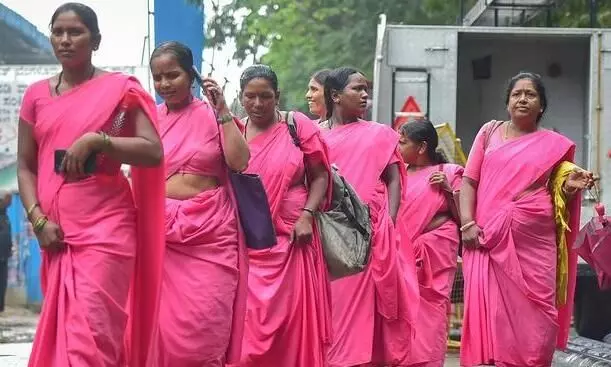
What that vision leaves out is where most patients’ journeys actually begin not at a hospital gate, but at a household door in rural India, where a woman arrives on foot, sometimes weeks behind on her incentive payments, carrying a government-issued phone loaded with tracking apps. That woman is the ASHA worker. And it is at her door, without much public announcement, that a parallel digitisation is quietly taking root. Across several states, AI-powered chatbots running on platforms as ordinary as WhatsApp are being deployed to screen symptoms, guide women through pregnancies, and field the daily health questions the ASHA has traditionally answered in person.
“A hybrid model is best suited. I have implemented in my constituency —a real doctor and an AI platform—are working together to help patients,” Singh explained.
Those building these tools are candid about their pitch. “askNivi complements frontline workers by de-burdening routine tasks while delivering cost-effective, accessible, and anonymous support in regional languages,” said Rubiya Bano, Project Coordinator for askNivi in India. “By combining AI with behavioural science, they are beginning to positively shift health-seeking behaviour at scale.”
If a chatbot handles routine queries, the logic goes, she is free for work that genuinely requires a human being.
Shweta Raj, an ASHA worker from Patparganj in Delhi, said that the trouble is that most of her work genuinely requires a human being. She knows which household stopped trusting the local health system after a difficult delivery.
“A chatbot cannot notice what goes unsaid,” she said. “It cannot sit with someone until the fear passes. In community health, trust is not a supporting feature. It is the whole architecture,” she added.



