India’s military might showcased at Army Day Parade in Jaipur
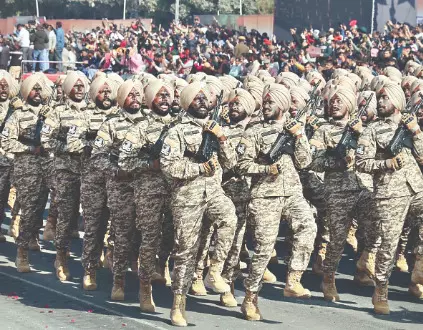


New Delhi: The Indian Army celebrated its 78th Army Day in Jaipur on Thursday, not within a traditional cantonment, but on Mahal Road, marking a historic step toward greater public involvement and transparency.
Chief of Army Staff General Upendra Dwivedi highlighted that choosing Jaipur was a conscious move to strengthen the Army’s bond with the public. He explained that taking the Army Day Parade outside conventional locales reflects the force’s commitment to building mutual trust and understanding with civilians.
The parade kicked off with Chetak helicopters showering flower petals along the route, while mounted columns and precisely synchronised contingents, including the Nepal Army Band, received warm applause. The 61st Cavalry — the world’s sole active horse-mounted unit — brought to mind a history dating back to the Battle of Haifa in 1918.
But the emphasis remained on the future. Displaying indigenous military hardware underscored the core message of General Dwivedi’s speech: ‘Atmanirbharta’, or self-reliance. A wide array of ‘Made in India’ systems passed by the dais, including T-90 ‘Bhishma’ and Arjun main battle tanks, NAG missile systems, K-9 Vajra howitzers, Dhanush artillery, and the BrahMos cruise missile. The Army chief stressed that indigenisation isn’t just a goal anymore but a vital strategic necessity for operational flexibility and long-term reliability.
General Dwivedi noted that Operation Sindoor set a new standard for the Army, demonstrating its ability to act swiftly, precisely, and confidently. A dedicated tableau depicting the operation skillfully blended battlefield heroism with modernisation, featuring drones, robotic mules, and a human-robot handshake to symbolise the fusion of bravery and technology.
This transformation, the Army chief explained, is part of a broader strategic shift. The force is actively gearing up for future warfare with new units like the Bhairav Battalions, Ashni Platoons, and Divyastra Missile Batteries, all designed to be agile and mission-focused. He announced that the coming two years would be dubbed the ‘Years of Networking and Data Centricity.’
The parade also highlighted the Army’s diverse makeup. The Mixed Scouts Battalion, comprising personnel from Ladakh, Himachal, Uttarakhand, Sikkim, and Arunachal Pradesh, symbolised resilience in high-altitude regions. The presence of trained service dogs and indigenous canine units underscored their crucial role in detection and combat. Aerial displays by the Dhruv Mk-III, Rudra, and the Light Combat Helicopter Prachand, along with an Indian Air Force flypast, showcased the integrated combat capabilities at play.