India signals maritime deterrence through high-tempo Navy Day combat display
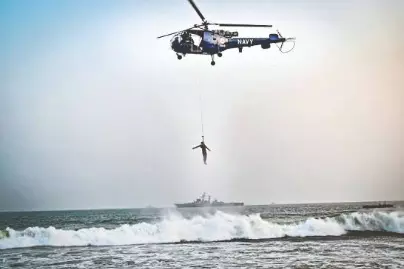


Thiruvananthapuram: The Indian Navy on Wednesday marked Navy Day 2025 with a high-intensity, multi-domain operational demonstration at Shangumugham Beach here, offering a rare and powerful public glimpse into India’s expanding maritime combat capability and operational readiness. The display of firepower and precision manoeuvres underlined the Navy’s preparedness to respond decisively across the full spectrum of maritime conflict, from high-end warfare to emerging non-traditional threats.
The President of India and Supreme Commander of the Armed Forces, Droupadi Murmu, addressed the event and was received by Chief of the Naval Staff Admiral Dinesh K. Tripathi with a 150-member ceremonial Guard of Honour. Kerala Governor Rajendra Vishwanath Arlekar, Chief Minister Pinarayi Vijayan, senior civil and military officials, and a large gathering of citizens watched the demonstration along the city’s iconic coastline.
Held against the backdrop of heightened security challenges in the Indo-Pacific, the Arabian Sea, and critical Sea Lanes of Communication, the operational showcase was widely viewed as a calibrated assertion of India’s strategic resolve at sea. The 53-minute demonstration commenced after the ceremonial arrival of the President on the main dais and the live rendition of the National Anthem, formally flagging off the operational sequence.
The war-simulated battle scenario started with the detection of hostile surface and aerial targets through a layered surveillance grid of shipborne radars and long-range maritime patrol aircraft and helicopters. Real-time data fusion ensured that command centres could quickly build a common operational picture, highlighting the transformation of the Indian Navy into a fully network-centric fighting force. Surface combatants soon manoeuvred into attack positions, launching simulated anti-ship missile engagements against targets beyond visual range, followed by swift tactical movements of fast attack craft and corvettes to demonstrate operations in congested littoral zones and strategic choke points.
Frontline multi-role destroyers and frigates then engaged simulated aerial targets with air-defence missiles, reflecting the multi-layered missile shield that now protects Indian naval task groups. A major highlight of the demonstration was the deployment of carrier-borne fighter aircraft that executed low-level attack profiles, undertook simulated precision strikes under protective cover provided by surface-based air defence and airborne helicopters, and then undertook tactical runs at high speeds to demonstrate the Navy’s growing blue-water power projection capability.
Simultaneously, naval helicopters conducted both anti-submarine and surface surveillance missions, deploying simulated sonobuoys to detect and track the position of underwater threats and cue surface combatants for targeting. Submarines-much less visible to the audience but key contributors to the operational narrative-conducted simulated torpedo attacks as part of the vignettes, reflecting an emerging focus on subsurface dominance as the foundation of a robust deterrent.
The exercise also demonstrated the Navy’s amphibious warfare capability. A simulated amphibious assault saw landing craft and amphibious ships deploy Marine Commandos in a coordinated coastal strike operation. Combat swimmers were inserted to neutralise hostile shoreline positions, demonstrating preparedness for island defence, coastal security, and maritime counter-terror operations.
The demonstration included more than twenty naval ships and submarines, including the indigenous aircraft carrier INS Vikrant, along with frontline air assets and Marine Commandos. Most of the platforms on display were indigenously designed and built in keeping with the government’s focus on self-reliance in defence manufacturing. Officials said the demonstration reflected India’s growing maritime strength and validated combat readiness while providing valuable feedback for future technological refinement.
Addressing the gathering on the eve of Navy Day, Admiral Tripathi said the presence of the President at the operational demonstration for the second consecutive year underlined the nation’s highest priority to maritime security and the Indian Navy’s central operational role. The occasion, he said, was one of “immense pride and honour.” Navy Day, observed annually on December 4, commemorates the daring and decisive Indian Navy strikes during the 1971 war and honours the sailors whose courage and sacrifice continue to inspire the service and the nation.
Navy chief further said Kerala’s selection was deeply symbolic of India’s historic maritime engagement, recalling the naval resistance of the Travancore Kingdom and the legendary exploits of the Kunjali Marakkars along the Malabar coast. Quoting strategist K.M. Panikkar, he said that for India to become a true naval power, it must also create a naval tradition in public consciousness.
The combat display gave way to ceremonial grandeur as naval personnel performed a traditional Hornpipe dance, there was an evocative Beating Retreat by the Indian Naval Band, and the ceremonial sunset at the shoreline. Events post-sunset included cultural displays, a high-octane Continuity Drill, and addresses by the Chief of the Naval Staff and the Chief Guest. The evening ended with the illumination of warships along the seafront, followed by a fireworks display, the National Anthem, and the Navy Day Song 2025-a fitting finale to the celebrations.
The operational demonstration on Navy Day 2025, as the last flares faded over the Arabian Sea, was a poignant reminder of India’s growing maritime reach, the technological transformation into a networked fighting force, and its enduring commitment toward safeguarding national interests across the blue frontiers anytime, anywhere, and under all conditions.