
‘Increase urea price, transfer cash to farmers’
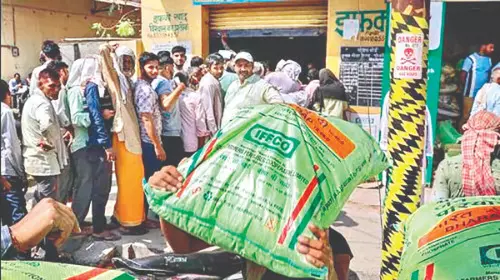


New Delhi: The Economic Survey 2025-26 has called for a “modest increase” in the retail price of urea — unchanged since March 2018 at Rs 242 per 45-kg bag — and transferring an equivalent amount directly to cultivators on a per-acre basis. The move seeks to shift fertiliser support from input subsidies to income support, correcting long-standing distortions that have harmed soil health and crop productivity.
Tabled in Parliament on Thursday, the Survey flagged a sharp deterioration in India’s nitrogen-phosphorus-potassium (N:P:K) usage ratio, from 4:3.2:1 in 2009-10 to 10.9:4.1:1 in 2023-24. This imbalance, driven by excessive nitrogen use through subsidised urea, diverges significantly from the agronomic ideal of around 4:2:1 for most crops.
“A more durable correction requires re-anchoring fertiliser decisions in soil and crop requirements rather than in administered price distortions,” the Survey said, proposing to separate farmer income support from fertiliser purchase by allowing nutrient prices to reflect agronomic scarcity.
The Survey warned that excess nitrogen degrades soil organic matter, depletes micronutrients, weakens soil structure and increases nitrate leaching into groundwater. In several irrigated regions, yields have stagnated or declined despite rising fertiliser use, indicating misallocation rather than underuse of inputs.
Under the proposed system, farmers would retain the same purchasing power, but nitrogen prices would better reflect agronomic costs. Efficient users would benefit by spending less than the transfer received, while overuse would be discouraged, nudging farmers towards balanced fertilisation, soil testing, nano-urea and organic inputs.
The Survey recommended zone- and crop-specific transfers to account for differing nitrogen needs across agro-climatic regions, such as rice-wheat belts and sugarcane areas. India’s digital infrastructure — Aadhaar-linked sales, the Integrated Fertiliser Management System and PM-Kisan — makes the reform feasible, it said.
A phased rollout through pilot projects was suggested, with attention to tenancy issues.
Voluntary crop diversification
Meanwhile, the Survey suggested that the government should encourage voluntary crop diversification rather than altering minimum support prices (MSP) or weakening procurement.
It noted that India remains structurally dependent on imports of edible oils, pulses and some feedstocks, creating an opportunity to better align farm support with changing consumption patterns, environmental sustainability and national self-reliance while preserving the food security architecture.
“Rather than altering MSP or weakening procurement, a calibrated strategy may use savings from improved stock management to support voluntary crop diversification,” the Survey said.
Farmers can be offered financially attractive alternatives to rice and wheat acreage, particularly in regions where procurement volumes are high but farm profitability remains modest and agro-ecological conditions favour other crops.
The initial phase can focus on the eastern and central regions, where rainfall patterns, soil conditions, and market access make pulses, oilseeds, and maize economically viable. Regions critical for national food security can be incorporated later, once the approach has been tested.
Linking agronomy and markets
Crop choices would be guided by agro-climatic suitability and market demand. In eastern India, maize, pulses, and oilseeds fit existing cropping systems. In central regions, oilseeds such as gram and soybeans suit prevailing rainfall and soil conditions.
These crops support national priorities: edible oils and pulses reduce import dependence, while maize and oilseeds contribute to ethanol, livestock, and bioenergy value chains.
Centre-state partnership
State-level diversification missions would be implemented through the Centre-State partnership. The Centre’s contribution would come from procurement, storage, and interest savings, while states would fund their share from reduced input subsidies and existing incentive frameworks. Transitional financing could be provided, conditional on verified acreage shifts.



