Fuel risk & supply disruptions in focus at high-level defence meet
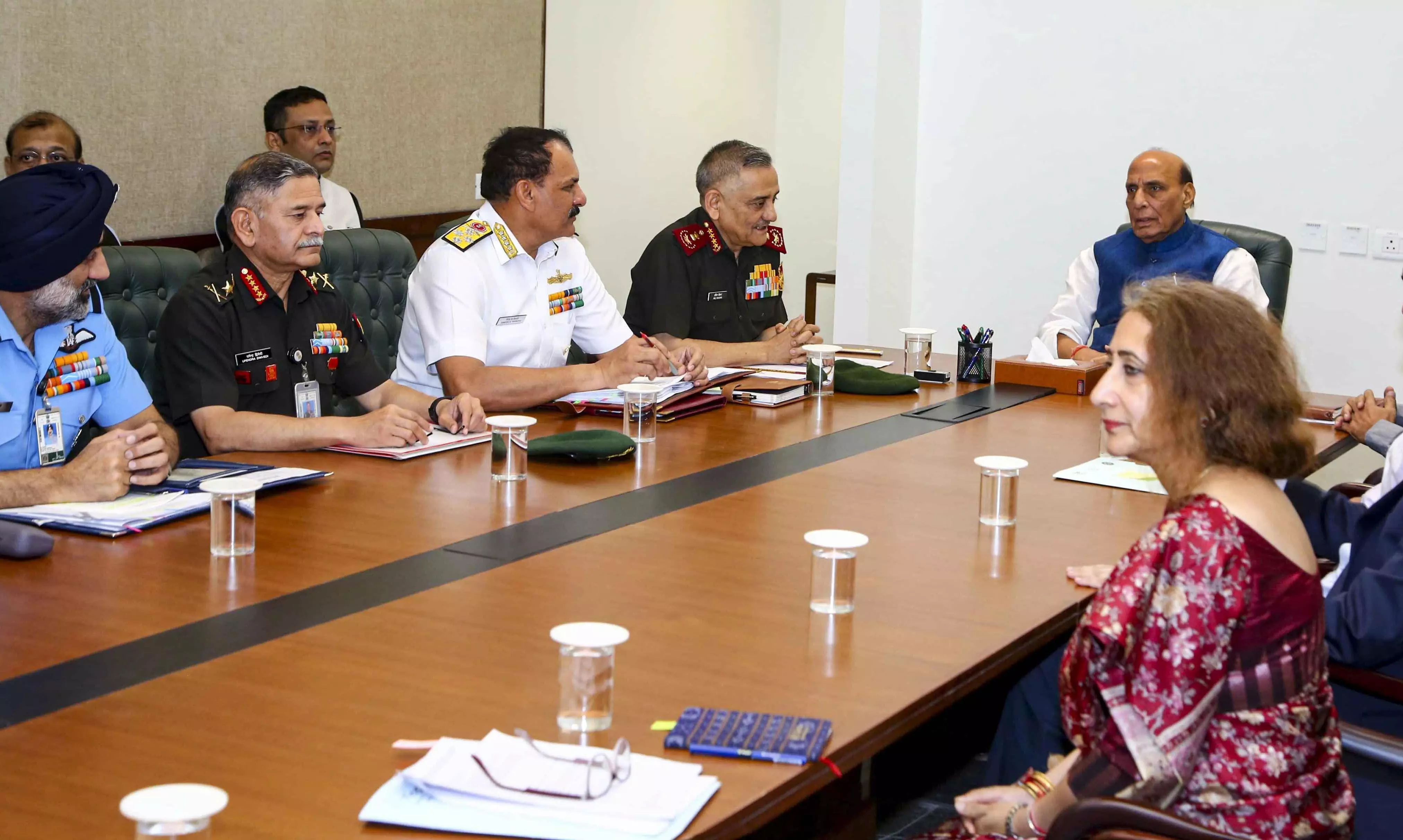


New Delhi: Amid rising tensions and volatility in West Asia, concerns have emerged over potential disruptions to India’s defence exports and supply chains, prompting a high-level meeting here on Tuesday chaired by Defence minister Rajnath Singh.
As per the ministry communication, it was a review meeting over the evolving security situation and for assessing its possible impact on India’s defence preparedness.
It was also focused on the possible disruption to the procurement, production, maintenance and serviceability of defence equipment, with particular emphasis on ensuring that existing military platforms remain fully operational.
India’s armed forces depend heavily on imported fuel for aircraft, naval ships, tanks, and logistics. Nearly 90 per cent of India’s crude oil is imported, much of it through the Gulf region. Around 20 per cent of India’s imports pass through the Strait of Hormuz, a key route near Iran. Hence, if conflict escalates, fuel prices will rise, and pressure will mount on the defence budget. Apart from this, military exercises and operations become costlier. Also, strategic reserves may need to be used.
The Defence minister called for the formulation of a comprehensive and integrated roadmap for the next decade, which should incorporate lessons learned from ongoing global conflicts, address future challenges and opportunities, and prioritise self-reliance in defence production while maintaining a high level of operational readiness across all fronts. At the same time, reportedly, India has already strengthened strategic petroleum reserves and alternative supply plans to handle such crises.
Indian Navy deployment increases in the Arabian Sea and the Indian Ocean. Whenever West Asia tensions rise, the Indian Navy increases patrols in the Arabian Sea, shipping routes to India must be protected, and oil tankers and cargo ships need escort.
Also, India must ensure the safety of sea lanes, the safety of Indian ships and the safety of Indians in Gulf countries.
The government has also said it is closely monitoring the situation and staying in touch with Indians in the region.
As per the defence ministry officials, stressing the need for constant assessment, the defence minister directed the armed forces and defence establishment to closely study the operational and technological aspects emerging from the current conflict so that India can strengthen its own preparedness.
Strategic balancing between the US and Iran affects defence diplomacy. India has defence ties with the US, but also relations with Iran. Where India and the US share a pact over defence technology, weapons, and intelligence, Iran provides India access to Central Asia and the Chabahar port. Through the Gulf countries, India shares a vast logistics route, and there are around 1 crore Indians in the Gulf countries.
The meeting was attended by the Chief of Defence Staff General Anil Chauhan, the three Service Chiefs - General Upendra Dwivedi (COAS), Admiral Dinesh K Tripathi (CNS) and Air Chief Marshal Amar Preet Singh (CAS), the Defence Secretary Rajesh Kumar Singh, Secretary (Defence Production) Sanjeev Kumar and the Chairman of the Defence Research and Development Organisation (DRDO) Samir V. Kamat.