Fiscal indiscipline of states to have an impact on sovereign borrowing costs: CEA
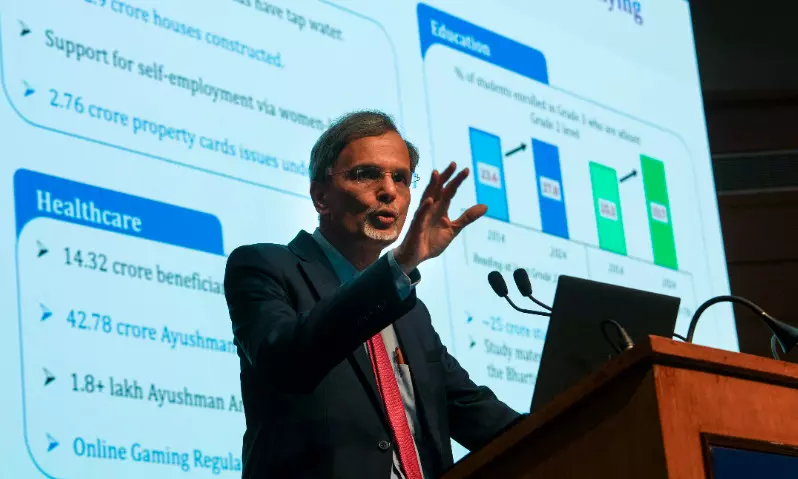


New Delhi: With state after state splurging on populist electoral doles, the Economic Survey on Thursday warned that states' fiscal indiscipline will have an adverse impact on the sovereign borrowing costs.
In the post-Economic Survey interaction with media, Chief Economic Advisor V Anantha Nageswaran said income transfers to households play a role, but their impact is highest when complemented by productivity-enhancing investments.
"Sustaining growth requires careful re-prioritisation within revenue spending by the states, so that short-term income support does not erode the very investments on which inclusive, medium-term prosperity ultimately rests," he said.
"...any fiscal indiscipline at the state level also casts a shadow on the sovereign borrowing costs," he said.
While the Centre has achieved consolidation, alongside record public investment, rising revenue deficits and unconditional cash transfers in several states pose emerging risks by crowding out growth-enhancing spending, according to the Economic Survey tabled in Parliament earlier in the day.
With Indian government bonds now globally indexed and investors increasingly assessing general-government finances, weak fiscal discipline at the state level can no longer be treated as locally contained; it increasingly affects the cost of sovereign borrowing, he said.
India’s 10-year bond yield is 6.7 per cent, while Indonesia’s is 6.3 per cent, even though both countries have the same credit rating of BBB.
"States' fiscal priorities, perhaps, are casting a shadow on the sovereign’s borrowing cost, as investors focus on the fiscal parameters of the general government rather than just those of the Union government," it said.
More importantly, it said, the economic costs of the insidious impact that unconditional fiscal transfers have on the incentives for self-improvement, upskilling, and employability may be more significant in the long term, it added.
Speaking about the easy money era, Nageswaran said years of ultra-loose monetary policy have resulted in stretched asset valuations, rising concentration risks, and a growing reliance on less regulated sources of capital.
"The era of easy money, which was there from 2008 onwards, has resulted in high inflation in 2022 and 2023 and has resulted in a very expensive stock market, almost reaching the highs before the tech bubble burst in March 2000," he said.
Cautioning about current market risks, he said these are being amplified by the dominance of a handful of very large companies and a shift in global financial flows away from banks towards relatively less regulated non-bank sources.
Nageswaran said the unemployment rate has declined from 6 per cent then to 3.2 per cent in 2023-24. He said that female labour force participation has increased by nearly 18 percentage points.
The CEA said the unemployment rate in the first nine months of the year has steadily declined from 5.4 per cent to 4.9 per cent in the last quarter.
He described India as an oasis of economic performance in the global scenario.