‘Crop waste to bio-bitumen may cut imports’
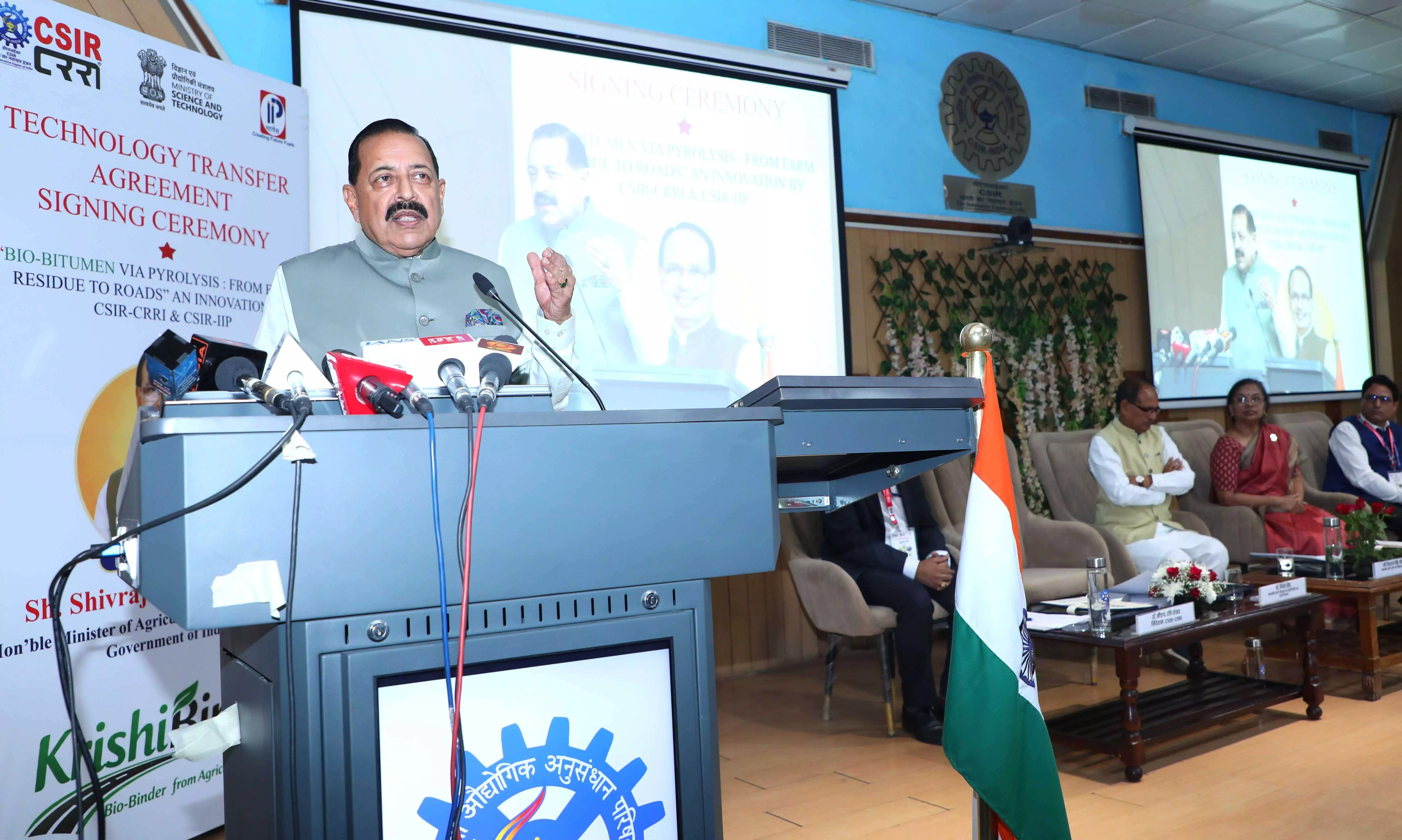


New Delhi: India’s push to convert agricultural waste into industrial inputs could emerge as a key pillar of its transition to a low-carbon, self-reliant economy. Crop residue waste converted into bio-butamen through indigenously developed bio-butamen technology can save around Rs 40,000 crore in annual imports for India, Union minister Jitendra Singh said.
Addressing a Technology Transfer event, the minister described the conversion of crop residue into bio-bitumen as a “transformative shift” that aligns environmental goals with economic gains.
India generates nearly 600 million tonnes of agricultural waste annually, much of which is burnt, contributing to severe air pollution. Through indigenously developed technology, this biomass, such as paddy straw, can now be processed into a renewable binder for road construction, potentially saving up to Rs 40,000 crore in annual imports.
The development, spearheaded by scientific institutions under the Council of Scientific and Industrial Research, represents a broader “waste to wealth” approach, in which materials once considered agricultural residues are repurposed as high-value industrial inputs. The Minister said such initiatives would reduce dependence on fossil fuels like petroleum and coal while supporting India’s long-term goal of achieving net-zero emissions by 2047. Officials also underlined the multi-dimensional utility of biomass. Beyond its use as a bio-binder, agricultural residue is being explored for applications in pest management, advanced materials and energy systems, signalling a paradigm shift in how rural waste streams are integrated into industrial supply chains. The approach, they said, not only addresses environmental concerns but also opens new income streams for farmers, who can now monetise crop residue rather than burn it.
Director General of CSIR N. Kalaiselvi described the transition from petro-based binders to renewable alternatives as a structural shift in industrial thinking. She noted that the technology had already seen early adoption, with pilot road projects demonstrating durability and reduced carbon emissions.
The minister stressed the need for effective outreach, noting that technological innovations must be communicated in accessible formats to farmers and other stakeholders to ensure large-scale adoption.