Change must come at velocity of relevance, says Army Chief on military reforms
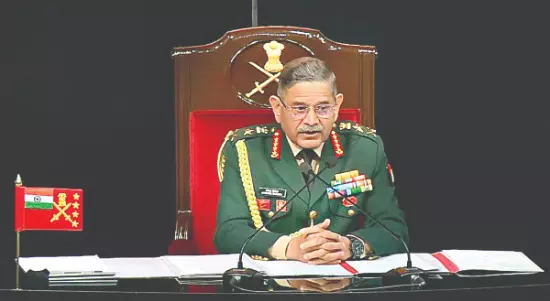


New Delhi: Future wars will demand a unified national effort across all arms and services. Chief of Army Staff Gen Upendra Dwivedi underscored this, citing Operation Sindoor, and emphasised the Army’s approach to change: “Acceleration as a way of functioning” and “change must come at the velocity of relevance.”
The Army Chief stated that the Army had witnessed an unprecedented rise in the number and intensity of military conflicts during the past year, which reiterates that only those nations that prepare themselves will be able to emerge victorious. It was against this background that Operation Sindoor came into action and thereby exemplified India’s operational preparedness in dealing with cross-border terrorism.
At the annual Indian Army press conference, Gen Dwivedi highlighted that security preparedness for 2025 is driven by JAI—Jointness, Atmanirbharta, and Innovation.
These principles, outlined by the PM and affirmed by the Defence Minister, underpin the Army’s Decade of Transformation and have shaped successful reforms.
“We can justifiably be satisfied with the progress made during the year 2025,” said the Army Chief.
“Elaborating the five pillars that define the Decade of Transformation, he said, ‘The focus of force restructuring has remained the improvement of the multi-domain combat potential, through the raising of formations like the Rudra Brigades, Light Commando Battalions, and also the development of improved artillery and surveillance capabilities. More than 31 organisational reforms have been sanctioned in the past 14-15 months, which include the relocation of a Corps and the formation of Aviation Brigades. The enrolment in the Territorial Army commenced in the year 2025 after a five-year pause.’ “
Modernisation in the Army, he said, focuses on enhanced mobility, network-enabled warfare, electronic warfare, drones, loitering munitions, and the development of the ‘next generation’ missiles. Time taken for emergency acquisitions has been drastically cut down, with increased financial authorities even at the level of Corps Commanders.
“Logistics drones have transported almost 10 tonnes of materiel for the first time in the central sector,” he said.
On Technology Infusion, Gen Dwivedi: “The years 2024-2025 have been identified as the ‘Years of Technology Absorption’ as part of our national Missions, including 6G and National Quantum Mission. We have started joint endeavours with IIT Madras, established an AI incubation cell at Bengaluru, and have taken Indian-made agentic AI ‘AI-in-the-Box’ into service as the first sovereign agentic A.I. developed by various agencies of government.”
“We are going to move to a sovereign, large language model to remove bias and ensure a secure integration across battle-space systems,” he said.
On the Northern Front, the Army Chief stated the situation is stable, although it needs constant vigilance. The apex-level military interactions, contacts, and confidence-building measures have resulted in the normalisation of activities like the grazing and hydrotherapy camps.
“Our deployment along the Line of Actual Control remains balanced and robust,” he said, adding that infrastructure development is progressing through a whole-of-government approach.
Meanwhile, on the Western Front, said Gen Dwivedi, following the attack at Pahalgam, a decision was taken at the highest level. Conceptualised and crystallised to the last detail, Operation Sindoor was launched on May 7; critical strikes were through within 22 minutes, and sustained orchestration over 18 months.