Bengal Assembly polls 2026: A fishy campaign
‘Ironically for the BJP in Bengal, the fish almost overshadowed the lotus’
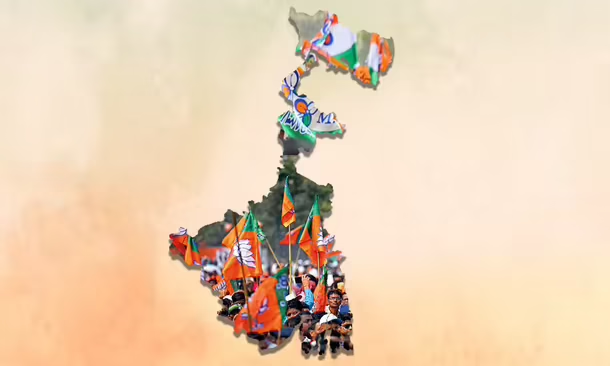


Kolkata: So far, in the grand theatre of Indian democracy, the Bengal chapter has seen elections fought over literati, poets, freedom fighters, bullet trains, and even the humble cow. This time, as West Bengal hurtles towards the 2026 Assembly elections—with the first phase on April 23—the discourse has taken a decisively aquatic turn. No loud promises of industry or infrastructure; instead, scales, gills and fins are being deployed as political baits. Food habits have become a potent marker in the contest over the Bengali identity. The party banners seem soaked in mustard oil, speeches speckled with fishy facts, and hands, metaphorically at least, slippery with fish slime. Bengalis, it must be said, are a sensitive lot when it comes to culture and lifestyle. And fish holds a distinctly exalted position there.
From folklore to nursery rhymes, from festivals to trousseaus, this aquatic creature has long been elevated to something of a crowned glory. Remove it from Bengali literature, films, paintings—or plates—and you are inviting trouble. No one, of course, has ever asked Bengalis to give up fish. Yet interpreting signals and anticipating trouble is part of the human condition—particularly in a mind as imaginatively inclined as the over-thinking Bengali mind. In recent years, the national conversation has repeatedly returned to what people (read: Hindus) ought to eat. Bengalis, with their enduring fascination with politics, listened closely. Over time, they reached their own conclusions. No ban was announced, no restriction imposed, yet a quiet rallying around fish began to take shape. Better safe than sorry. It was only a matter of time before fish swam into the campaign strategy. In Bidhannagar, Sharadwat Mukherjee, a BJP candidate and medical professional, was seen moving through his constituency cradling a five-kilogram katla. The unfortunate fish, held aloft in the April heat, gasped while the gathered crowd looked on with predictable interest.
Mukherjee, it must be clarified, was not returning from a fish market. The katla was not lunch—it was strategy. Ironically, for the BJP, in Bengal, the fish almost overshadowed the lotus. Mukherjee also escalated the symbolism to legislative ambition, declaring, “We will distribute hilsa… cook them in the Assembly…” Exhausted by being labelled “vegetarian outsiders” by the Trinamool Congress (TMC), BJP candidates appear to have embraced the “fish-walk”—hoisting generous specimens to demonstrate they have no intention of replacing the Bengali macher jhol with the Gujarati muthiya. In Pandaveswar, another constituency in South Bengal, BJP candidate Jitendra Nath Tiwari took matters further, filing his nomination amid a full-fledged “fish procession,” supporters carrying baskets while he himself displayed a sizeable catch. State BJP president Samik Bhattacharya went a step beyond reassurance and into mythology, invoking Swami Vivekananda to argue that even Mother Kali partakes of meat. His vow to “crush” anyone attempting to stop Bengalis from eating what they please may well be the most aggressive defence of a lunch menu in recent political memory.
On the other side of the frying pan, the TMC has turned the Bengali platter into a gastronomic fortress. Chief Minister Mamata Banerjee warned voters against “outsiders,” suggesting that those unfamiliar with Bengal’s culture might one day interfere with its food habits—eggs, meat, and, most crucially, fish. All varieties—katla, hilsa, pabda, chingri—have been invoked, each finding coveted spaces in the campaign rhetoric. The phrase mache bhate Bangali (fish and rice Bengalis) has effectively become an electoral slogan. In the TMC’s telling, the BJP’s sudden affection for the Katla is nothing short of a “Trojan Fish.” A candidate may hold and display a fish today; tomorrow, the party might well regulate the fish-eater. The opponent is thus recast not merely as a rival, but as a dietary—and therefore cultural—threat. There is, of course, a delicious irony in watching candidates who usually speak of “vikas” spend their mornings inspecting the gills of a rohu to ensure sufficient cultural compatibility for a photograph. The 2026 election has demonstrated that in Bengal, culture is synonymous with the kitchen. The BJP is keen to show it can handle a boti (a typical cutting tool in Bengali kitchens), while the TMC claims long-standing rights over the kadhai. For now, the aroma of this contest hangs thick in the humid April air. Ultimately, voters will decide who gets the head of the fish and who is left with the tail. But one thing is certain: in Bengal, the path to the ballot box runs firmly through the stomach. One only hopes the Kantaas (bones) are handled with care.