CEO speaks: Are We Becoming the AI We Use?


To many, this question may sound almost philosophical, even slightly unsettling. Yet, today it is one of the most pertinent for students, young professionals and educators alike. Artificial Intelligence (AI) has, slowly but silently, transformed from being a futuristic tool to becoming an invisible companion, suggesting what we should read, how we should write, what we should learn and even who we should connect with! And with this shift, the boundary between using a tool and being shaped by it has started to blur.
It is indeed time for a reality check. When technology becomes so deeply woven into daily life, its influence on our behaviour becomes subtle but powerful. Satya Nadella, CEO of Microsoft, has gone on record to state that AI should not take away what makes us human, our creativity, empathy and curiosity. It should empower these qualities, not replace them. His words are not about limiting AI; they are about preserving humanity.
Across classrooms, including those at Sister Nivedita University (SNU), teachers are witnessing a shift that no textbook prepared them for. Students who once wrestled with complex ideas now turn to AI tools to interpret, summarise, explain or even generate ideas. The instantaneous convenience is undeniable. But convenience has a hidden cost: it weakens the mental muscles that build solid understanding. Learning without the struggle is information collection and collation, not understanding. AI can speed up learning, but it cannot replace the intellectual sweat and rigour that builds true insight.
Career paths, too, are being quietly nudged by algorithms. Students often look at what is “in demand” based on what platforms recommend rather than what aligns with their ambition. Ryan Roslansky, the CEO of LinkedIn, has voiced this worry clearly. “Your career should not be shaped by an algorithm. It should be shaped by your ambition.” Yet every day, millions of young people subconsciously adjust themselves, skills, interests, even aspirations, to fit what the algorithm seems to reward. It is efficient, but it is also dangerous. Efficiency is the domain of machines; purpose is the domain of human beings.
Creativity, the soul of human expression, faces an even more complex challenge. AI can write essays, generate music, design artworks and even mimic voices. But it cannot feel the heartbreak behind a poem, the lived experience behind a novel or the instinctive leap behind a breakthrough idea. AI is a powerful tool, perhaps the most powerful yet, but will always lack the “human spark.” That spark is not data; it is emotion, intuition, memory and imagination. It is the essence of what makes each person irreplaceably unique.
The workplace of the future will not reward those who merely know how to use AI. It will reward those who know how to think beyond it. Employers are valuing communication, ethical judgment, leadership, empathy and adaptability more than ever, skills that no machine, however advanced, can truly replicate. In fact, the more AI grows, the more valuable these human skills become. Leaders across industries are already noticing that a professional who uses AI well but thinks independently stands leagues apart from one who simply follows whatever the tool produces. At universities, in startups and in global corporations, one truth is becoming clear: the danger is not that AI will become too human-like. The danger is that humans may become too machine-like. Efficient but unreflective. Informed but not wise. Connected but not compassionate.
We must not allow that to happen. Young people today are growing up in the first generation where AI can finish their sentences, polish their essays, generate their ideas and suggest their career choices. But if they allow the machine to think for them, they risk losing the ability to think beyond it. Education, therefore, must evolve not by resisting AI but by redefining how humans interact with it. Students must learn to use AI as a thinking partner, not a thinking replacement; as a creative amplifier, not a creative shortcut; as a productivity booster, not a dependency.
The challenge is not technological. It is philosophical. It is about understanding where human intelligence ends and machine intelligence begins, and why that boundary must be protected. Human progress has never come from efficiency alone. It has come from curiosity, from mistakes, from imagination, from the refusal to be predictable. Algorithms are good at predicting the next word; only humans can write the next chapter of their lives with purpose.
The question, then, is not whether AI is becoming more like us. The moot question is whether we are slowly becoming more like it, structured, predictable and automated. To prevent that, we must hold on to those uniquely human qualities that no algorithm can ever engineer. And we must believe that meaning, real, lasting, profoundly human, cannot ever be manufactured by code!
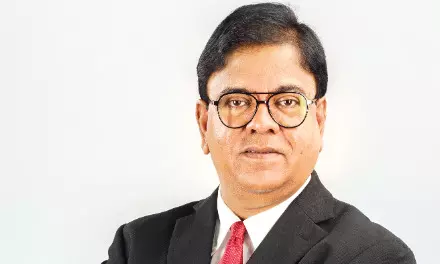
The author is the Vice-Chancellor of Sister Nivedita University and Group CEO, Techno India Group. A visionary leader, he is shaping future-ready institutions and inspiring students to lead with purpose