Sense and Sensibility: Returning to the Himalayas
Kanchenjunga remains where it has always been - immovable, indifferent and quietly magnificent


There is a moment in the film ‘Kanchenjunga’ that has always amused me. A character, played by Pahari Sanyal, is deeply absorbed in birdwatching, binoculars in place and attention sharpened to a fine point. Another, played by Chhabi Biswas, watches this flurry of earnest activity with mild bemusement and asks, almost dismissively, “Roast kora jaaye?” -can the bird be roasted? If not, he sees little point in the exercise.
I was reminded of that exchange recently, not in a cinema hall, but high up in the Himalayas.
At nearly 10,000 feet, in a small, unassuming lodge, the days had a way of stretching and softening at the edges. Mornings arrive crisp and blue, the kind that gently insists you step outside, if only to stand still and take in the sight of Kanchenjunga gleaming in the distance. By afternoon, the mist would roll in like an uninvited but familiar guest and the sun would retreat into a game of quiet hide and seek. There were cups of freshly brewed French press coffee - unexpected at that altitude - books that asked to be read slowly and the comforting weight of a thick quilt that made you reluctant to leave its fold.
I have been going to the Himalayas since I was a child. The mountains, in that sense, are far from new to me. And yet, they never quite repeat themselves. Or perhaps, more accurately, I do not.
Kanchenjunga remains where it has always been - immovable, indifferent and quietly magnificent. But the eyes that return to it carry a different lens each time. What once felt like awe now carries a shade of stillness. What was earlier excitement has mellowed into something more reflective. The mountain doesn’t change; the gaze does. And somewhere in that subtle shift lies the quiet reason one returns - not to see something new, but to see differently - to soak in its quiet reassurance.
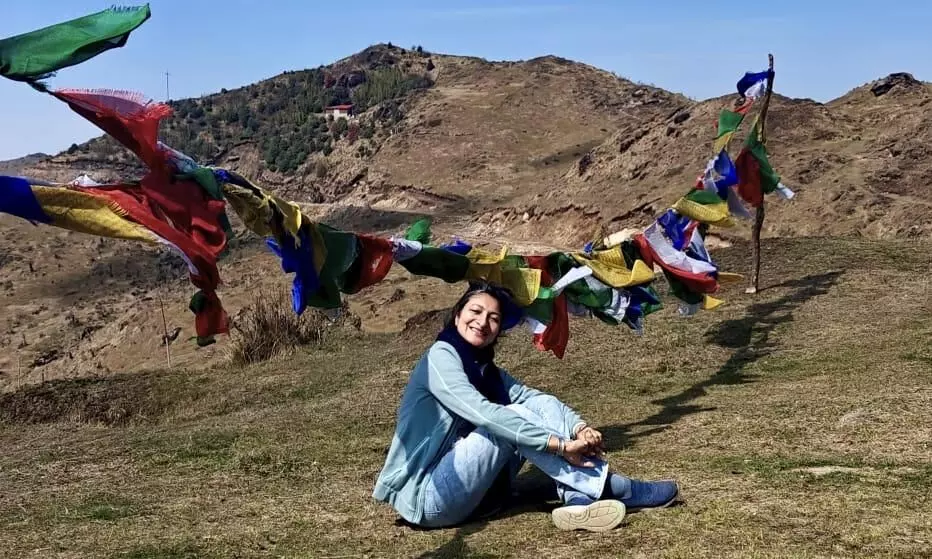
My days there were unhurried. I wandered into nearby villages without a map, trusting instinct more than direction. Conversations unfolded in half-broken Nepali with children who seemed far less bothered by linguistic accuracy than I was. I watched prayer flags converse with the breeze, their quiet flutter carrying something that did not need translation. There was no checklist, no urgency - just the gentle act of being present, of allowing the place to reveal itself at its own pace.
Sharing this space, however, were others who were experiencing the very same landscape in a markedly different way.
They were avid bird watchers. Their mornings began earlier, their movements sharper and their purpose clearly defined. Equipped with cameras and lenses that looked capable of doubling up as gym equipment, binoculars slung with familiarity, they set out with a focus that was almost admirable in its intensity. There was energy, anticipation and an unmistakable thrill in the air. A sighting - a raptor, a thrush, a magpie, a sunbird - would be met with hushed excitement, sometimes even a triumphant whisper. Each moment felt earned, each discovery precise.
We occupied the same geography, woke up to the same mountain, breathed the same crisp air - and yet, inhabited entirely different experiences of it.
For me, the joy lay in returning - in recognising, in lingering and in allowing the familiar to deepen rather than dazzle. For them, it was in the pursuit of locating, identifying and momentarily holding something elusive before it slipped away again. Neither seemed incomplete. Neither seemed superior, just different ways of entering the same vastness. The only bird that I saw every day without fail was the village rooster, calling ritually at daybreak as it scurried about, its plumage a bright red, almost making it look like jungle fowl.
It struck me then that places don’t offer a singular experience. They respond instead to the temperament we arrive with. Some of us seek to dissolve into a landscape, to let it seep in slowly and quietly. Others engage with it more actively, drawing out its details, naming them, framing them and celebrating them in bursts of discovery.
The mountain, indifferent to these preferences, accommodates both.
Some arrive with binoculars and some with the fragrance of memory. Some scan the horizon for movement; others sit still and let it come to them. And somewhere between the two, without choosing sides, the mountain remains as it was - resolute, reminding us that there is more than one way to see and no single way to belong.
Supriya Newar is a multi-lingual writer and poet from Calcutta. Besides being a music aficionado, she is also an avid traveller. She may be reached at [email protected]