We suffer from ostrich syndrome in Tollywood: Tota Roy Choudhury
The actor dabbles in both Bollywood & Tollywood and has completed 30 years in the film industry
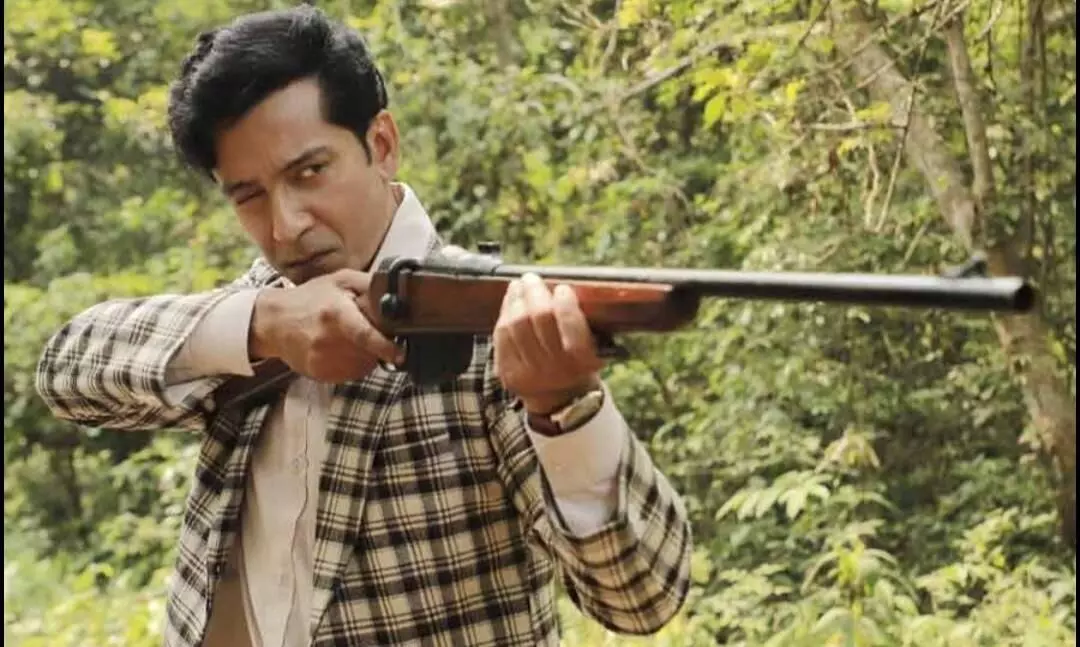


For actor Tota Roy Choudhury, it has never been about the length of a role. While the character certainly matters, the director is equally important to him. “When you work with a great director, your craft sharpens and you gain experience,” he says with a smile.
We were seated at a cafe a few days before welcoming 2025 and right on cue, Tota appeared quietly content with how the year had unfolded. “In 2025, I’ve worked with three remarkable directors: Vikramaditya Motwane, Neeraj Pandey and Anand L Rai,” he says.
While his work in Hindi cinema has been earning appreciation, back home in Bengal, he continues to bag several coveted projects. His return as Feluda to Kamaleswar Mukherjee’s ‘Royal Bengal Rawhoshyo’ has also been warmly received.
Having completed 30 years in the film industry, Tota reflects on a long journey that has done little to make him complacent. If anything, his hunger for meaningful work is stronger than ever, though, true to form, he remains unhurried. That calm and measured approach defines him. As we settle in for a conversation, he reflects on the need for introspection within the Bengali film industry to elevate the quality of work. From Feluda to the portrayal of violence in mainstream cinema, Tota speaks candidly to ‘Millennium Post’. Excerpts from the chat:
We have just left 2025 behind. That year was indeed special for you, with so many important works released.
(Cuts in) 2025 has been the best year of my life as far as my career goes. On December 31, 2025, I completed 30 years as a professional actor. On January 1, 1996, I finally made up my mind that I would be a professional actor. God has been very kind in my 30th year. He gave me a stream of success, a mix of highs and lows.
I entered 2025 with Feluda’s ‘Bhuswargo Bhayankar’ and ‘Chaalchitro: The Frame Fatale’ and then took the year forward with ‘Black Warrant’ and ‘Special Ops’ Season 2. There was ‘Nikhoj 2’ and ‘Jawto Kando Kathmandute’, followed by ‘Tere Ishk Mein’. I ended 2025 and stepped into 2026 with another ‘Feluda’ series ‘Royal Bengal Rawhoshyo’. ‘Police’ didn’t do well and that was a slight dip in an otherwise impeccable year. But then again, that’s part of the journey.
You have worked in both the Bangla and Hindi industries. How would you rate 2025 separately for both?
I would rate the Hindi aspect of my work a little higher. That’s because I got the opportunity to work with three directors who are extremely renowned in their own right: Vikramaditya Motwane in ‘Black Warrant’, Neeraj Pandey in ‘Special Ops’ S2 and Anand L Rai in ‘Tere Ishk Mein’. In all these projects, I was noticed and appreciated.
In Bollywood, while films like ‘Saiyaara’ and ‘Dhurandhar’ were blockbusters, not all big-budget films performed well at the box office.
I feel this is a corrective phase for Mumbai. A lot of people are getting opportunities to showcase their work. Some did very well, some didn’t. So now, there’s a process of post-correction happening. The greatest thing about Mumbai is that it constantly corrects itself. People there are broad-minded enough to admit, “Yes, we made a mistake. Let’s fix it.”
And what about Tollywood?
Here, we don’t do that as much. Of course, some of us introspect and make corrections, but many don’t. We suffer from a kind of ostrich syndrome in Tollywood. We complain, we discuss, but then many of us don’t correct ourselves. Some do, as I said, but largely we are complacent.
I am very surprised by the kind of work Bengalis are doing in Mumbai. Whenever I meet them, I ask, “Why did you leave Bengal?” And they reply, “Where are the opportunities?” In Mumbai, departments like cinematography, costumes, set design and others are dominated by Bengalis. Yet in Bengal, we fail to recognise and retain our own talent… They moved to Mumbai instead. We need to self-introspect at times.
In ‘Feludar Goyendagiri: Royal Bengal Rawhoshyo’, the director has changed. Srijit Mukherji first approached you to play Feluda and now the baton has passed to Kamaleswar Mukherjee. How was the equation on set this time?
Just like Srijit, Kamal Da also believes strongly in teamwork. We (read Tota as Feluda, Anirban Chakraborty as Jatayu and Kalpan Mitra as Topse) have been a team since pre-COVID times. It was Srijit who chose us. So, the first thing Kamal Da told us was that he would not alter the look or mannerisms of the characters. The template remains the same, but Kamal Da has changed the way the story is told. And I’ll tell you why. Both Kamal Da and Srijit are ardent fans of ‘Feluda’.
Now that you’ve worked with both Srijit Mukherji and Kamaleswar Mukherjee on ‘Feluda’, what do you think are their strengths?
(Laughs) Srijit is like boiling water, always on the go and always buzzing with energy. He has the personality of a ship’s captain, which is essential for a director. On the other hand, Kamal Da is absolutely cool, calm and composed. Even under pressure, he remains unfazed. That impresses me a lot… It’s another style of captaincy altogether.
As directors, they may have different styles, but if the destination is the same, you will eventually reach it. For both, respecting Satyajit Ray’s work was of paramount importance and they never lost sight of that. Also, we are all from the same generation, mid-60s to late-70s. We grew up reading Feluda. So, Srijit, Kamal Da and I could connect very easily.
What is your favourite ‘Feluda’ text?
‘Sonar Kella’, both as a film and as a text.
What’s keeping you busy in 2026?
In Bengali, I am really looking forward to ‘Kew Bole Biplobi Kew Bole Dakat’ with Jeet and Srijit Mukherji’s ‘Emperor vs Sarat Chandra’. I’ve completed a Hindi film with Kunal Deshmukh and an OTT project with Nikhil Advani. And of course, there’s a possibility of another ‘Feluda’ series. So, I have a good mix of Hindi and Bengali projects.
BOLLYWOOD CALLING
Your character in ‘Tere Ishk Mein’ is starkly different from what you did in ‘Rocky Aur Rani Ki Prem Kahaani’. What made you take up such a role? Also, how do you approach diversity while choosing roles in Hindi cinema?
When I choose a Hindi project, be it a film or a series, I try to portray something I haven’t done before. For the next three or four projects at least, I want to explore different sides of myself and my potential as an actor.
Honestly, in Mumbai, you don’t decide - the trade decides. And in my position, I can’t dictate terms. But I try to be very careful. That’s why I didn’t sign too many projects after ‘Rocky Aur Rani Ki Prem Kahaani’. I remember being offered five ‘dancing dad’ roles. I refused all of them. I didn’t want to repeat myself. My manager was livid. She said, “This is the time to make money.” I told her, “I’m not here just to make money. If that was my goal, I could have done it long ago through my family business.” People might not believe that, but it’s true. In Mumbai, you must keep working. Sometimes, you do have to accept familiar roles in the hope of eventually getting roles you’ve never done before. That’s how Anand L Rai’s ‘Tere Ishk Mein’ came to me. I admire and respect his sensibilities. I also knew I’d be working with exceptional actors like Prakash Raj, Dhanush and Kriti Sanon. And this was a film that people would actually watch. You may do your best work in many films, but if nobody watches them, what’s the point? I’m really glad I listened to my casting director.
But ‘Tere Ishk Mein’ had a lot of violence. So does ‘Dhurandhar’. Do you agree that films today depict excessive violence?
I want to ask those who complain about violence: Have you watched ‘Tom and Jerry’? Isn’t that violent? Someone hitting someone, throwing them off a cliff or beating them with a bat multiple times. Even cartoons are violent.
Think of video games. We’ve been killing characters for fun for the last 30 years. We’ve been breeding violence through cartoons and video games for decades and now we’re suddenly complaining about violence in films. If we had to complain, we should have done it long ago.
And why are we complaining now? This is because we’re picking on films that are doing well. Was there no violence in the 1970s and 1980s? Every film had multiple action scenes and molestation scenes and people were okay with it. In the 1990s, we had double-meaning songs. Wasn’t that violent in its own way? People criticising ‘Tere Ishk Mein’ or ‘Dhurandhar’ for violence are the same ones who watch Korean cinema. How many of us have seen ‘Oldboy’ or ‘Scarface’? Aren’t those violent?