
Beyond Partition, beyond labels: Remembering Ritwik Ghatak
At the 49th International Kolkata Book Fair, a centenary tribute brings together Ritwik Ghatak, his cinema & Surama Ghatak
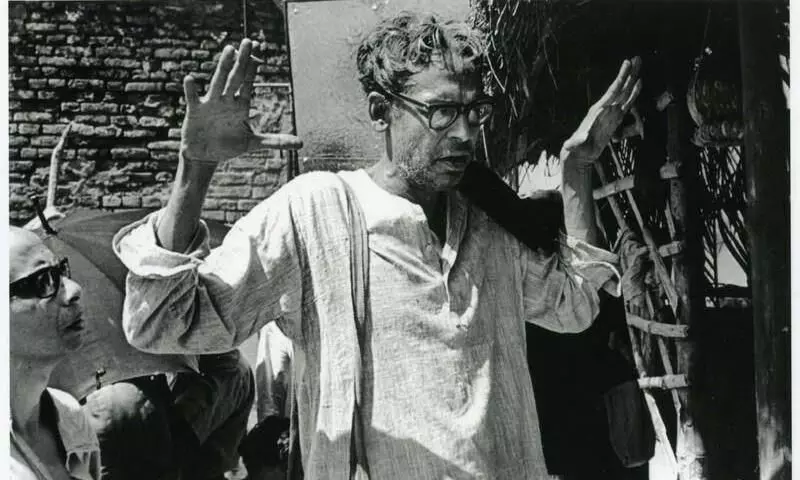


Back when noted critic and scholar of film, literature and theatre Samik Bandyopadhyay was associated with the literary magazine ‘Parichay’, he had a wish. He wanted Ritwik Ghatak to write for the magazine on how words and cinema speak to each other. To make that happen, he turned to Mrinal Sen. One early morning, around 7 am, the two of them walked to Ganga Prasad Mukherjee Lane, where Ghatak lived with his wife Surama and their children. Surama opened the door. Ghatak was asleep. The house was modest - two small sofas, one large sofa in the middle.
Bandyopadhyay shared the idea with Ghatak. Initially reluctant, he finally agreed but wanted a month’s time. He also told Bandyopadhyay to send him a telegram seven days before the deadline. That being done, Ghatak and Sen started talking about the business of cinema, the anxieties, the compromises, the frustrations. And then, without warning, Ghatak began to shake. He collapsed.
Sen and Bandyopadhyay rushed to him, lifting him onto the sofa. His children, still small, came running in, crying. Panicked, Sen and Bandyopadhyay ran out to find a doctor. They couldn’t find one. Surama, however, remained strangely calm. She told them she hadn’t let Ghatak drink the night before. This, she said, was withdrawal. She would call their doctor. It would be alright.
Ghatak was admitted to the hospital soon after. Bandyopadhyay quietly gave up hope of ever getting that article. But time passed. The month was nearly over. And just as Ghatak had asked, seven days before the deadline, Bandyopadhyay sent the telegram. A week later, at the ‘Parichay’ office on College Street, Bandyopadhyay found a manuscript waiting in the letterbox. Ghatak had written it. The piece was titled ‘Chhobite Sobdo’, a stunning meditation on cinema and language.
What Bandyopadhyay later learned was this: Surama had taken his letter to Ghatak in the hospital. And before returning home after being discharged, Ghatak had stopped by and posted the write-up.
Nearly five decades after his death, Ghatak, the father of Indian ‘New Wave’ cinema, refuses to fade into history. People still argue about him. Still return to him. Still struggle with him. Bandyopadhyay said that no filmmaker in India truly reflects Ghatak’s influence on screen. And yet, Ghatak’s vision continues to be the talking point of cinema. He didn’t make many films. Some arrived painfully late. ‘Nagarik’, completed in 1952, was released only in 1977, after Ghatak was gone. Most of his films failed at the box office. And yet, his birth centenary reminds us how stubbornly timeless he remains.
On Thursday, ‘Anustup Publication’ organised a special session on Ghatak at the 49th International Kolkata Book Fair in Salt Lake. Bandyopadhyay and filmmaker-educator Ashoke Viswanathan were present. A special centenary book on Ghatak was unveiled. Scholar and theorist Gayatri Chakravorty Spivak, awarded the Holberg Prize for 2025, was meant to attend but couldn’t, following the death of her sister.
Viswanathan spoke about something that defines Ghatak’s cinema, endlessness. His films end, but never really conclude. Yes, there is tragedy, Viswanathan said, but it is not Aristotle’s tragedy. “From Nagarik onwards, there is this sense of something continuing. Take ‘Subarnarekha’. The ending breaks your heart, yet it refuses closure,” he said. Viswanathan reminded the audience that Ghatak was highly aware of film theory and he used it. But we often trap great filmmakers in labels. “Ghatak becomes Partition. Ray becomes liberal humanism. That does them a disservice. Both rose above categories,” he said.
Asked whether Ghatak’s cinema should be read mainly as exile, protest or mourning, Bandyopadhyay was firm. “That is an oversimplification. Look at ‘Bari Theke Paliye’, a beautiful film about a child discovering Kolkata. Subarnarekha offers something entirely different. Each film creates its own universe. Reducing him only to Partition does injustice to his range,” the film scholar said.
The evening, tellingly, was as much about Surama, known lovingly as Lokkhi, as it was about Ghatak himself. Anil Acharya, founder of ‘Anustup Publication’, said, “Surama or Lokhhi was the bridge between Ghatak and the world that remembers him today. The way we read Ritwik now and research him… It’s because of Surama. Ritwik was never organised. Surama Ghatak wrote about him. She archived him. She made sure Ghatak lived through books and archives. Today, we hold lectures on Ghatak. But we must pause and remember Surama. Nothing would be the way it is today if she hadn’t been there with him,” he said. Along with the special centenary edition on Ghatak, ‘Anustup Publication’ released several other books at the fair. Along with the special centenary edition on Ghatak, ‘Anustup Publication’ released several other books at the fair. It’s their 60th year of publication.



