Supreme Court asks six accused to provide permanent addresses
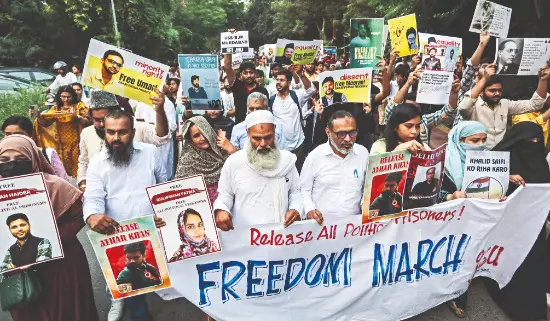


New Delhi: The Supreme Court on Wednesday directed six accused in the 2020 Delhi riots larger conspiracy case to furnish their permanent addresses, as it continued hearing their bail pleas. A Bench of Justices Aravind Kumar and NV Anjaria issued the direction while examining the petitions filed by Umar Khalid, Sharjeel Imam, Gulfisha Fatima, Meeran Haider, Shadab Ahmed and Mohd Saleem Khan.
“Give the present address of each of them,” the Bench said. When Senior Advocate Siddhartha Dave replied that the “present address is jail,” Justice Kumar clarified that the Court sought their earlier residential addresses. Dave assured the Bench that the details would be submitted.
Expressing concern over the length of submissions, the Court remarked that counsel were arguing a bail case “as though it’s a second appeal.” To streamline proceedings, the Bench fixed strict time limits.
Each side will get 15 minutes for oral submissions, while the Additional Solicitor General (ASG) will be allowed 30 minutes for clarifications. The case will next be heard on December 9.
The accused have approached the Supreme Court after the Delhi High Court rejected their bail on September 2.
Notices to the Delhi Police were issued by the apex court on September 22.
The Special Cell of the Delhi Police has accused the six of orchestrating a broader conspiracy behind the February 2020 communal violence linked to protests against the Citizenship Amendment Act (CAA). The riots claimed 53 lives and left hundreds injured. The FIR against the accused invokes provisions of the Indian Penal Code and the Unlawful Activities (Prevention) Act (UAPA).
Khalid, arrested in September 2020, has remained in custody for over four years. Imam, booked in multiple cases nationwide, has secured bail in some matters but continues to be detained in the larger conspiracy case.
The Delhi Police, in its affidavit, has claimed the existence of “irrefutable documentary and technical evidence” indicating a coordinated plan to trigger riots and engineer a “regime-change operation.” On multiple dates in October and November, the Solicitor General and ASG argued that the violence was pre-planned, the speeches delivered by the accused were aimed at creating communal tension, and trial delays were
attributable to them.
The defence, however, has maintained that the accused made no calls for violence and were only participating in peaceful protest. They argued on Tuesday that their prolonged incarceration as undertrials threatened to make “a caricature” of the justice system, rejecting allegations that they were responsible for slowing the trial.