Smog steps back as winds step in, but comeback likely
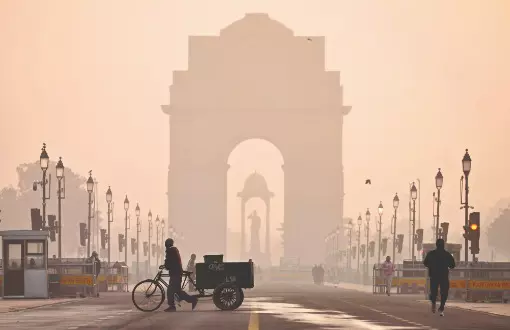


New Delhi: After nearly two weeks of hazardous smog, Delhi’s air quality showed a marked improvement on Wednesday, slipping into the ‘poor’ category with an Air Quality Index (AQI) of 271, aided by stronger surface winds. However, agencies have cautioned that the relief may be short-lived, with conditions expected to deteriorate again over the coming days.
According to data from the Central Pollution Control Board (CPCB), the city’s 24-hour average AQI stood at 271 on Wednesday, a sharp improvement from the ‘severe’ AQI of 412 recorded at 4 pm on Tuesday. December 10 was the last occasion when Delhi’s air quality was categorised as ‘poor’, after which it remained in the ‘very poor’ and ‘severe’ ranges for several days. Favourable meteorological conditions, particularly surface winds of 15–25 kmph during the day, played a key role in dispersing pollutants. The predominant winds were from the northwest, reaching speeds of up to 20 kmph in the afternoon. However, wind speeds are expected to drop below 10 kmph during the evening and night, raising concerns over a renewed buildup of pollution.
Out of 40 functional air quality monitoring stations, four, Lodhi Road, IIT Delhi, IGI Airport and Aya Nagar, recorded ‘moderate’ AQI levels below 200, while 33 stations remained in the ‘poor’ category. Only Nehru Nagar and Dwarka reported ‘very poor’ air quality, according to the CPCB’s SAMEER app.
Data from the Decision Support System for Air Quality Management indicated that vehicular emissions were the largest contributor to Delhi’s pollution load on Wednesday, accounting for 17.5 per cent. This was followed by industries in Delhi and neighbouring areas (8.6 per cent), construction activities (2.4 per cent) and waste burning (1.3 per cent). Among NCR districts, Jhajjar in Haryana contributed the highest share at 12 per cent.
Meanwhile, Chief Minister Rekha Gupta said the government will establish air quality monitoring stations at six additional locations in the capital, including the premises of JNU and IGNOU. This will enable data-driven pollution control interventions, she added.
At present, 40 Continuous Ambient Air Quality Monitoring Stations (CAAQMS) are operational in Delhi, including 24 under Delhi Pollution Control Committee (DPCC), seven under Indian Institute of Tropical Meteorology (IITM), Pune, six under Central Pollution Control Board (CPCB), and one under the Union Ministry of Housing and Urban Affairs.
In accordance with the directions of the Commission for Air Quality Management (CAQM), the Delhi government will establish air quality monitoring stations at six additional locations, the chief minister said. These stations will be set up at IGNOU, JNU, ISRO Earth Centre, Commonwealth Sports Centre, and NSUT
(West Campus), further strengthening Delhi’s air quality monitoring network.