
House goes full throttle: ‘Sheesh Mahal’ row, walkout, bomb scare
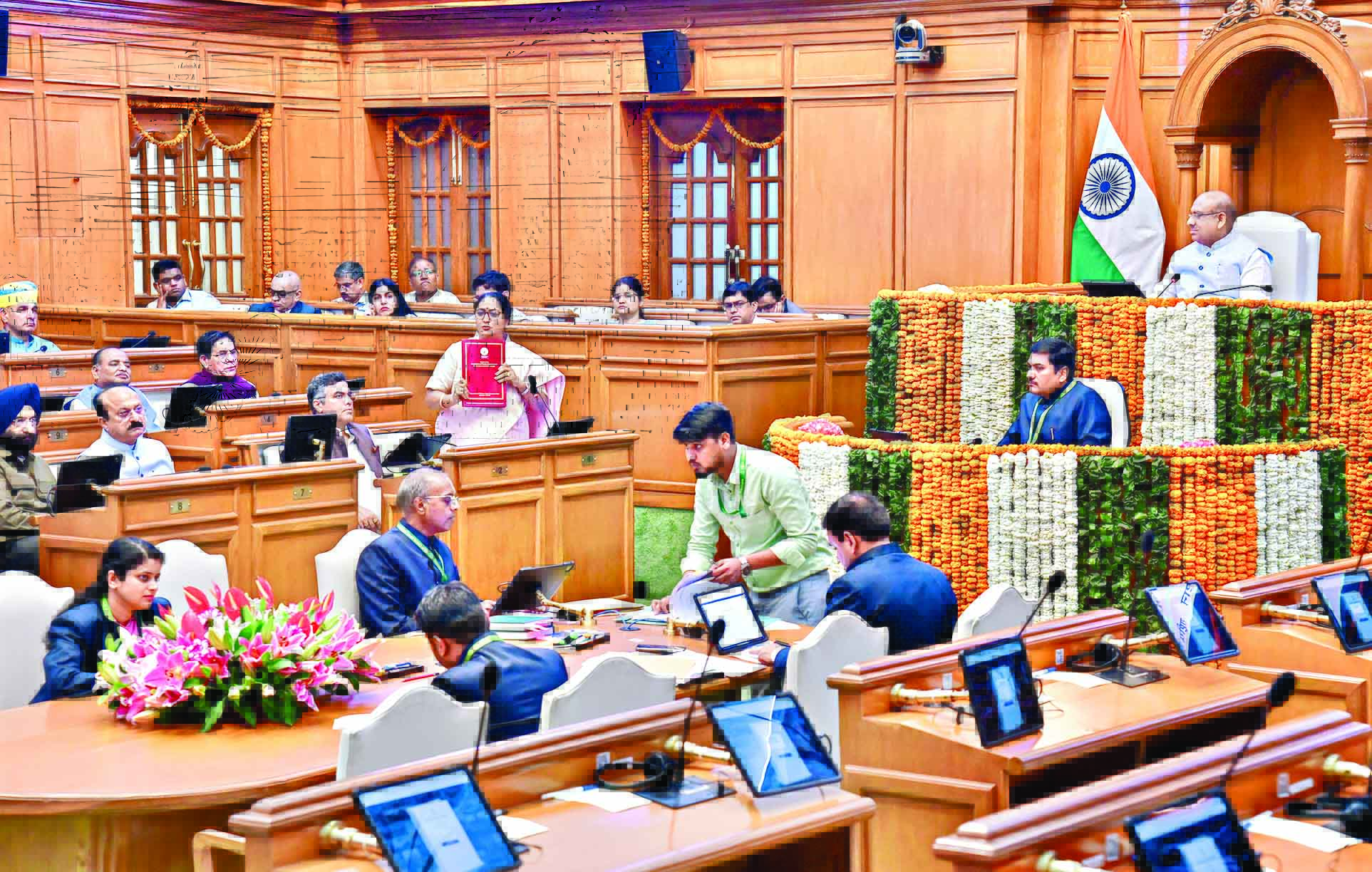


New Delhi: The Delhi Legislative Assembly on Wednesday witnessed high-voltage proceedings marked by sharp political exchanges, detailed allegations over the “Sheesh Mahal” controversy, discussions on the Budget 2026–27, a condemnation motion on Punjab, Opposition boycott, and security concerns following hoax bomb threats.
Chief Minister Rekha Gupta tabled a detailed account in the House alleging serious financial irregularities in the construction of former Chief Minister Arvind Kejriwal’s official residence, popularly referred to as the “Sheesh Mahal.” Calling the CAG findings a “document of moral decline,” she said the issue reflected a “well-planned deception” and not merely expenditure on infrastructure. At her request, the report was referred to the Public Accounts Committee (PAC) for a detailed probe.
Striking a combative tone, Gupta said Kejriwal “saw himself as the ‘Shahanshah-e-Alam’,” treating people as subjects. Quoting a couplet, she remarked, “Wo zahar deta to sabki nigah mein aa jaata… usne yoon kiya ki dava dena band kar diya.” She questioned the contrast between claims of simplicity and alleged extravagance, pointing out that while Kejriwal once criticised Sheila Dikshit for having 10 ACs, his residence allegedly had “50 ACs and 70 fans.”
She further alleged that the project cost escalated from Rs 8 crore to Rs 62 crore and included luxury features such as a lift for transporting food, premium refrigerators, imported coffee machines and engagement of six private consultants for interiors, furniture and landscaping. Raising the COVID context, she said construction continued while people were suffering. She also listed expenditure on residences of other politicians, alleging misuse of public funds, including Rs 7.5 crore on Manish Sisodia’s residence, Rs 2.33 crore on Rakhi Birla’s, Rs 3.23 crore by Ram Niwas Goel, Rs 2.55 crore by Gopal Rai, Rs 2 crore by Satyendar Jain, Rs 3 crore each by Imran Hussain and Rajendra Pal Gautam, and Rs 1 crore by Saurabh Bharadwaj.
Joining the attack, Minister Parvesh Sahib Singh delivered an extensive speech, saying, “I kept saving my home from termites, but a few worms of power devoured the entire city.” He alleged that within 20 days of assuming office, a bungalow was allotted, calling it a betrayal of promises. Referring to the pandemic, he said, “When Delhi was struggling for oxygen… one file alone was marked ‘Most Urgent’… for the construction of a palace,” adding, “Not for oxygen, not for ICU beds… only for a palace.”
He claimed the cost rose from Rs 7 crore to Rs 58 crore and argued that the amount could have created over 2,300 ICU beds. Displaying a long expenditure list, he said, “This is not just a list. It is a record of misplaced priorities. The paper kept rolling, and so did the excess.” The list included luxury furniture, imported fittings, chandeliers, gym equipment, multiple TVs, mini bars and barbecue units. He also alleged that 28 trees were cut without permission, structures were demolished, tenders were restricted, approvals were rushed, and an additional structure worth Rs 25 crore was being planned.
In another development, Cabinet Minister Manjinder Singh Sirsa moved a condemnation motion regarding alleged atrocities under the AAP government in Punjab. Referring to the reported suicide of an official, he alleged undue pressure for tenders and said, “The Aam Aadmi Party’s pursuit of power… has reached such an extent that… lives are being lost.” He also cited cases involving alleged threats to officials, harassment and suicides in Punjab, stating that the situation reflects “fear and injustice.” The motion was unanimously passed. The proceedings were also marked by the absence of Opposition MLAs. Speaker Vijender Gupta criticised the boycott, stating, “Do not use any pretext to stay away… By staying away, it creates an impression that the Opposition has nothing left to say.” He added, “In a democracy, both the Government and the Opposition carry equal weight… The public is watching,” and urged them to attend the House on March 27, recalling that even with just three MLAs earlier, his party never abandoned proceedings.
The Speaker also informed the House about repeated hoax bomb threats, saying, “The email claimed 16 RDX-IEDs had been planted… Despite these threats, the House proceedings continued consistently and without any interruption.” He said both emails had been handed over to police for investigation and directed a thorough probe.
Education Minister Ashish Sood defended the Budget 2026–27, calling it a “Budget that Redefines Good Governance.” He said, “This budget is not merely a financial document; rather, it serves as a clear roadmap for building a developed Delhi,” while criticising the Opposition for avoiding discussion. He highlighted record capital expenditure crossing Rs 32,000 crore, rising tax revenues, declining debt, and falling inflation to 1.13 per cent by December 2025. He also detailed education reforms including smart classrooms, AI labs, digital libraries, CM Shri schools, bicycles for 1.3 lakh girls, and expansion of technical education infrastructure.
Tourism Minister Kapil Mishra highlighted increased allocations, noting tourism funding has risen to Rs 412 crore from Rs 121 crore, along with Rs 173 crore for art, culture and language.



