Delhi Assembly clears Revised 2025–26 estimates, ends stormy Winter Session
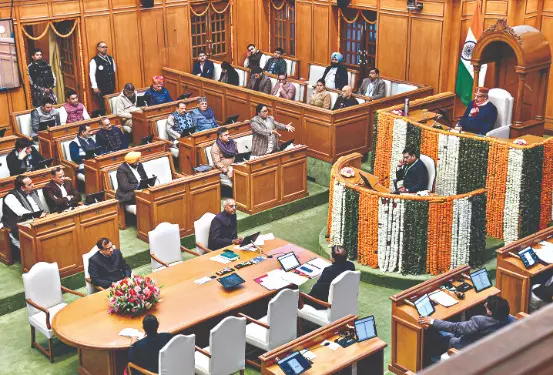


New Delhi: The Delhi Legislative Assembly on Friday passed the Revised Estimates (R.E.) for 2025–26, supplementary demands for grants and the Delhi Appropriation Bill 2026, marking the end of a stormy Winter Session dominated by political confrontations, budgetary revisions and sharp exchanges between the ruling BJP and the opposition Aam Aadmi Party (AAP).
As per the Revised Estimates, the overall budget of the Government of NCT of Delhi remains unchanged at Rs.1 lakh crore. However, capital expenditure was increased from Rs.28,115.48 crore in the Budget Estimates (B.E.) to Rs.30,247.56 crore in R.E. 2025–26, while the revenue budget was revised downward from Rs.71,884.52 crore to Rs.69,752.44 crore. The establishment budget rose from Rs.40,700 crore to Rs.42,150 crore, while allocation under schemes, programmes and projects was revised from Rs.59,300 crore to Rs.57,850 crore.
Sector-wise, the transport sector, including roads and bridges, saw a sharp increase from Rs.12,952 crore to Rs.16,024 crore. Education allocation rose from Rs.19,291 crore to Rs 20,702 crore, while housing and urban development increased from Rs.10,694 crore to Rs.11,754 crore.
Major scheme-wise hikes included an increase of Rs.2,117 crore for the Delhi Metro Rail Corporation to Rs.5,046.66 crore, Rs.1,031 crore additional funds for the Municipal Corporation of Delhi to Rs.11,428 crore, Rs.1,000 crore more as loan to the Delhi Jal Board, Rs.653 crore for the Delhi Transport Corporation, Rs.496 crore for strengthening of roads to “help control pollution”, and Rs.862 crore for purchase of flats and land for universities.
Additional provisions included Rs.500 crore to clear legacy liabilities of the Eastern and Western Peripheral Expressways, Rs.825 crore under Special Assistance to States for Capital Investment, Rs.100 crore for the Barapulla Phase-III elevated corridor, Rs.128 crore for unauthorised colonies, Rs.180 crore under the Yamuna Action Plan, and Rs.140 crore to clear pending RTE tuition fee reimbursements.
During the debate, Chief Minister Rekha Gupta became emotional over memes circulated by AAP leaders over her “slip of tongue”, saying, “I made a mistake, but what they are doing is extremely wrong. ‘How can a woman run Delhi?’ This is their mindset.” Taking a swipe at the opposition, she said, “You said you would not take a car or bungalow, but you did. You came to power through an anti-corruption movement and then deliberately built a ‘Sheesh Mahal’.”
Countering AAP’s allegations, Gupta said, “We formulated policies to develop Delhi in accordance with PM Modi’s vision. We have succeeded in improving Delhi’s situation in just 11 months.” She outlined priorities including pollution control, completion of 1,100 Arogya Mandirs, Yamuna rejuvenation, wall-to-wall road recarpeting and a shift towards electric mobility.
The Chief Minister also announced that the Delhi government has signed an MoU with the RBI to raise low-interest loans for capital expenditure, stating, “Now, no work in Delhi will be stalled due to a shortage of budget.”
The House, which resumed proceedings after two days of washout, also saw the expulsion of AAP MLAs Sanjiv Jha, Jarnail Singh and Kuldeep Kumar for the remainder of the session, tabling of the Privileges Committee report in the ‘Phansi Ghar’ row, and passage of all financial business by voice vote, bringing the Winter Session to a close.