City's air improves to 'moderate'; experts say relief to be short-lived
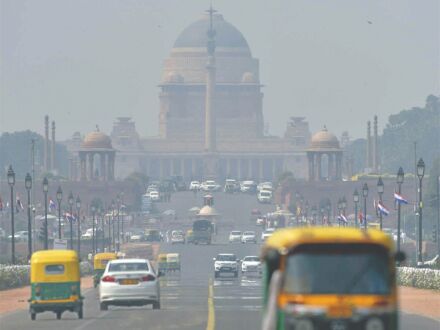


New delhi: The air quality in the national Capital improved significantly on Tuesday as rainfall, along with stronger winds, helped clean up pollutants, authorities said.
According to Central Pollution Control Board's mobile application SAMEER, the air quality index (AQI) was recorded in the "moderate" category at 171 in the evening, while it was 168 in the morning, much better than the city's AQI on Monday which stood at 221 in 'poor' category. The city's 24-hour average AQI was 435 on Sunday and 414 on Saturday (Diwali).
"Surface winds are west-southwesterly and energetic, very favourable for pollutant dispersion. Rainfall along with stronger winds under the influence of Western disturbance helped to clean the build-up of pollution in the Indo Gangetic Plain," SAFAR said.
It also said that effective stubble fire counts with sufficient potential estimated from SAFAR-multi-satellite products are significantly reduced and are around 98.
"Boundary layer wind direction is north-northwesterly, however, since the fire-related emissions have significantly reduced, a significant impact is not expected. Stubble burning share in PM2.5 in Delhi's air is almost negligible and estimated at a marginal three per cent for today, SAFAR said.
It, however, said that the significant AQI improvement is short-lived. The AQI is likely to marginally deteriorate to the 'poor' category on Wednesday.
"AQI is forecasted to further deteriorate to the higher end of the 'poor' to the lower end of the 'very poor' category on 19th and 20th November, it said.
The neighbouring cities of Faridabad (172), Ghaziabad (166), Greater Noida (186), and Noida (178) recorded their AQI in the moderate category. They recorded 'poor' AQI on Monday and braved severe air quality on Saturday and Sunday.
Delhi had recorded the worst pollution levels on Diwali in the last four years due to the combined effect of stubble burning, firecrackers and unfavourable meteorological conditions.
The air quality on the day after Diwali was also the poorest since 2016.
In a special report released on Sunday, the Central Pollution Control Board had said that almost all pollutants reported higher values on Diwali this year as compared to 2019.
It could be attributed to the bursting of firecrackers, a higher share of stubble burning and unfavourable meteorology during the festival season, the CPCB had said.