Republic Day Diplomacy: India, EU signal deeper strategic partnership
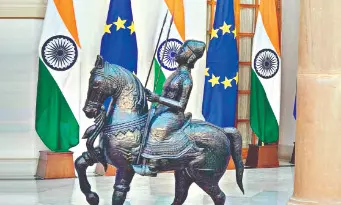


New Delhi: The Indian government recently confirmed that discussions on the long-delayed India–European Union Free Trade Agreement (FTA) are progressing as expected, giving new momentum to a partnership that has become increasingly important in recent years.
Ministry of External Affairs spokesperson Randhir Jaiswal informed, on Friday, that the next India–EU Summit is scheduled for January 27, coinciding with a high-profile State Visit by the President of the European Council and the European Commission. In a clear diplomatic signal, both leaders will serve as Chief Guests at India’s Republic Day celebrations.
Emphasising this sense of progress, Commerce Secretary Rajesh Agrawal mentioned, on Thursday, that New Delhi and Brussels are very close to finalising a trade deal, although some sensitive agricultural items are likely to be kept outside the agreement. The government noted that negotiations on a Bilateral Trade Agreement (BTA) are already in advanced stages, with most chapters nearly settled.
The EU–India BTA talks have had a long and somewhat uneven journey. Launched in 2007, negotiations stalled for years before being revived in 2022 amid a rapidly changing global economic and geopolitical landscape. The pace picked up considerably in February 2025, following a visit to India by European Commission President Ursula von der Leyen, which prompted both sides to accelerate discussions. Since then, negotiators have been working intensively, often on a daily basis, to bridge the remaining gaps.
“We have closed 20 out of 24 chapters completely,” Agrawal stated, noting that only a few issues are still on the table. “We are engaged virtually every day, trying to meet the timeline for our leaders’ meeting,” he added, indicating that the January summit has become an informal deadline for delivering tangible results.
The presence of top EU leaders at India’s Republic Day is widely seen as a sign of a strategic shift in New Delhi–Brussels relations. While the goal was to wrap up a comprehensive FTA by the end of 2025, that deadline was missed. The recent acceleration suggests that the outcome may be a more limited or phased agreement, shaped by both political priorities and commercial considerations. Certain contentious areas, particularly agriculture, are likely to be set aside to ensure that an agreement—no matter how modest—can be showcased as a key achievement of the summit.
Nonetheless, the implications go beyond trade. The European Union is India’s second-largest trading partner, while India ranks as the EU’s largest in the Global South. Even a narrower deal could help solidify a more predictable economic partnership between the two blocs during these uncertain global times.
This renewed dynamism in EU–India ties is also driven by broader geopolitical shifts. Changes in U.S. foreign policy under the Trump era, characterised by unilateral actions and a more confrontational stance towards Europeans and India, have led New Delhi and Brussels to view each other more strategically. Both increasingly see the U.S. and China as systemic rivals, which underscores the need for closer coordination in today’s multipolar world.
At the same time, experts feel that working toward deeper cooperation has not been without its hiccups. Divergent views on Russia nearly disrupted the launch of a joint strategic agenda last September, especially amid Moscow’s Exercise Vostok. However, relations regained momentum less than two months later, during EU–India foreign policy and security talks in Brussels, where both sides reaffirmed their shared goal of working toward peace in Ukraine. The visit of Russian President Vladimir Putin to New Delhi in December, which resulted in no major deals, further underscored its largely symbolic nature.
The long-term vision for this partnership is perhaps best reflected in the New EU–India Strategic Agenda unveiled on September 17, 2025. The document sets out an ambitious roadmap for cooperation across five key pillars: sustainability, technology and innovation, connectivity, security and defence, and key enablers. This agenda is expected to be formally adopted during the upcoming leaders’ summit alongside the Republic Day celebrations.
With clear priorities and renewed political momentum from both sides, the EU–India relationship seems ready for a deeper and more structured engagement. While challenges remain, the convergence of strategic interests, economic complementarities, and geopolitical realities suggests that New Delhi and Brussels are laying the groundwork for a lasting partnership in an increasingly uncertain world.