‘India on comfortable footing despite tensions in West Asia’
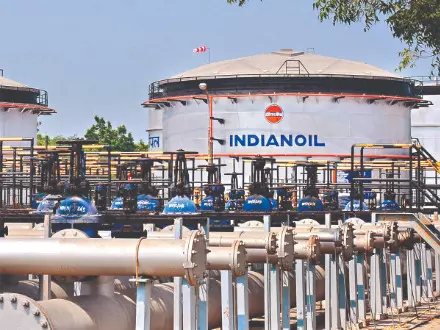


New Delhi: The issue of energy security in India is again in focus amid rising tensions in West Asia. The tensions in the region have led to sharp fluctuations in crude oil prices in the international market. The rates of crude oil have increased by almost 8 per cent in a single day in light of the rising tensions in West Asia.
Such a situation is a cause of concern for a nation like India that imports almost 80 per cent of its crude oil requirement. However, according to sources in the government, India is in a comfortable situation in light of the current scenario.
Sources said that the government has been actively working towards diversifying the source of energy as well as strengthening the supply chain over the past few years, which has helped the country become more resilient to such geopolitical shocks. The crude procurement basket of India has become much more diversified in the present scenario as opposed to what it was a decade ago, officials claimed. Presently, 55 per cent of India’s crude oil imports come from suppliers that are not part of the Strait of Hormuz, which is the critical shipping lane through which a significant portion of the world’s oil traffic is supposed to move. The tensions in the region have resulted in the shipping of crude oil being delayed, and the diversified supply chain is helping to cushion the impact of such delays in the present scenario.
Besides, government sources also mentioned that concerned petroleum and natural gas ministry is keeping a close watch on the situation and is in constant touch with all the stakeholders in the energy value chain to ensure that there is no disruption in the domestic supply chain. “India has over 50 days of crude oil stocks, and this is another comfort in case there is a disruption in the supply chain. Also, we have a large refining capacity, and in case we want to, we can divert the output to produce LPG from the same barrels that are being used to produce petrol, diesel, and other petroleum products, so that we can meet the demand for LPG in the country, which is used for domestic purposes,” an official said while asked.
At the operational level, the government and public sector oil marketing companies continue to be in constant engagement with key international suppliers and traders. The key international suppliers and traders include global energy companies like Total, Sonatrach from Algeria, ADNOC Trading from the UAE, and traders like Vitol and Trafigura, among others. The engagements are centred on the continued availability of crude, LPG, and LNG from diversified sources.
At the multilateral level, consultations are also underway with international energy organisations such as the International Energy Agency and the Organisation of the Petroleum Exporting Countries, as well as with the energy ministers of the key producing countries. Officials have stated that these consultations are meant for evaluating the possible supply scenarios and seeking cooperative approaches for stability.
One of the areas of concern is the gas supply chain. Qatar has invoked the force majeure, which is a part of the gas supply contract during the conflict, allowing Qatar to suspend the supply of gas due to the conflict. India requires 190 million metric standard cubic meters per day of gas, out of which 60 mmscmd of gas is usually imported via the route affected by the Strait of Hormuz conflict.
The authorities claim that this shortage is being managed by strategic management of available gas supplies, as well as the use of alternative energy sources for meeting gas requirements, while ensuring that essential consumers such as households, farmers, etc., remain unaffected.
Government insiders also claimed that in spite of the geopolitical tensions, there is no cause for concern, as the government’s strategy of diversified gas sourcing, strategic stockpiling, and international cooperation, is likely to ensure stable and affordable gas supplies.
The conflict, however, again highlights the inherent risks associated with India’s dependence on imported crude oil, which necessitates continued efforts towards diversification of energy sources for ensuring energy security for the country.