India & EU near landmark trade, security and defence partnership
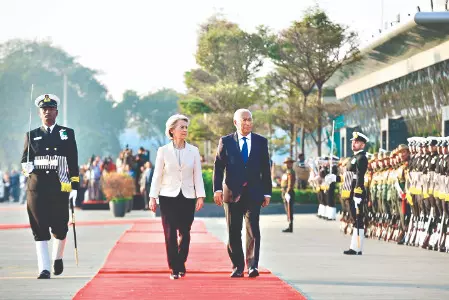


New Delhi: The European Union and India are nearing the conclusion of what officials in Brussels have called “the mother of all deals” — a comprehensive agreement that combines a long-anticipated free trade pact with an expanded security and defence partnership.
On Sunday, an official EU statement indicated, “The summit will present an opportunity to build upon the EU-India strategic partnership and to enhance further collaboration across key policy areas such as trade, security and defence, the clean energy transition, and people-to-people exchanges.”
The combined scope of these agreements aims to deepen diplomatic and economic ties with New Delhi significantly while subtly encouraging India to diversify its strategic reliance away from Russia, experts suggest. The framework for this ambitious reset will be unveiled during the 16th EU-India Summit in New Delhi on January 27, hosted by Prime Minister Narendra Modi. The EU will be represented by European Council President António Costa and European Commission President Ursula von der Leyen, emphasising the political importance Brussels places on this partnership, the EU statement highlighted.
“India is a key partner for the European Union,” Costa stated ahead of the summit, adding, “Together, we have both the ability and the duty to uphold the rules-based international order.”
Currently, EU-India relations are marked by high-level engagement across multiple domains, including trade, security, technology, and climate change. In October 2025, the EU Council endorsed a new strategic agenda aimed at reinforcing bilateral ties with India, aligning efforts on global and regional issues.
Leaders are expected to adopt a comprehensive EU-India strategic framework that will expand cooperation in four main areas: prosperity and sustainability, technology and innovation, security and defence, and connectivity and global governance. This will be supported by overarching policy measures. Discussions will heavily focus on concluding a free trade agreement, with negotiations originally launched in 2007 and revived in 2022 after a lengthy hiatus, the EU statement added.
It is anticipated that the agreement will substantially enhance bilateral trade and investment, creating a combined market of nearly two billion consumers—roughly a quarter of the world’s GDP. For the EU, this deal represents a gateway to one of the world’s fastest-growing major economies, while for India, it offers increased integration with European supply chains and access to advanced technologies such as renewable energy solutions, digital infrastructure, and the automotive sector.
Beyond economic negotiations, security and defence cooperation will be a critical focus. The two sides are expected to formalise a bilateral security and defence partnership—the EU’s third such arrangement in Asia, following partnership agreements with Japan and South Korea.
The pact is also likely to prioritise maritime security initiatives, defence industry collaboration, and joint production efforts, reflecting India’s push to bolster indigenous manufacturing while diversifying its defence partnerships beyond traditional sources.
The summit will also address regional and global challenges, including the future of multilateralism, stability in the Indo-Pacific, Russia’s ongoing war in Ukraine, and the evolving situation in the Middle East. Notably, Brussels’s approach diverges from Washington’s more coercive stance on India’s relationship with Moscow. While the United States has attempted to discourage Indian imports of Russian crude oil through tariffs and sanctions, the EU is adopting a more facilitative strategy—offering expanded trade access and closer defence cooperation as incentives for strategic realignment.
In a symbolic gesture, Presidents von der Leyen and Costa will attend India’s 77th Republic Day celebrations on Monday as distinguished guests—the first time senior EU leaders have been accorded such a role. Their presence underscores the EU’s intent to position India as a central pillar of its Indo-Pacific strategy.
The trade component of the agreement is expected to address long-standing issues such as tariff reductions, labour mobility, and regulatory barriers. The EU is pushing for significant reductions in India’s high tariffs on automobiles and alcoholic beverages, while India seeks easier access for its pharmaceuticals, textiles, and skilled professionals into European markets.
The EU-India FTA is framed not only as a commercial agreement but also as a strategic step toward a deeper, more independent alliance between two big democratic powers as New Delhi navigates demands from US economic sanctions and an unstable international climate.