India central to global green transition, says Jitendra Singh
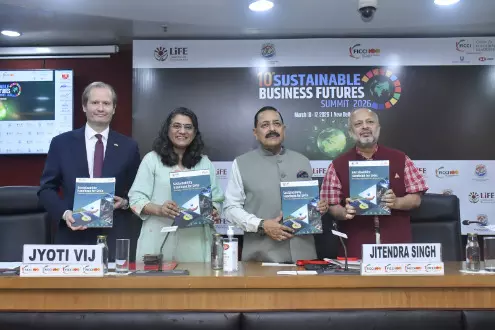


New Delhi: India’s role will be unique in shaping the global green transition, Union Minister of State for Science and Technology Jitendra Singh said on Tuesday, asserting that “the world cannot turn green unless India turns green.”
Addressing the valedictory session of the 10th Sustainable Business Futures Summit organised by FICCI, the Minister underscored the need for convergence among stakeholders to drive sustainable growth. He said India must align with global benchmarks and priorities if it seeks to play a defining role in the evolving economic order.
Dr. Singh pointed to an imminent “paradigm shift” in the global economy, moving away from conventional production systems towards regeneration, recycling, and genetic processes. “We need to sustain economic growth while consistently moving up and ensuring adherence to global norms,” he said.
Highlighting priority areas, he called for a coordinated push in energy system innovation, particularly next-generation energy storage and grid management. He also emphasised the importance of climate modelling and risk analytics, alongside advancements in materials, construction technologies, and digital infrastructure. “We cannot be working in silos,” he said, stressing that the transition to green infrastructure must be “seamless, uneventful and optimum.”
The Minister noted that India’s domestic infrastructure strategy already integrates climate considerations across sectors, including renewable energy expansion, green hydrogen, electrification of transport, and sustainable urban planning.
Dr. Singh also drew attention to India’s startup ecosystem, which now comprises over two lakh ventures generating significant employment. “Nearly 50% of these startups come from tier-two cities, and about 40% are women-led,” he said, describing it as a transformative shift in the country’s innovation landscape.
Cristiano Massimo Pasini of UNIDO highlighted that industrial transformation is inherently ecosystem-driven. “The quality of infrastructure, institutions, and linkages determines long-term competitiveness,” he said, adding that sustainability must be embedded into production systems rather than retrofitted later.
The summit concluded with a consensus on the need for integrated, forward-looking strategies to align economic growth with environmental responsibility.