India, Canada deepen energy cooperation, eye LNG, clean tech and investments
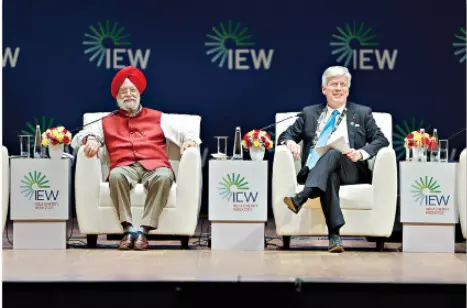


Goa: India and Canada on Tuesday signed a joint statement on energy cooperation at India Energy Week 2026 in Goa, signalling a significant reset in bilateral energy engagement. The agreement was formalised following talks between Union Minister for Petroleum and Natural Gas Hardeep Singh Puri and Canada’s Minister of Energy and Natural Resources Timothy Hodgson, marking the first participation of a Canadian Cabinet Minister at the strategic event.
The two sides also launched the renewed India–Canada Ministerial Energy Dialogue, underscoring a shared focus on energy security and supply diversification.
“This renewed engagement reflects the complementary strengths of India and Canada in the global energy landscape,” Puri said, adding that “energy security and diversity of supply are central to the economic stability and well-being of both our countries.”
The engagement follows directions issued by the Prime Ministers of India and Canada during their meeting on the sidelines of the G7 Summit in June 2025 in Kananaskis, where both leaders had stressed the need to revive senior-level and working-level cooperation. Puri noted that Canada’s growing role in clean and conventional energy aligns well with India’s expanding energy needs, describing the partnership as “long-term, pragmatic and mutually beneficial.”
The joint statement highlighted strong potential for collaboration across hydrocarbons, with Canada expanding LNG, LPG and crude oil exports to Asian markets through projects including the Trans Mountain Expansion pipeline, while India continues to scale up refining capacity, domestic production and the use of natural gas. Both sides agreed to deepen bilateral energy trade, including the supply of Canadian LNG, LPG and crude oil to India and refined petroleum products from India to Canada, while also facilitating reciprocal investment in each other’s energy sectors.
“India is investing nearly $500 billion across the energy value chain, while Canada is fast-tracking major energy projects worth over $116 billion. There is clear scope for our companies to partner and invest across borders,” the Minister said.
Climate objectives formed a key pillar of the renewed engagement, with both countries agreeing to cooperate on emissions reduction in conventional energy systems, carbon capture, utilisation and storage, and the deployment of cleaner technologies. Opportunities were identified in renewable energy, hydrogen, biofuels and sustainable aviation fuel, battery storage, critical minerals, clean technologies, electricity systems, energy supply chain resilience and the application of artificial intelligence in the energy sector. Canada also acknowledged India’s leadership in advancing global biofuels through the Global Biofuels Alliance, where it is an observer.
Energy transition pathways were further deliberated at a high-level leadership panel on the opening day of India Energy Week, which brought together global energy leaders to examine the evolving role of natural gas and LNG amid geopolitical uncertainty. Panellists noted that global gas demand is projected to rise by 30–35 per cent by 2050 and identified coal-to-gas switching as the most viable near-term pathway for emissions reduction while maintaining grid stability.
From India’s perspective, speakers highlighted the country’s rapidly expanding gas ecosystem, supported by diversified LNG imports, domestic production and sustained investments in pipelines, terminals and city gas distribution. “The energy transition must be approached as energy addition, not abrupt replacement,” Puri said earlier in the day, stressing that properly abated gas-based power would remain a vital complement to renewables. While affordability remains a challenge, panellists emphasised that policy stability, transparent global gas markets, infrastructure expansion and renewed upstream investment would be critical to ensuring gas and LNG remain competitive and accessible.
Welcoming delegates to the fourth edition of India Natural Gas Week, Puri said the new venue had been constructed in a record 13 months under the supervision of Engineers India Limited. “What was once 150 acres of barren land is steadily transforming into a world-class conference and tourism centre,” he said, announcing that a press tour of the facility would be organised in the coming days.
Detailing his engagements, the Minister said he had held multiple high-level bilateral meetings, including with the UAE Minister, who is also the Global CEO of ADNOC. “India is currently sourcing around 4.5 million metric tonnes per annum of natural gas from the UAE, which is a significant component of our energy basket,” he said.
In his meeting with the Canadian Minister, Puri said the discussions covered hydrocarbons, critical minerals and small modular reactors, adding that talks were already underway between Oil India and Canadian counterparts. “This is a very welcome and timely level of cooperation,” he remarked.
The Minister also referred to the second India–Brazil Ministerial Energy Dialogue held during the day and listed several agreements signed on the sidelines of the event. These included two shipbuilding contracts between ONGC and Mitsui O.S.K. Lines of Japan, with Samsung Heavy Industries of South Korea as the shipbuilder, with deliveries expected in 2028 and 2029. BPCL and Petrobras also signed a term contract for the supply of around 12 million barrels of Brazilian crude oil in FY 2026–27, valued at approximately $780 million.
In addition, agreements were concluded involving IOC, ONGC, Petronet LNG and other partners for setting up 30 compressed biogas plants, while GAIL and its partners entered into a term sheet for equity participation in a city gas distribution company. Engineers India Ltd also unveiled an indigenous tail gas treating technology, and several indigenously developed innovations, including a hydrogen-powered drone with a flight endurance of about one and a half hours, were showcased.
Concluding his remarks, Puri said further details would be shared during the press tour, before opening the floor for questions, citing time constraints due to subsequent engagements.