Food delivery workers hold nationwide strike over pay, insurance and working conditions
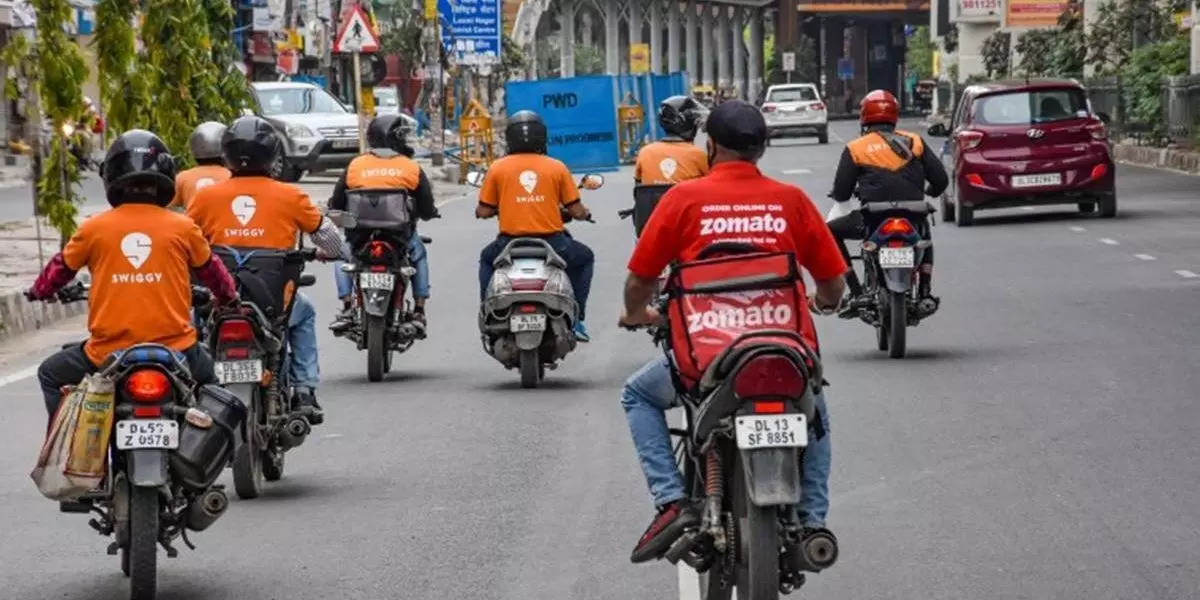


New Delhi: Platform-based delivery workers affiliated with the Indian Federation of App-Based Transport Workers (IFAT) observed a nationwide strike on Wednesday, protesting against unfair working conditions, low wages, and the absence of social security, warning that delivery services may be severely disrupted during peak hours. According to food delivery agents, despite spending long hours on the road, their income has reduced significantly, leaving them financially strained. A delivery agent said that workers are often required to remain polite and courteous to customers, irrespective of the challenges they face during deliveries. He added that riders are penalised even when orders are cancelled for reasons beyond their control. "We are also participating in the strike. There are many reasons. For example, the rate card. We don't get paid enough. The company doesn't provide insurance... When we go to the customer, no matter how much trouble we're in, we smile and say, 'Thank you, sir, please give us a rating.' If an order is cancelled for any reason, the penalty falls on the rider... The company should take action on this matter. We work 14 hours a day, spending day and night on the road... We don't get paid according to the amount of work we do," he told media reporters.
Another delivery worker said that while the rate structure was reasonable in the initial phase, recent changes have made it increasingly difficult for riders to earn a better income. He cited the case of a rider who met with an accident in the Barakhamba area and did not receive any insurance support from the company. "Initially, the rate card was fine, but now they have changed it, causing difficulties and problems for all the riders. We don't even get insurance claims. A rider recently had an accident at Barakhamba, and he didn't receive any claim... Our team leader and senior company officials told him to create a PDF, which they would send to Bangalore... There was no response from there. We all chipped in Rs 1000-2000 to help that rider. Now that guy is working even at night, taking orders at 1 or 2 AM... The TL never answers the phone. After 20 or 25 calls, the TL answers with an attitude. And if you argue with him even a little, he blocks your ID... After working 14 hours, we're only getting Rs 700-800... Today, there's a strike all over Delhi," he said. The worker further alleged that team leaders often remain unresponsive and, in some cases, block riders' IDs if they raise concerns. "After working for 14 hours, we barely earn Rs 700 to Rs 800. Despite this, many of us are forced to continue working late into the night," he added. Another delivery agent said services were completely halted in several areas as part of the protest. "Currently, deliveries are stopped... We heard there's a strike, so we're not working at all... We are grateful that the company gave us a lot in the beginning. But now, they are taking back everything they gave... Other companies offer promotions, but here, we're only getting demotions... We have to work 15-16 hours to make ends meet," he said.
Earlier, Aam Aadmi Party's Rajya Sabha MP Raghav reiterated his call to ban 10-minute delivery apps, claiming that the same companies have been oppressing gig workers and shooting up their evaluations on their backs, enriching only the companies. "In today's time, Swiggy Zomato delivery boys, Blinkit Zepto riders, Ola Uber drivers, are a workforce on the back of which these big companies have become unicorns; they have got billion-dollar valuations. In this entire ecosystem that has been created, if there's one group of people who are oppressed and under immense pressure, it's the gig workers," the AAP MP said during an exclusive interview with reporters. Under the 10-minute delivery guarantee, a gig worker who drives recklessly, becomes increasingly anxious, risks losing incentives, and faces customer abuse if the delivery is late, while not receiving any regular worker protections, Chadha said. As part of improving working conditions and rights for workers, Chadha has proposed setting working hours for gig workers to end the practice of people working 14-16 hours a day for incentives.