'40% gig workers earn below Rs 15K/month'; Economic Survey advocates minimum per-task earnings


New Delhi: Stating that about 40 per cent of gig workers in India earn below Rs 15,000 per month, the Economic Survey 2025-26 called for significant policy interventions in the gig economy, suggesting the setting of "minimum per-hour or per-task earnings", which includes compensation for waiting time, to ensure fair wages and reduce the cost disparity between regular and gig employment.
Tabled in Parliament on Thursday, the Survey said the aim of the gig-economy policy should be to reshape terms, allowing workers to exercise genuine choice instead of being forced into gigs by weak demand, skill mismatches, or the lack of a safety net.
The gig economy continues to expand rapidly, yet income volatility remains a key issue, creating obstacles to credit access. Financial inclusion for gig workers also trails behind; they face limited 'thin-file' credit options, which continue to raise concerns.
Platform algorithms control work allocation, performance monitoring, wages, and supply-demand matching, raising concerns about algorithmic biases and burnout.
"About 40 per cent of gig workers report earnings below Rs 15,000 per month," the Survey said, adding that limited skilling and fears of job losses due to technological advances such as Artificial Intelligence (AI) and Machine Learning (ML) exacerbate worker vulnerability.
"Platforms have become essential gig-market infrastructure for finding workers and work. This concentration of power raises concerns over fees, algorithms, and worker protections. Policy should address this through competition rules, data access, and algorithmic transparency, while reorganising the social contract so that gig work benefits workers more fairly.
"Policy can reduce the cost gap between regular and gig work by limiting incentives to avoid mandatory benefits and by setting minimum per-hour or per-task earnings (including waiting time), encouraging formal employment and raising incomes for low- and medium-skilled gig workers," the Survey noted.
Identifying limited access to productive assets as a major hurdle for upward mobility, the Survey suggested that platforms and employers should be encouraged to "co-invest" in assets and training.
"Many cannot upgrade from low- to medium-skilled gigs because they lack tools (for example, a bike, car, or specialised equipment)," the document observed.
It argued that such co-investment would help workers progress into more secure, higher-quality jobs.
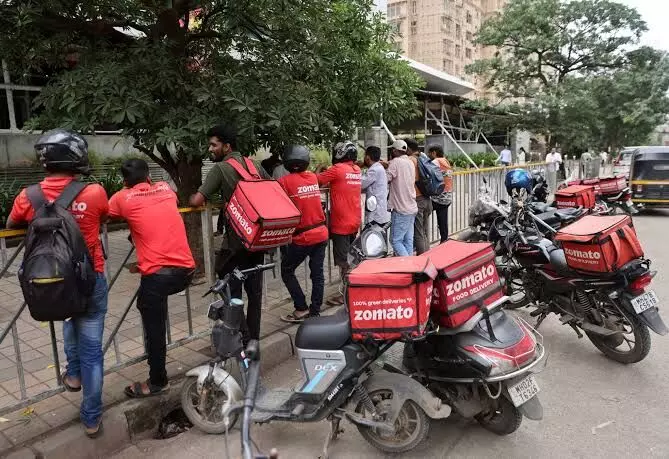
Gig workers in India -- including quick commerce and food delivery riders -- recently staged strikes and protests through their unions to demand better payouts, improved working conditions, formal recognition under the country's labour laws and removal of tight 10-minute delivery deadlines, with their unions taking up the issue with the Union Ministry of Labour and Employment.
Consequent to the agitation, the government asked e-commerce players to remove 10-minute delivery branding from their platforms.
India's gig economy has undergone a structural shift, with the workforce expanding 55 per cent to 1.2 crore in FY25 from 77 lakh in FY21. It now accounts for more than 2 per cent of the total workforce in India.
Growth in gig workers has outpaced overall employment, with non-agricultural gigs forecast to make up 6.7 per cent of the workforce by 2029-30 and contribute Rs 2.35 lakh crore to the GDP.