Vehicular emissions biggest polluter in Delhi-NCR, CAQM tells Supreme Court
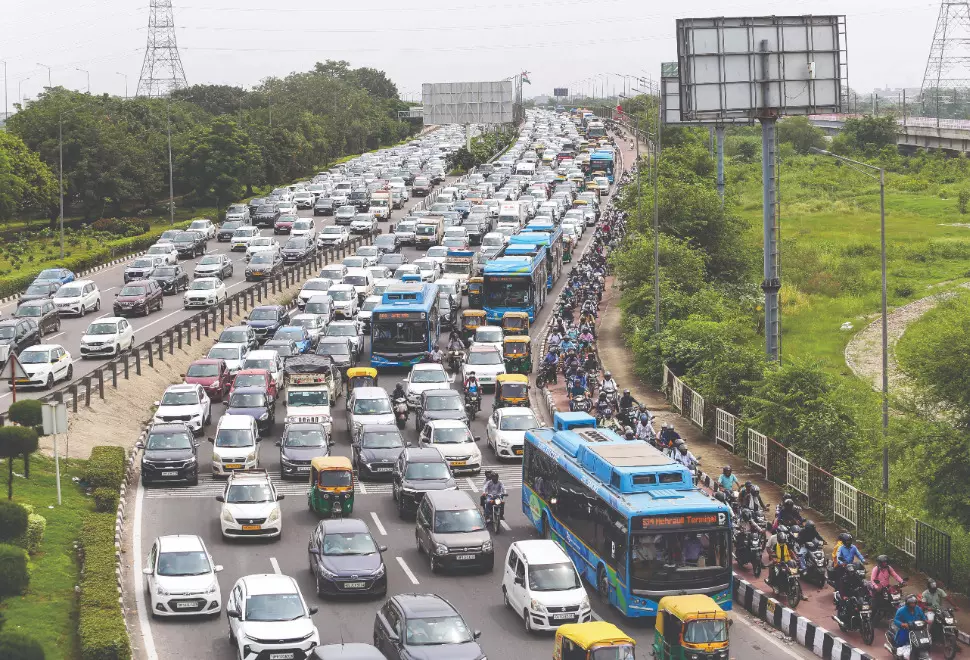


New Delhi: Vehicular pollution has emerged as the single largest contributor to deteriorating air quality in Delhi-NCR, the Commission for Air Quality Management (CAQM) informed the Supreme Court on Wednesday, while recommending 15 long-term measures to address the region’s persistent pollution crisis.
Appearing for the CAQM, Additional Solicitor General Aishwarya Bhati told a Bench comprising Chief Justice of India Surya Kant and Justices Joymalya Bagchi and Vipul M Pancholi that a meta-analysis of multiple studies conducted between 2015 and 2025 shows PM2.5 pollution in Delhi is caused by both primary emissions and secondary particulate formation, largely originating within the National Capital Region. According to the commission, emissions from vehicles account for the dominant share.
Based on its assessment, the CAQM proposed a phased implementation of 15 long-term steps, including the time-bound removal of highly polluting vehicles from Delhi-NCR based on emission potential, strengthening the PUC 2.0 regime, and monitoring on-road vehicles through remote sensing technology. Other recommendations include expansion of Metro and regional rail networks, development of multi-modal transport hubs, improved last-mile connectivity with real-time passenger tracking systems, and revision of electric vehicle policies to speed up the shift to zero-emission transport.
The commission also suggested expanding EV charging and battery-swapping infrastructure, permitting retrofitting of vehicles into electric ones with certification from ARAI or ICAT, augmenting city bus services through e-buses and CNG fleets, and creating a robust CNG and LNG fuelling network for long-haul commercial vehicles.
Additional measures include installing ANPR cameras and RFID-based toll systems at Delhi borders, deploying integrated traffic management systems across NCR cities, implementing parking management plans, levying higher environmental protection charges, and intensifying enforcement through AI-based surveillance. Taking note of the CAQM’s recommendations, the Supreme Court directed the Centre, the Delhi government, municipal bodies and NCR state agencies to submit their respective action plans within four weeks. “The CAQM has recommended 15 long-term measures and has also identified the competent agencies to implement them,” the Bench observed.
The court made it clear that implementation cannot be delayed. “There can be no doubt that these long-term measures are required to be given effect with no delay. This court is not inclined to entertain any objections with respect to these measures,” it said.
Senior advocate Aparajita Singh, the amicus curiae in the matter, pointed out that similar recommendations had been made earlier as well and urged the court to ensure strict timelines for implementation. In response, Bhati informed the Bench that agencies capable of managing an Environment Compensation Charge (ECC) fund have been identified to ensure smooth execution of the measures. The court also sought a fresh proposal from the CAQM on revising the ECC fund and directed the Delhi government to submit a detailed plan for its utilisation. Recalling its earlier displeasure, the apex court noted that it had previously criticised the CAQM for an “unserious” approach and emphasised that the air pollution crisis has become an “annual feature” requiring practical and enforceable solutions.
The matter will be reviewed after four weeks, once action-taken reports and timelines are placed before the court.