
Unprecedented possibilities in energy sector: PM Modi
'Today India is the most suitable place in the world for your investment'
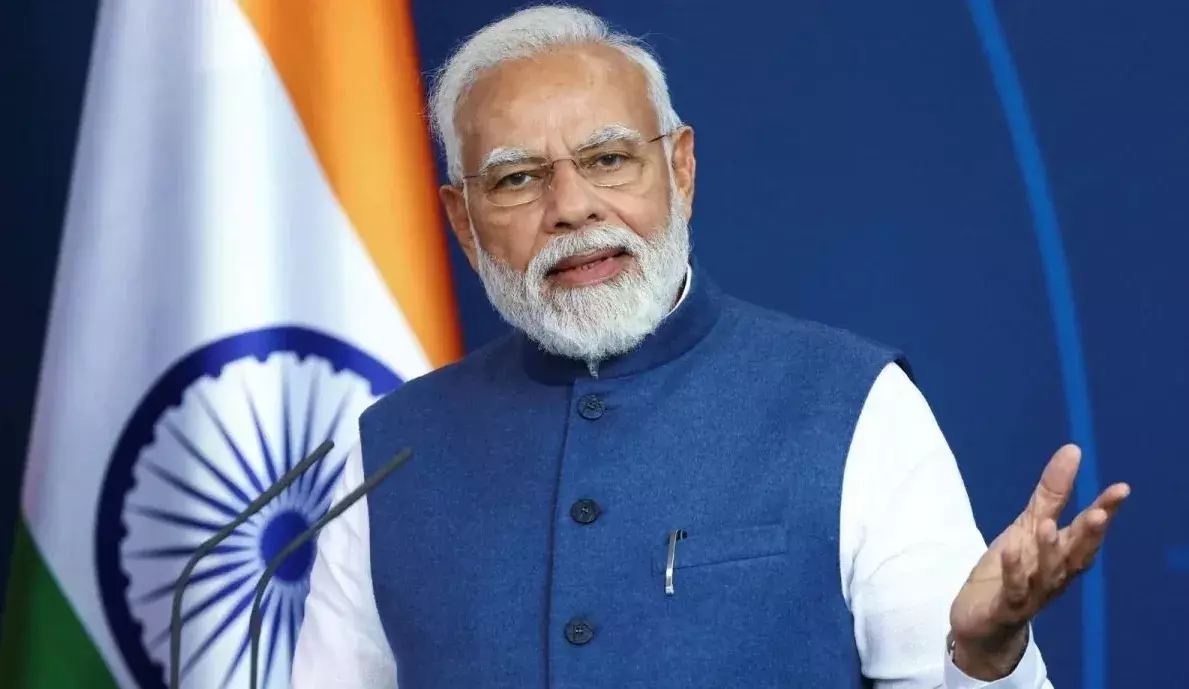


Prime Minister Narendra Modi inaugurated the India Energy Week 2023 in Bangalore on Monday, where he said that in developing the energy resources and transition, India now plays a key role. Also, he added that the opportunity in the energy sector is growing in India along with its development.
During his address at the inaugural session here, the prime minister called the three-day-long event the biggest energy event during India's G-20 presidency. He further referred to IMF's growth projection of India that the country will remain the major fastest growing economy.
"Inspite of the global crisis due to both the pandemic and the Russia-Ukraine war, India could manage to remain a 'Global Bright Spot'. Whatever the external circumstances, India could overcome the hurdles, due to internal resilience," PM Modi mentioned. Adding further he also claimed that his decisive governance in the past nine years helped to develop a large portion of the aspirational class in India. "The people of India want better products, better services and infrastructure. Hence, to fulfil the aspiration/desire of the people, energy plays a major role here," the prime minister said.
He also referred to the International Energy Association's statement that India's energy demand will be highest in this decade. PM Modi informed that India's share in the global oil demand is 5 per cent which is expected to rise to 11 per cent, whereas the gas demand of India is expected to rise up to 500 per cent. He underlined that new opportunities for investment and collaboration are being created by the expanding energy sector of India.
The prime minister explained four major verticals for the strategy for the energy sector- first, increasing domestic exploration and production, second is diversifying the supply, third, expanding fuels like biofuel, ethanol, compressed biogas and solar and fourth is de-carbonisation via electric vehicles and hydrogen.
Elaborating on these verticals he also underlined that India is the fourth largest country for its refining capacity. "Efforts are on to increase the capacity to 450 MMTPA from the current capacity of 250 MMTPA. We are continuously making our refining capacity indigenous, modern and upgraded," he mentioned.
India is working to enhance petrochemical production capacity. The prime minister asked the industry representatives to utilise technology and the startup ecosystem of India to expand their energy landscape. He informed that the government is working on mission mode to increase the consumption of natural gas in our energy mix from 6 per cent to 15 per cent by 2030 where all the needed infrastructure will be provided by 'One Nation One Grid'.
"The government is trying to increase the capacity of LNG Terminal regasification", the prime minister said. He further added that the terminal regasification capacity of 21 MMTPA has doubled in 2022 while efforts are being made to increase it even more. He also added that the number of CGDs in the country has gone up nine times and the number of CNG stations has gone up to 5000 from 900 in 2014.
PM Modi also emphasised that the gas pipeline network which has increased to 22000 kms from 14000 kms in the last nine years and pointed out that the network will expand to 35000 kms in the next 4-5 years.
"We have reduced the 'No-Go' areas. Due to this, 10 lakh square kilometre area has been freed from the restrictions of No-Go. I would urge all the investors to make use of these opportunities, and increase your presence in the exploration of fossil fuels," PM added.
Regarding bio-energy expansion, he also talked about the first 2G Ethanol bio-refinery in August, 2022 and said that preparation is for 12 commercial 2G Ethanol plants. Similarly, efforts are in the direction of the commercial feasibility of sustainable aviation fuel and renewable diesel. Mentioning the provisions of this year's budget the prime minister informed about 500 new 'waste to wealth' Gobardhan plants, 200 compressed biogas plants and 300 community-based plants which will create new avenues of investments.
"The national green hydrogen mission will give a new direction to the India of the 21st century," he mentioned and underlined that the country is aiming to produce 5 MMTPA green hydrogen by the end of this decade which brings in the possibility of investments of more than Rs 8 lakh crore. The PM also added that India will increase the share of green hydrogen to 25 percent by replacing grey hydrogen.
Moreover he emphasised on the crucial subject of battery cost in electric vehicles and noted that its cost is 40-50 per cent of the cost of the car. He informed that the government has already started a PLI scheme worth Rs. 18000 crores which will be a significant step towards manufacturing advanced chemistry cells of 50 GigaWatt hours. The prime minister gave a detailed exposition of emphasis on renewable energy, energy efficiency, sustainable transportation and green technologies in the new budget. Rs. 35000 crores have been kept for priority capital investment to push energy transition and net-zero objectives. Provision for Rs. 10 lakh crore capital expenditure will give a push to green hydrogen, solar to road infrastructure.
He further elaborated on the green energy initiative and informed that in the last nine years of his regime, renewable energy capacity increased from 70 GWh to about 170 GWh in that solar power increased by 20 times. "We are aiming to have 50 per cent non-fossil fuel capacity by the end of this decade. We are also working very fast on bio fuel, and Ethanol blending. In the last nine years, we have increased ethanol blending in petrol from 1.5 per cent to 10 per cent. Now we are moving towards the target of 20 percent ethanol blending," the prime minister added.
Referring to the E-20 rollout on the same day, PM Modi further said that the first phase of the rollout will cover 15 cities and within two years it will be expanded to the entire country. He noted that the mass movement going on in India regarding energy transition has become the subject of a case study.
Union Petroleum and Natural Gas Minister Hardeep Singh Puri, Karnataka chief minister Basvaraj Bommai, and the Governor Thawar Chand Gehlot were also present at the event.
India Energy Week is being organised from February 6 to 8 and aims to showcase India's rising prowess as an energy transition powerhouse. Leaders from the traditional and non-traditional energy industry, governments, and academia to discuss the challenges and opportunities that a responsible energy transition presents. More than 30 ministers from across the world will also take part in the three-day-long event and over 30000 delegates, 1000 exhibitors and 500 speakers are expected to gather to discuss the challenges and opportunities of India's energy future.



