

UN raises concerns over detentions during Delhi protests; India says 'unwarranted interference'


Geneva: The UN human rights office has raised concerns over mass detentions during large-scale protests in Delhi on Saturday, as it urged Indian authorities to respect the right to peaceful assembly and called for the immediate release of anyone arbitrarily detained.
The Permanent Mission of India in Geneva rejected the concerns, describing them as "misplaced" and an "unwarranted interference" in the country's internal affairs.
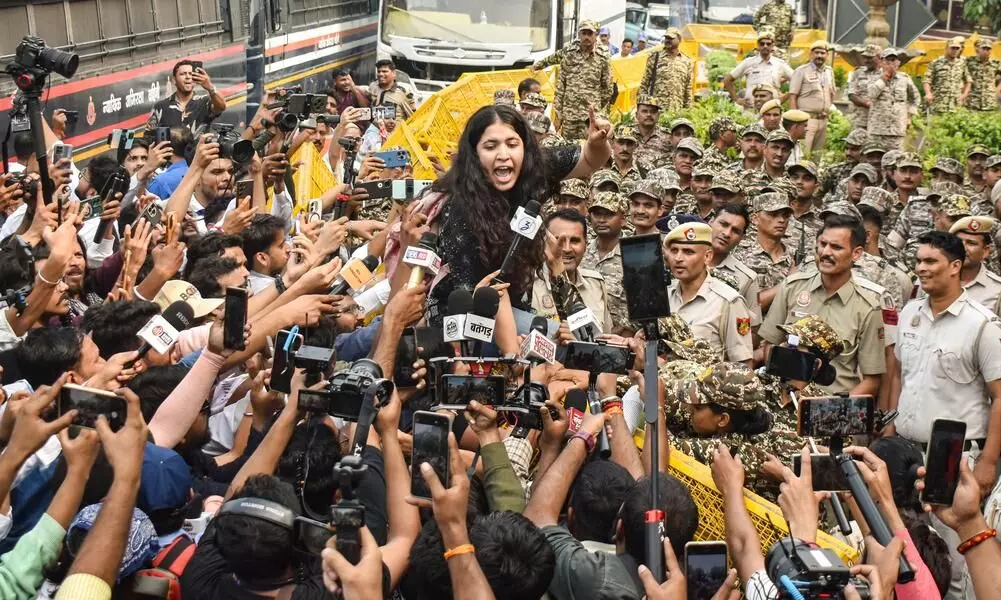
Hundreds of protesters were detained as security forces prevented a planned demonstration by the Gen Z-led Cockroach Janta Party (CJP) from reaching Jantar Mantar in central Delhi.
The protest was called to demand electoral reforms and the resignation of Chief Election Commissioner (CEC) Gyanesh Kumar over allegations of manipulation of voter lists. The Election Commission and the ruling Bharatiya Janata Party (BJP) have denied the allegations.
In a statement on Saturday, UN human rights spokesperson Thameen Al-Kheetan said the office was “concerned by reports of mass detentions in India of demonstrators, protest leaders, members of civil society organisations, lawyers and journalists, before and during today’s large-scale demonstrations in Delhi”.
“We call on the authorities to ensure that the right to peaceful assembly is fully respected and fulfilled,” it said. “Restrictions on peaceful protests must meet strict tests of necessity and proportionality.”
Al-Kheetan also called on Indian authorities to ensure that law enforcement personnel exercise “utmost restraint” in responding to peaceful protesters, consistent with the country’s democratic traditions and human rights obligations.
“All those arbitrarily detained must be immediately and unconditionally released,” he said.
The UN also urged the authorities to “engage in meaningful dialogue to address the broadly held concerns expressed”.
The CJP had planned to hold a demonstration at Jantar Mantar, a landmark in central Delhi.
Delhi Police had refused permission for the protest, and heavy security measures and roadblocks prevented most demonstrators from reaching the area.
The CJP’s founder, Abhijeet Dipke, and two other leaders, Saurav Das and Ashutosh Ranka, were detained shortly after their flight from Mumbai landed in Delhi, the group said.
Delhi Police have not publicly commented on their detentions.
Responding to the remarks by the Office of the UN High Commissioner for Human Rights (OHCHR), the Permanent Mission of India in Geneva said, "The right to peaceful assembly is guaranteed by our Constitution and safeguarded by robust institutions, an independent judiciary and a free media."
"As in every democracy, Indian citizens exercise this right subject to reasonable restrictions in the interest of public order," it said in a social media post.
The mission said the authorities acted in accordance with the law and that Indian courts remained available to all for redressal of grievances.
"The OHCHR's concerns are therefore misplaced and constitute an unwarranted interference in the internal affairs of India," it said.
The mission also urged the UN rights office to pay comparable attention to large-scale protests in other parts of the world, saying it should act in accordance with its mandate of impartiality and non-selectivity.
The CJP and opposition parties have accused CEC Kumar of favouring the BJP in the updating of electoral rolls.
The Election Commission has said its nationwide revision of voter lists, termed Special Intensive Revision (SIR), is a routine exercise to remove the names of dead, duplicate or ineligible voters.
While tens of thousands of people in several states have alleged that their names were wrongly removed from electoral rolls, the Election Commission has denied allegations of political interference.
The CJP is a Gen Z-led satirical movement that is not registered as a political party. It emerged in May after its founder, Dipke, posted a question on X in response to India's chief justice likening some unemployed young people to “cockroaches”. The post went viral, and the movement was born.
The group became a major protest movement during weeks of demonstrations over the summer, demanding education reforms and the resignation of Education Minister Dharmendra Pradhan. The protests ended in July after Pradhan resigned.
The CJP has now returned to the streets demanding electoral reforms and the resignation of CEC Kumar.
The BJP criticised Saturday's protests, accusing opposition groups led by Congress leader Rahul Gandhi and associates of Aam Aadmi Party leader Arvind Kejriwal of trying to destabilise the country.
BJP president Nitin Nabin alleged that the groups were pursuing their political agendas “at the behest of foreign forces”.
He also accused them of refusing to accept the people’s verdict and trying to create instability instead. He added that Indian democracy was strong enough to thwart their efforts.