Tehran rejects ceasefire proposal, Trump says Iran could be taken out in one night


Dubai/ Washington: Iran on Monday rejected the latest ceasefire proposal and instead said it wants a permanent end to the war, as US President Donald Trump’s ultimatum loomed within hours.
Iran’s state-run IRNA news agency said Tehran had conveyed its response through Pakistan, a key mediator.
“We won’t merely accept a ceasefire,” Mojtaba Ferdousi Pour, head of the Iranian diplomatic mission in Cairo, told The Associated Press. “We only accept an end of the war with guarantees that we won’t be attacked again.”
The response makes clear that Tehran is not open to a temporary truce, instead stressing the need for a “permanent end to war.”
Iran’s reply is structured as a 10-clause framework that goes beyond an immediate ceasefire. At the core, Iran is asking for a permanent end to the war, not just within its borders but also in Lebanon and Gaza, along with firm guarantees that the conflict will not restart. It also wants recognition of its control over the Strait of Hormuz, including the right to regulate traffic and collect tolls from ships passing through the route.
Later on Monday, Trump said Iran could be “taken out” in a single night and suggested that such an operation “might” happen as soon as Tuesday evening, escalating rhetoric as tensions deepen.
“The entire country could be taken out in one night, and that night might be tomorrow night,” Trump told reporters during a press conference, underscoring what he described as the United States’ military capability.
The US President’s remarks came as he detailed a high-risk US rescue operation inside Iran following the crash of an F-15 aircraft, in which two airmen ejected and landed “deep in enemy territory.” Trump said the initial mission involved 21 aircraft flying under “very, very heavy enemy fire,” with one helicopter returning riddled with bullets.
He also threatened to jail the journalist who first reported that US forces were searching for the F-15 weapons officer if they don’t reveal their sources.
“The person that did the story will go to jail if he doesn’t say, and that doesn’t last long,” Trump said.
Trump didn’t name the journalist or news organisation. He said the leak tipped off the Iranians, endangering the officer and his rescuers. He called the leaker “a sick person”.
Earlier, Trump said he was “very upset” with Iran and warned that Tehran is “going to pay a big price” if it fails to reach a deal, signalling a hardening stance as his self-imposed deadline approaches.
Speaking to reporters outside the White House, Trump made it clear that the Tuesday deadline for Iran to agree to terms is final. “It could end very quickly if they do what they have to do,” Trump said. “They have to do certain things. They know that.” He added that “the people there now are much more reasonable than the lunatics that you had in phase 1 and phase 2.”
Trump said the US has “many alternatives” as the conflict continues, but hinted he is not ready to step back just yet. He said Washington could “leave right now” and that it would take Iran years to recover, but added that he wants to “finish it up”.
He also reiterated that “Iran cannot have a nuclear weapon”, a claim Tehran has repeatedly denied, insisting its nuclear programme is not aimed at developing weapons.
Trump wants Tehran to open the Strait of Hormuz or see its power plants and bridges attacked. Ferdousi Pour said Iranian and Omani officials were working on a mechanism for administering the shipping chokepoint.
The rejection came as Israel struck a key petrochemical plant in the massive South Pars natural gas field and killed two paramilitary Revolutionary Guard commanders.
The gas field attack aimed at eliminating a major source of revenue for Iran, Israel said. The field is critical to electricity production, but the strike appeared to be separate from Trump’s threats to target power plants and bridges if Tehran doesn’t reopen the Strait of Hormuz to all shipping traffic by Monday night Washington time.
Iran’s grip on the strait has caused oil prices to surge and shaken the world economy.
Israel’s Defence Minister Israel Katz called the plant Iran’s largest petrochemical facility. The gas field shared with Qatar is the world’s largest. Iranian state media blamed the US and Israel for the attack.
After Israel’s attack on South Pars in March, Trump said Israel would not attack it again but warned that if Iran continued striking Qatar’s energy infrastructure, the US would “massively blow up” the field.
Egyptian, Pakistani and Turkish mediators have sent Iranian Foreign Minister Abbas Araghchi and US Mideast envoy Steve Witkoff a proposal calling for a 45-day ceasefire and the reopening of the strait, two Mideast officials told AP.
Iran’s foreign ministry spokesman Esmail Baghaei earlier told journalists that messages were being exchanged with mediators but “negotiations are entirely incompatible with ultimatums, crimes and threats of war crimes.”
In Islamabad, two senior officials said Pakistan’s ceasefire efforts are at an advanced stage but “several spoilers and detractors” are trying to sow confusion. The officials spoke on condition of anonymity because they were not authorized to speak publicly about the talks.
Meanwhile, explosions boomed in Tehran and low-flying jets could be heard for hours. Among those killed was the head of intelligence for Iran’s paramilitary Revolutionary Guard, Maj Gen Majid Khademi, according to Iranian state media and Israel’s defense minister. Israel said it also killed the leader of the Revolutionary Guard’s undercover unit in its expeditionary Quds Force, Asghar Bakeri.
Israel’s defence minister vowed to keep targeting top-ranking officials. Israel’s military later said it struck three Tehran airports overnight — Bahram, Mehrabad and Azmayesh — hitting dozens of helicopters and aircraft it said belonged to the Iranian Air Force.
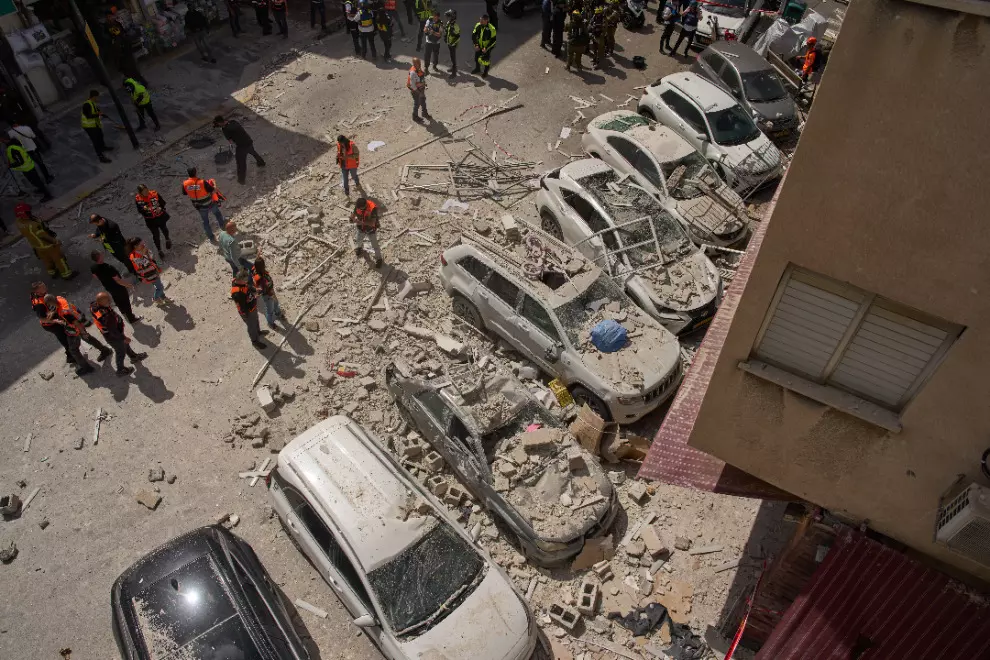
Separately, Kuwait, the United Arab Emirates and Saudi Arabia activated air defences to intercept Iranian missiles and drones. Tehran has kept up pressure on Gulf neighbours, which has included strikes against infrastructure like oil fields. In Israel, Iranian missiles hit the northern city of Haifa, where four people from one family were found dead in the rubble of a residential building.
Iran’s attacks on regional energy infrastructure and its hold on the Strait of Hormuz, through which a fifth of the world’s oil is shipped in peacetime, have sent global energy prices soaring.
Brent crude oil, the international standard, rose to USD 109 in early Monday spot trading, about 50 per cent higher than when the war started, then wavered. US stocks were mostly holding steady.
Thick smoke rose near Tehran’s Azadi Square after an airstrike hit the grounds of the Sharif University of Technology.
Iranian media reported damage to buildings and a natural gas distribution site next to campus. The university is empty as the war has forced all schools into online classes.
A strike near Eslamshar, southwest of Tehran, killed at least 15 people, authorities said.