Reservation for women in legislative bodies need of hour: PM Modi
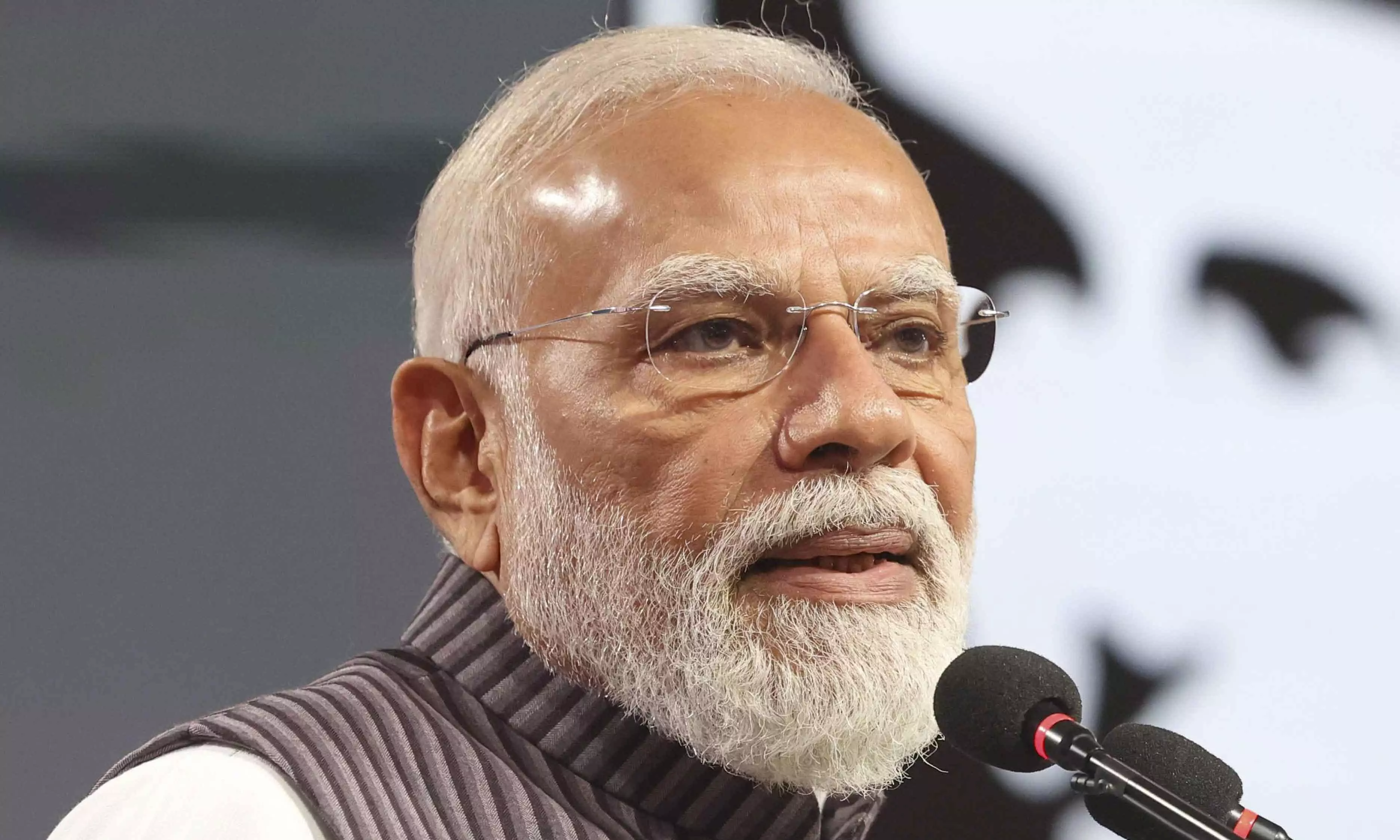


New Delhi: Prime Minister Narendra Modi said on Thursday that the proposed amendments to the Women Reservation Act are not just a legislative exercise but a reflection of the aspirations of crores of women across India and urged all MPs to come together to support this significant move.
In a signed article posted on his website narendramodi.in, the prime minister also said that the initiative is an affirmation of a principle that has long guided India's civilisational ethos that society progresses when women progress.
He said it is imperative that the 2029 Lok Sabha elections and the Assembly elections to the various states in the coming times are conducted with women's reservation in place.
The prime minister said the nation stands at the threshold of a historic occasion, and it is an opportunity to deepen the foundations of the country's democracy and to reaffirm the collective commitment to equality and inclusion.
He said that on April 16, Parliament will be convened to discuss and pass an important Bill that advances women's reservation.
"To describe this merely as a legislative exercise would be an understatement. It is a reflection of the aspirations of crores of women across India," he said.
The Budget Session of Parliament has been extended, and a special three-day sitting of the House has been convened on April 16 to 18 when the 'Nari Shakti Vandan Adhiniyam', more commonly known as Women Reservation Act, would be amended for its implementation from 2029 general elections.
It will ensure an increase in the number of Lok Sabha seats to 816, of which 273 will be reserved for women.
The provision to provide 33 per cent reservation to women in the Lok Sabha and state assemblies was brought by amending the Constitution in 2023, but it will come into effect after the completion of the delimitation exercise on the basis of 2027 Census. Therefore, it is expected to come into force only in 2034 if the present law remains as it is.
According to the broad contours available, the number of Lok Sabha seats would be increased from the present 543 to 816, with 273 seats reserved for women. The reservation will also be done on a "vertical basis" with seats allocated for SCs and STs.
The redrawing of the constituencies will be done on the basis of 2011 Census rather than the proposed 2027 Census.
A similar exercise will be carried out for state assemblies where seats will be reserved on a pro-rata basis.
In the article, Modi said women constitute nearly half of India's population, their contributions to the nation are vast and invaluable and today, India is witnessing remarkable achievements by women across every field.
"From science and technology to entrepreneurship, from sports to the armed forces and from music to the arts, women are at the forefront of India's progress," he said.
The prime minister said that over the years, sustained efforts have been made to create an enabling environment for women's empowerment.
He said greater access to education, improved healthcare, enhanced financial inclusion and better access to basic amenities have strengthened the foundations of women's participation in economic and social life.
"Yet, their representation in the world of politics and legislative bodies has not always been commensurate with their role in society," he said.
Modi said this is particularly unfortunate because when women participate in administration and decision-making, they bring with them experiences and insights that enrich public discourse and improve the quality of governance.
He said that over the decades, there have been repeated efforts to provide women with their rightful place in democratic institutions by the previous governments. Committees were made, Bill drafts were introduced but they never saw the light of day.
"But the broad consensus has remained that women's representation in legislative bodies has to increase," he said.
The prime minister said that in September 2023, Parliament passed the 'Nari Shakti Vandan Adhiniyam' with the same spirit of consensus.
"I consider it to be among the most special occasions of my life. This opportunity to ensure women's reservation also resonates deeply with the spirit of our Constitution. The makers of our Constitution envisioned a society where equality is both enshrined and realised in practice," he said.
Modi said strengthening women's participation in legislative institutions is an important step towards fulfilling that vision.
"It reflects our commitment to building a society where every citizen has an equal stake in shaping the nation's destiny.
"This is a moment that cannot be deferred any longer. Every delay in advancing women's representation is, in effect, a delay in strengthening the quality and inclusiveness of our democracy," he said.
The prime minister said that as the country approaches this historic Parliament sitting, "I appeal to all Members of Parliament, across party lines, to come together in support of this important step for the women of India".
"Let us seize this opportunity with a sense of responsibility and purpose. Let us act in a manner that reflects the highest traditions of our democracy," he said.
Modi said India has always shown that when it comes to matters of national importance, it can rise above differences and act with unity.
"This is one such moment. Let us move forward together and strengthen Constitutional values and empower our Nari Shakti for national progress," he said.
The prime minister said that for decades, the need for greater participation of women in legislative institutions has been acknowledged, discussed and reaffirmed.
He said that to postpone action now would mean extending an imbalance that we already recognise and have the capacity to correct.
"At a time when India is moving forward with confidence and purpose, it is essential that our institutions reflect the aspirations of all citizens, especially those who form half our population," he said.
Modi said timely action will not only honour long-standing commitments but also ensure that the momentum of progress is sustained.
"This is truly a historic opportunity to make our democracy more representative, responsive and future-ready. This moment calls for collective action. It is not about any one government, party or individual," he said.
The prime minister said it is about the nation as a whole recognising the importance of this step and coming together to realise it.
He said it is what "we owe to our 'Nari Shakti' (women power) and that is why the passage of a bill for women's reservation should reflect the broadest possible consensus and be guided by the larger national interest.
"Such opportunities call upon us to act not for ourselves, but for future generations. They remind us that the true strength of a democracy lies in its ability to evolve and to become more inclusive over time," he said.
Modi said in the coming days, India will be immersed in a festive season, with celebrations taking place across the length and breadth of the nation.
He said the people of Assam will mark Rongali Bihu while Odisha will celebrate Maha Bishuba Pana Sankranti, in West Bengal, Poila Boishakh will usher in the Bengali New Year and in Keralam, Vishu will be observed with immense enthusiasm.
In Tamil Nadu, Puthandu will be celebrated, while in Punjab and other parts of northern India, it will be Baisakhi, which will usher in a spirit of hope as well as positivity, he said.
Furthermore, Modi said, on April 11, there will be the 200th birth anniversary celebrations of Mahatma Phule and on April 14, India will pay homage to Babasaheb Ambedkar on Ambedkar Jayanti.
"I convey my best wishes to all those across India and the world who are marking these festivals. May these auspicious occasions bring happiness and prosperity to everyone's lives," he said.