PM Modi and Jordan’s King discuss bilateral ties, exchange perspectives on regional and global issues
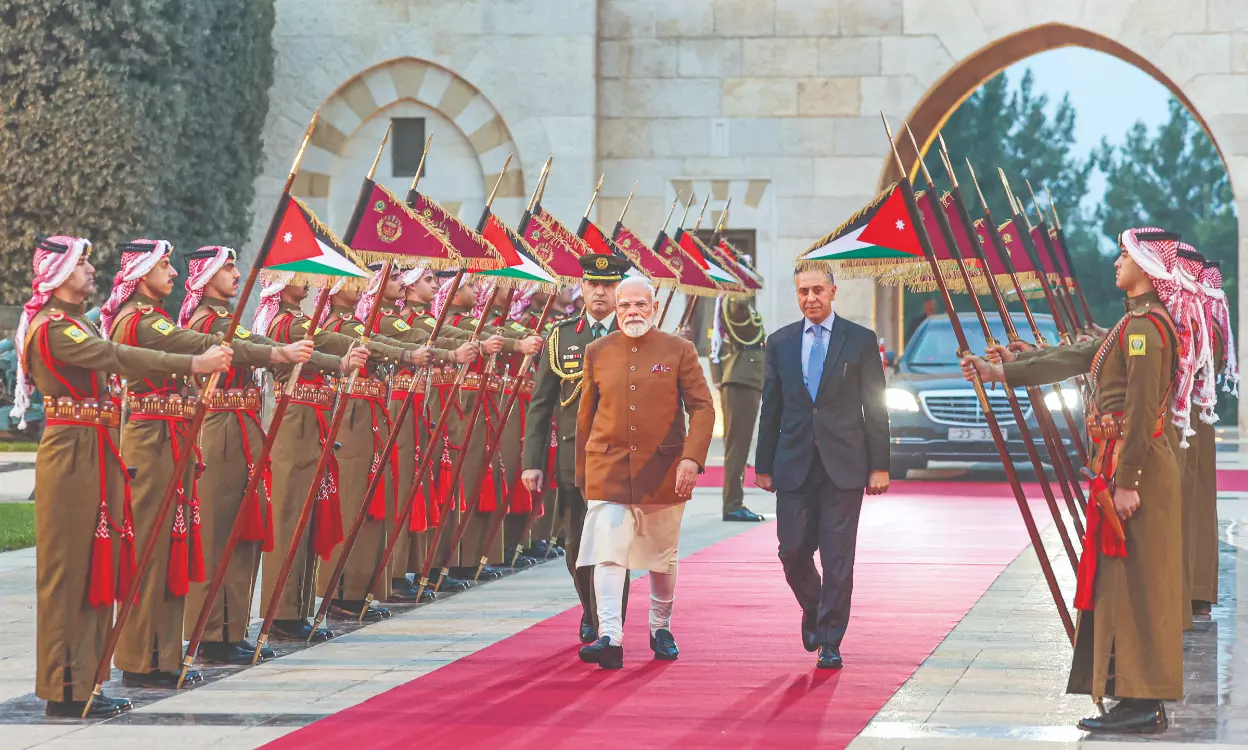


Amman: Prime Minister Narendra Modi and Jordan’s King Abdullah II held extensive talks in Amman on Monday, surveying the full spectrum of bilateral cooperation and sharing views on regional and global developments at a time of heightened tensions in West Asia. Modi, in Jordan for a two-day visit at the king’s invitation, was received with ceremonial honours at the Husseiniya Palace before the leaders met privately and later joined their delegations for formal discussions.
Modi told King Abdullah II that he was confident the engagement would drive India-Jordan relations into a new phase. “We will continue our cooperation in areas such as trade, fertilisers, digital technology, infrastructure and people to people ties,” he said, noting that both nations hold a shared position against terrorism. He also referred to the king’s “active and positive role” regarding the situation in Gaza and added, “We hope that peace and stability will prevail in the region. Under your leadership, Jordan has sent a strong and strategic message to the world against terrorism, extremism and radicalisation.”
The prime minister expressed gratitude for the reception extended to him and his delegation. He said the ideas flagged by King Abdullah II for expanding cooperation reflected the depth of their partnership as the two countries mark 75 years of diplomatic relations. “This milestone will continue to inspire us to move forward with renewed energy for many years to come,” Modi said.
Recalling earlier interactions, Modi noted that he joined the Jordanian monarch at a conference on Islamic heritage during the latter’s 2018 visit to India. He also recalled their first meeting in 2015 on the sidelines of a UN event focused on countering violent extremism. “Your efforts to promote moderation are extremely important not only for regional peace but also for global peace,” he told the king. Modi added that India and Jordan would continue strengthening every aspect of their cooperation while advancing shared priorities in combating extremism.
King Abdullah II said the visit held special meaning as the countries observe the 75th anniversary of diplomatic ties. “All Jordanians welcome you back to Jordan. Your presence here carries deep significance. I believe this visit reflects decades of friendship, mutual respect and productive cooperation between our two nations,” he said. The king added that both countries are committed to advancing prosperity. “Our nations enjoy a strong partnership, and they share a desire to advance prosperity for our people. Over the years, our collaboration has expanded across multiple sectors. Your visit provides an important opportunity to chart new paths of economic cooperation.”
Modi is in Jordan on the first leg of a four-day, three-nation tour that will also take him to Ethiopia and Oman. His last stop in Amman was in 2018 during a transit to Palestine. This visit marks the first full bilateral trip by an Indian prime minister to Jordan in 37 years.
Earlier in the day, Jordanian Prime Minister Jafar Hassan welcomed Modi at the airport, calling the gesture a reflection of close ties. “We look forward to broader horizons of cooperation between our two countries, particularly in the economic, investment and technological fields,” Hassan said.
Modi was later greeted at his hotel by members of Jordan’s Indian community and local well-wishers, with performers showcasing traditional Indian dances. On Tuesday, Modi and King Abdullah II will address a business gathering featuring leading companies from both nations. The prime minister, accompanied by the Crown Prince, is also scheduled to visit Petra, weather permitting.
India is Jordan’s third largest trading partner, with bilateral trade valued at $2.8 billion. Jordan is a key supplier of phosphates and potash to India, while more than 17,500 Indians work in Jordan in sectors including textiles, construction and manufacturing.