Modi hosts UAE Prez, sets $200 bn trade target, signs LNG deal
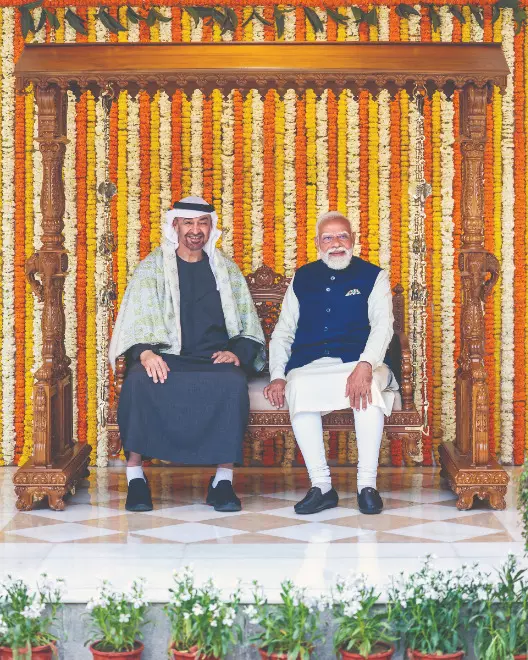


New Delhi: India and the United Arab Emirates on Monday agreed on an expansive roadmap to deepen their partnership across trade, defence, energy, civil nuclear cooperation, space, and advanced technologies, setting a headline target of $200 billion in annual bilateral trade by 2032.
The decisions were announced after Prime Minister Narendra Modi hosted UAE President Sheikh Mohamed bin Zayed Al Nahyan in New Delhi during the Gulf leader’s nearly three-and-a-half-hour visit, held in both restricted and delegation-level formats. Modi personally received Al Nahyan at the Delhi airport, where the two leaders shared a hug and later travelled together in the same vehicle to the prime minister’s residence, underlining the closeness that has come to define India-UAE ties.
“This has been a short, but extremely substantive visit,” Foreign Secretary Vikram Misri said at a media briefing, describing the discussions as wide-ranging and outcome-oriented. The visit took place amid heightened tensions in West Asia, with ongoing instability in Gaza, the Yemen situation, and strained Iran-US relations contributing to regional uncertainty. Misri noted that the leaders discussed developments in Yemen, Gaza and Iran, though he declined to provide further details.
A key economic outcome was the decision to more than double the existing trade volume. Misri said both sides agreed on a goal of $200 billion in annual trade by 2032, with bilateral trade currently at $84 billion in 2023-24. The Ministry of External Affairs (MEA) said the strategy to reach this target will include expanding market linkages, connecting MSMEs, and leveraging platforms such as Bharat Mart, the Virtual Trade Corridor, and Bharat-Africa Setu.
The two countries also moved to significantly step up defence cooperation. Misri confirmed that a Letter of Intent was signed to work towards a framework agreement for a strategic defence partnership. According to the MEA, the proposed framework aims to widen defence engagement in areas including defence industrial collaboration, advanced technologies, training and education, special operations, cyber security, counter-terrorism and interoperability.
Energy security was another major focus. India and the UAE concluded a long-term liquefied natural gas arrangement, with Hindustan Petroleum Corporation Limited (HPCL) and ADNOC Gas signing a Sales and Purchase Agreement for the supply of 0.5 million metric tonnes per annum of LNG over a 10-year period starting from 2028. The joint statement said both leaders welcomed the agreement and expressed satisfaction with the strength of the energy partnership, while also noting the UAE’s contribution to India’s energy security. Misri pointed out that the UAE is currently India’s second-largest supplier of LNG after Qatar.
In a major push into strategic high-tech sectors, India and the UAE agreed to explore broad civil nuclear cooperation, including a partnership in advanced nuclear technologies. Misri said the two sides will examine collaboration in developing large nuclear reactors and small modular reactors, as well as in advanced reactor systems and nuclear power plant operations. The MEA said the cooperation would build on new opportunities created by India’s SHANTI Act 2025, and include collaboration on nuclear safety, operations, and maintenance.
Artificial intelligence emerged as another priority area. Misri said the two sides decided to collaborate on setting up a supercomputing cluster in India through a partnership, with the MEA noting cooperation between India’s Centre for Development of Advanced Computing (C-DAC) and UAE-based G-42. Misri added that the UAE will also explore investments to expand data centre capacities in India, a move aligned with the broader digital cooperation agenda.
Both sides also agreed to explore the creation of a “data embassy”, a relatively new concept that would involve mutually recognised sovereignty arrangements. “There will be work done to see how these can be set up under mutually recognised sovereignty agreements,” Misri said.
Space cooperation also featured prominently in the outcomes. Misri said a separate Letter of Intent was signed for joint work in developing space infrastructure, with both sides looking at setting up new launch complexes, satellite fabrication facilities, joint missions, a space academy, and training centres. The MEA said the Indian National Space Promotion and Authorisation Centre (IN-SPACe) and the UAE Space Agency signed a Letter of Intent to pursue joint development of infrastructure to support the growth and commercialisation of the space industry. The joint statement said the initiative aims to develop an integrated space ecosystem with end-to-end infrastructure, enable India-UAE missions, expand global commercial services, and generate high-skilled jobs and start-ups.
Investment cooperation was bolstered through a document signed to facilitate the UAE’s participation in developing a special investment region in Dholera, Gujarat. According to Misri, the initiative will focus on strategic infrastructure including an international airport, pilot training school, Maintenance, Repair and Overhaul (MRO) facility, a greenfield port, and a smart urban township, as well as projects related to rail connectivity and energy infrastructure. The MEA said a Letter of Intent was signed between the Government of Gujarat and the UAE Ministry of Investment for this purpose.
The two countries also signed an agreement on food safety, aimed at strengthening cooperation in the food sector and encouraging agricultural and food exports from India to the UAE. Misri said it will benefit Indian farmers while supporting food security in the UAE.
Beyond the sectoral agreements, the MEA said additional outcomes include the facilitation of UAE companies such as First Abu Dhabi Bank and DP World setting up operations in GIFT City, exploration of digital or data embassies, plans for a ‘House of India’ in Abu Dhabi, and initiatives to promote youth exchanges.
In a separate cultural gesture during the visit, Modi hosted the UAE President and his family at his residence at Lok Kalyan Marg, and presented traditional Indian gifts. These included a Royal Carved Wooden Jhula from Gujarat and a Pashmina shawl presented in an ornate silver box. Gifts were also presented to Sheikha Fatima bint Mubarak Al Ketbi, including a Pashmina shawl in a silver box and Kashmiri saffron.
Misri said Modi and Al Nahyan also unequivocally condemned cross-border terrorism, agreeing that the perpetrators, supporters and financiers of all acts of terrorism must be brought to justice.
The UAE President also expressed support for the success of India’s chairmanship of the BRICS grouping this year, Misri said.
The MEA noted that the visit was held at Modi’s invitation and builds on recent high-level exchanges, including the visit of Sheikh Khaled bin Mohamed bin Zayed Al Nahyan to India in September 2024, and the visit of Sheikh Hamdan bin Mohammed bin Rashid Al Maktoum in April 2025. This was Sheikh Mohamed’s third official visit to India since assuming office as UAE President and his fifth visit in the past decade, reflecting the frequency and intensity of engagement between New Delhi and Abu Dhabi, which has grown after the two sides signed a Comprehensive Economic Partnership Agreement in 2022.
The UAE president was seen off at the airport by External Affairs Minister S Jaishankar.