Life and iron rule of Ayatollah Ali Khamenei
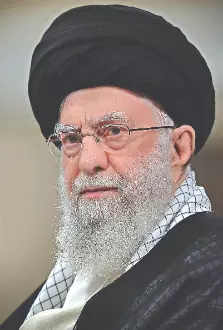


Dubai: For nearly four decades, Ayatollah Ali Khamenei stood at the apex of Iran’s political and religious order, presiding over a system that fused clerical authority with state power and reshaped the country’s domestic life and regional posture. Rising from a background of imprisonment and political struggle under the Shah, he became the Islamic Republic’s second Supreme Leader in 1989 and ruled longer than its founder, leaving an imprint that defined modern Iran.
Born in 1939 in the northeastern city of Mashhad, Khamenei was the second of eight children in a modest clerical family. He pursued religious studies in Qom from 1958 to 1964 and was drawn early into the movement led by Ayatollah Ruhollah Khomeini against Shah Mohammad Reza Pahlavi. His activism led to repeated arrests by the Shah’s secret police, SAVAK. In 1974, he was detained for eight months and subjected to severe torture, an episode later memorialised at Tehran’s Ebrat Museum, where his former cell remains on display.
After the collapse of the monarchy in 1979, Khamenei rose swiftly within the new revolutionary order. He served as deputy defence minister, became Tehran’s Friday prayer leader, and emerged as a prominent public voice of the Islamic Republic. In June 1981, he survived an assassination attempt when a bomb hidden in a tape recorder exploded at Tehran’s Abouzar Mosque, paralysing his right arm and damaging his hearing. “I won’t need the hand; it would suffice if my brain and tongue work,” he later said, a remark that helped cement his image as a survivor of the revolution. That same year, he was elected president, a post he held until 1989, steering the country through the latter years of the Iran-Iraq war.
Khamenei assumed the role of Supreme Leader following Khomeini’s death in 1989, despite doubts among senior clerics about his religious credentials. Addressing the assembly that selected him, he said his appointment should make them “cry tears of blood.” Over time, he consolidated authority through the doctrine of velayat-e faqih, or guardianship of the jurist, under which ultimate sovereignty rests with a senior cleric. The position placed him above elected institutions, giving him command of the armed forces and decisive influence over legislation, the judiciary, and state media.
During his tenure, Khamenei entrenched clerical dominance over Iran’s political system and expanded the power of unelected bodies that could overrule parliament and vet electoral candidates. The Islamic Revolutionary Guard Corps grew into the most influential institution in the country under his watch, overseeing Iran’s ballistic missile programme, extending its reach across the economy, and acting as the backbone of internal security. In return, the Guard became Khamenei’s most dependable pillar of support.
Khamenei’s rule was repeatedly challenged by popular unrest. A reformist movement that swept parliamentary elections and the presidency in the late 1990s called for greater power for elected officials, but unelected clerical bodies blocked reforms and sidelined candidates. Mass demonstrations erupted in 2009 after disputed election results, with protesters accusing authorities of vote-rigging. Khamenei endorsed the re-election of President Mahmoud Ahmadinejad, and security forces crushed the so-called Green Movement.
Economic pressures compounded political tensions. Years of sanctions, mismanagement, and corruption weakened the economy and fuelled protests in 2017 and 2019. In 2022, the death of Mahsa Amini, a 22-year-old detained by morality police for allegedly violating Iran’s dress code, triggered nationwide demonstrations that became some of the most severe since the revolution. Hundreds were killed in the ensuing crackdown.
The most violent unrest came in recent months after Iran’s currency plunged to a record low of 1.42 million rials to the US dollar. Protests that began in Tehran’s traditional bazaar spread across the country. Activists said more than 7,000 people were killed as security forces fired on crowds, while the government acknowledged over 3,000 deaths, a higher toll than in previous crackdowns. Khamenei responded by ordering security forces to restore order, underscoring the uncompromising nature of his final years in power.
In foreign policy, Khamenei defined the Islamic Republic through resistance to the United States and Israel, adopting the language of his predecessor, who branded them the “Great Satan” and “Little Satan”. Under his leadership, Iran cultivated a network of allied militias across Lebanon, Gaza, Yemen, Iraq, and Syria, allowing Tehran to confront regional rivals indirectly. He also promoted a “resistance economy” aimed at reducing vulnerability to sanctions, encouraging ties with China and Russia while seeking to cut dependence on oil.
Khamenei regarded nuclear technology as a symbol of sovereignty and national pride. He authorised negotiations that led to the 2015 nuclear agreement, then criticised Washington for withdrawing from the deal in 2018 and reimposing sanctions, a move that deepened Iran’s economic crisis and intensified domestic unrest.