‘Justice is crying behind closed doors’: Mamata urges SC to save democracy
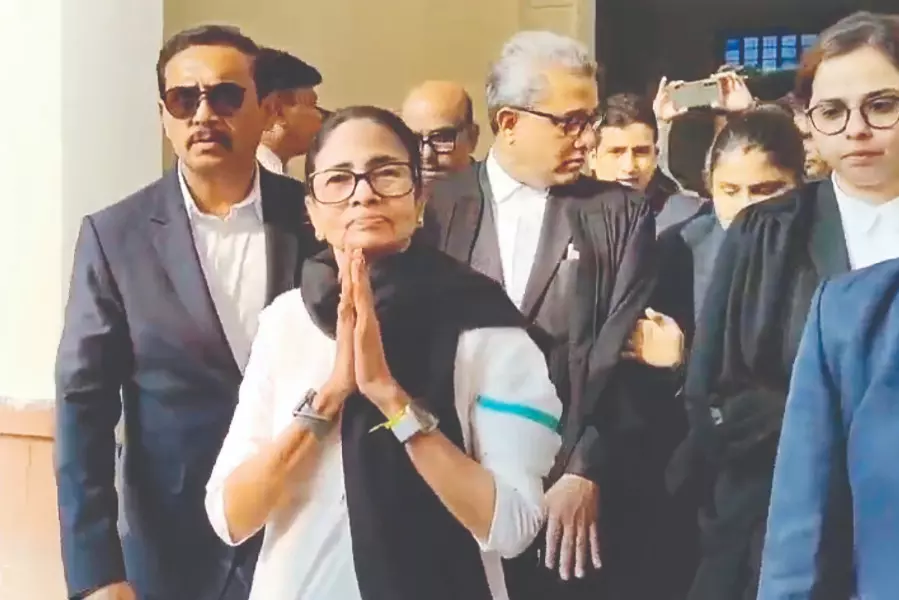


NEW DELHI: West Bengal Chief Minister Mamata Banerjee made history on Wednesday by arguing, in her fiery oratorical style, a case in the Supreme Court as a common citizen and appealing to the Chief Justice that “justice is crying behind closed doors” because the people of Bengal had not received fair treatment.
She made submissions in the petition filed by her challenging the Election Commission’s Special Intensive Revision (SIR) of voter lists in West Bengal. She denounced the EC for inflicting “unprecedented hardship and distress upon ordinary citizens across Bengal”.
Wrapping a black shawl over her familiar white saree, the Chief Minister waited for her turn patiently, sitting for over two hours in the rear of a courtroom led by Chief Justice Surya Kant. This is the first time a sitting Chief Minister has personally appeared before the Supreme Court to make oral submissions.
Although senior advocate Shyam Divan represented the West Bengal Chief Minister and addressed the bench comprising Chief Justice of India Surya Kant, Justice Joymalya Bagchi and Justice Vipul Pancholi on legal issues, Banerjee also made submissions.
When her time came, she made a fervent appeal to the Chief Justice; “Justice is crying behind closed doors”, she argued, telling the court the Bengali people had not received justice. Mamata Banerjee sought permission to address the court, folding her hands and appealing to the judges to “save democracy”. When she asked for five minutes, the CJI responded: “We will allow you 15 minutes.”
The Trinamool Congress (TMC) chief began by thanking the judges and members of the Bar, and went on to quote “Rabindranath Tagore”, saying: “Our lawyers fight for justice from the beginning, but when we don’t get justice, justice cries behind doors.”
The hearing was held amid an escalating confrontation between the TMC government and the EC over the SIR process in West Bengal. The state has alleged that SIR was being conducted in an “arbitrary and hurried” manner ahead of crucial Assembly elections, where Banerjee is seeking a fourth straight term. The EC, however, has maintained that the exercise is routine and aimed at ensuring clean electoral rolls.
In her submissions, Banerjee claimed that the SIR was “only for deletion and not inclusion” and reiterated her allegation that despite writing six letters to Chief Election Commissioner Gyanesh Kumar, she had received no response. “I am a bonded labourer. I am a very less important person. I am from a common family,” she told the Bench.
Raising concerns over alleged wrongful deletions, Banerjee placed photographs before the court and pointed to cases of married women being removed from voter rolls due to changes in surname. “Suppose a daughter after getting married, if she changes title, it’s also mismatched,” she submitted.
She also questioned the pace of the revision exercise in Bengal, claiming that a process that normally takes two years was being completed in three months. “More than 100 people died (during the SIR). Many BLOs committed suicide,” she alleged. “Why is this not happening in Assam? Bengal is targeted,” she said, referring to BJP-ruled Assam.
Banerjee further claimed that lakhs of names had been deleted from the rolls and that affected voters had no effective remedy under Form 6. She alleged that micro observers, appointed only in Bengal, were overriding Booth Level Officers (BLOs) and deleting names. The Chief Minister thanked the court for allowing Aadhaar cards and other documents to be considered during the SIR process, calling it a relief for ordinary voters.
She alleged that West Bengal was being “targeted” and its people were being “bulldozed”. The court took note of Banerjee’s petition and said genuine persons must remain on electoral rolls. Her request was simple enough; she asked the court to rule that the voter lists for the March/April election be based on data from 2005 and not from the 2026 SIR.
Mamata Banerjee also pointed to the 8,300 ‘micro observers’ deployed across the state by the EC, calling them “BJP officers” and labelling their appointments “unconstitutional”.
In an emotional appeal, she flagged the situation facing an estimated 63 lakh people who face exclusion from rolls over ‘logical discrepancies’ in the preparation of electoral rolls.
The chief minister referred to the poll panel as “WhatsApp Commission” in an apparent reference to directions being allegedly passed by the Election Commission to electoral officials through the instant messaging app.
Banerjee reached the Supreme Court premises flanked by her lawyers, including Trinamool Congress leader and senior advocate Kalyan Banerjee, around 10 am.
Several lawyers and litigants jostled to enter the CJI’s courtroom to catch a glimpse of the CM making her arguments.
Senior advocate Divan, representing her, referred to a large number of unmapped voters and said there was hardly any time left for remedial measures as the process was set to conclude on February 14.
He said the poll panel had to upload the reasons for putting names in the “logical discrepancy” list. Divan contended 1.36 crore people had been issued notices after their credentials were found to have logical discrepancies.
Taking the issue further, the CM said in some cases people who were alive had been declared dead by the poll panel. Banerjee alleged that despite the apex court’s direction, the panel was not allowing Aadhaar and kept insisting on other documents.
“In other states, documents like domicile certificate, family register card, etc are allowed... they are only targeting Bengal on the eve of elections. What was the hurry?” she asked.
Senior advocate Rakesh Dwivedi, appearing for the Election Commission, countered the charges and alleged that the West Bengal government provided the services of 80 grade-two officers for overseeing the SIR process.
Banerjee contested that and said the state provided whatever was sought by the Commission.
When the counsel appearing for the Commission interrupted, Banerjee, with folded hands, said, “Please allow me to speak, sir!”
She flagged that married women were being put to notice for shifting to their in-laws’ home or using their husbands’ surname.
When the counsel objected to her submissions, CJI Kant interrupted, saying, “Madam has come all the way to speak.”
The CJI said every problem could be solved and it must be ensured that no innocent person was left out. The CJI referred to a Bengali dialect and observed that at times names could be misspelt in English because of it.