
Iran retaliates after Israel kills its intelligence chief
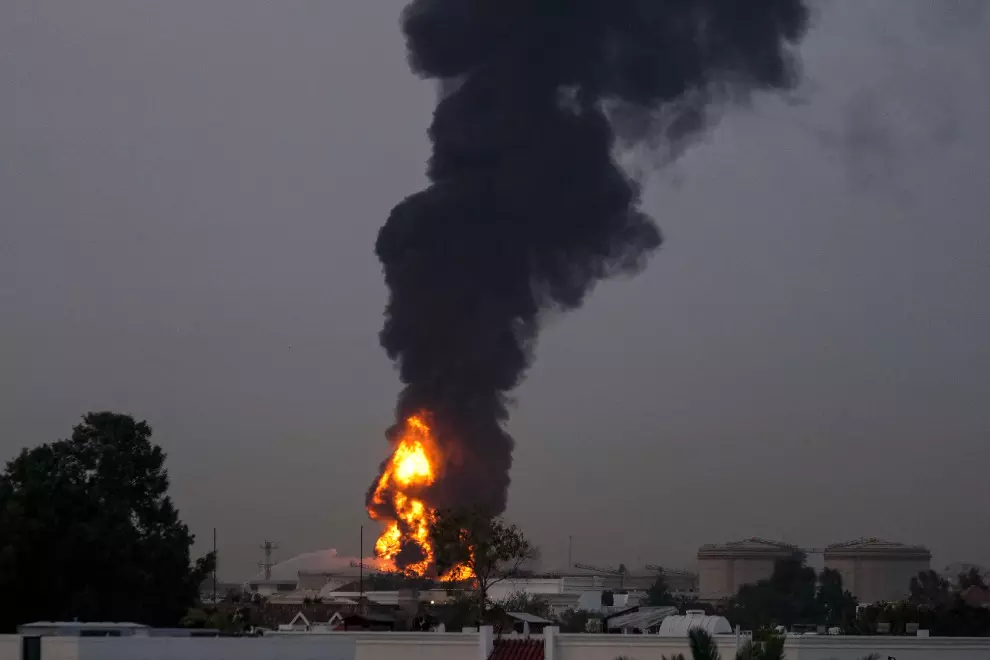


Dubai: Israel and Iran exchanged fresh, high-impact strikes on Wednesday, widening the conflict across the Middle East as energy infrastructure, military targets and urban centres came under sustained attack. Israel said it killed Iran’s intelligence minister Esmail Khatib in an overnight strike, the latest in a series of targeted killings of senior Iranian figures, while Tehran retaliated with missile barrages on Israel and attacks on Gulf Arab energy facilities. The escalation has pushed global oil prices above USD 100 per barrel and raised concerns about supply disruptions through the Strait of Hormuz, a vital shipping route for roughly one fifth of the world’s oil.
Israeli Defence Minister Israel Katz said Khatib was killed in a precision strike and warned that “significant surprises are expected throughout this day on all fronts.” Iranian state media later confirmed the death, with President Masoud Pezeshkian describing it as “an unfair assassination.” The killing marked the third high-profile Iranian figure targeted by Israel in two days, following strikes that killed senior security official Ali Larijani and Gen. Gholam Reza Soleimani, head of the Revolutionary Guard’s Basij militia.
Iran responded with a wave of missile strikes, including the use of multiple-warhead systems designed to overwhelm air defence networks. The Revolutionary Guard said it launched Khorramshahr-4 and Qadr missiles toward central Israel. Footage showed at least one missile dispersing cluster munitions mid-air. In Ramat Gan, near Tel Aviv, a residential building was hit, killing two people and bringing the total death toll in Israel from Iranian missile fire since the war began on February 28 to 14.
Police said the victims were an elderly couple who had not reached a designated shelter in time. “The munition collapsed the roof in on an elderly couple that were in their room,” a police spokesman said, describing the strike as a cluster munition impact. The barrage also disrupted infrastructure, with rail services in parts of central Israel suspended after shrapnel damaged a station.
The conflict has increasingly targeted energy assets across the region. Iran struck Saudi Arabia’s Eastern Province, home to major oil fields, and launched attacks or threats against facilities in Kuwait, Bahrain, Qatar and the United Arab Emirates. Explosions were reported near Al Minhad Air Base in the UAE, and a projectile caused a small fire at a facility used by international forces near Dubai, though no injuries were reported.
Saudi authorities said they intercepted a ballistic missile aimed at the Prince Sultan Air Base, which hosts US forces, and shot down two drones targeting Riyadh’s diplomatic quarter. Iran has also signalled it will continue to disrupt shipping through the Strait of Hormuz. While Tehran insists the waterway remains open, only a limited number of vessels, including some from India and Turkey, have passed through since the conflict began.
The disruption has sent oil prices sharply higher, with Brent crude trading above USD 100 per barrel and rising more than 40 per cent since late February. The surge has added pressure on global economies, with higher fuel costs feeding into broader inflation.
In Washington, the administration moved to ease sanctions on Venezuela, allowing US companies to engage with its state oil firm in an effort to boost supply. President Donald Trump, expressing frustration at the lack of international support for securing shipping lanes, said on social media that the United States would act independently, declaring, “WE DON’T NEED THE HELP OF ANYONE!”
Elsewhere in the region, attacks extended to Iraq, where the US Embassy in Baghdad came under fire for a second consecutive day. Iraqi officials said pro-Iran militia groups were behind the strikes, part of a pattern of attacks on American targets since the war began.
Inside Iran, Israeli strikes continued to hit a range of sites. An airstrike on a courthouse complex in Larestan in southern Fars province killed at least eight people, according to Iranian media, with additional casualties reported but not fully confirmed. The Iranian Red Crescent has said more than 1,300 people have been killed in the country since the conflict started.
Iran’s judiciary also announced the execution of Kourosh Keyvani, who it accused of spying for Israel’s Mossad intelligence agency by providing sensitive information and images. Sweden’s Foreign Ministry separately condemned the execution of a Swedish citizen in Iran, though details were limited.
Concerns about nuclear safety resurfaced after a projectile struck the Bushehr nuclear power plant complex. The International Atomic Energy Agency said the facility was not damaged and there were no injuries. Its chief, Rafael Grossi, called for restraint, warning of the risk of a nuclear accident if the conflict continues to intensify.
In Lebanon, Israel maintained heavy strikes against what it described as Hezbollah targets. Air raids hit multiple apartment buildings in Beirut, including one structure that was struck shortly after an evacuation warning was issued. The Israeli military said the building was being used to store funds for Hezbollah activities, though it did not provide evidence.
Lebanon’s Health Ministry said at least 10 people were killed in central Beirut and two more in the Bekaa Valley. Among the dead was Mohammed Sherri, a senior figure at Hezbollah’s Al Manar television network, who was killed along with his wife. His children and grandchildren were reported wounded.
The broader humanitarian impact in Lebanon has been severe. Government figures indicate more than 1 million people, about 20 per cent of the population, have been displaced. At least 912 people have been killed and 2,221 wounded in Israeli strikes since the escalation began.
The conflict, which started with joint US and Israeli strikes on Iran on February 28, has rapidly expanded into a multi-front confrontation involving state and non-state actors across the region. With energy infrastructure under repeated attack, shipping routes disrupted and civilian casualties mounting, the war shows no immediate signs of slowing.



