India welcomes US-Iran ceasefire; calls for freedom of navigation in Strait of Hormuz
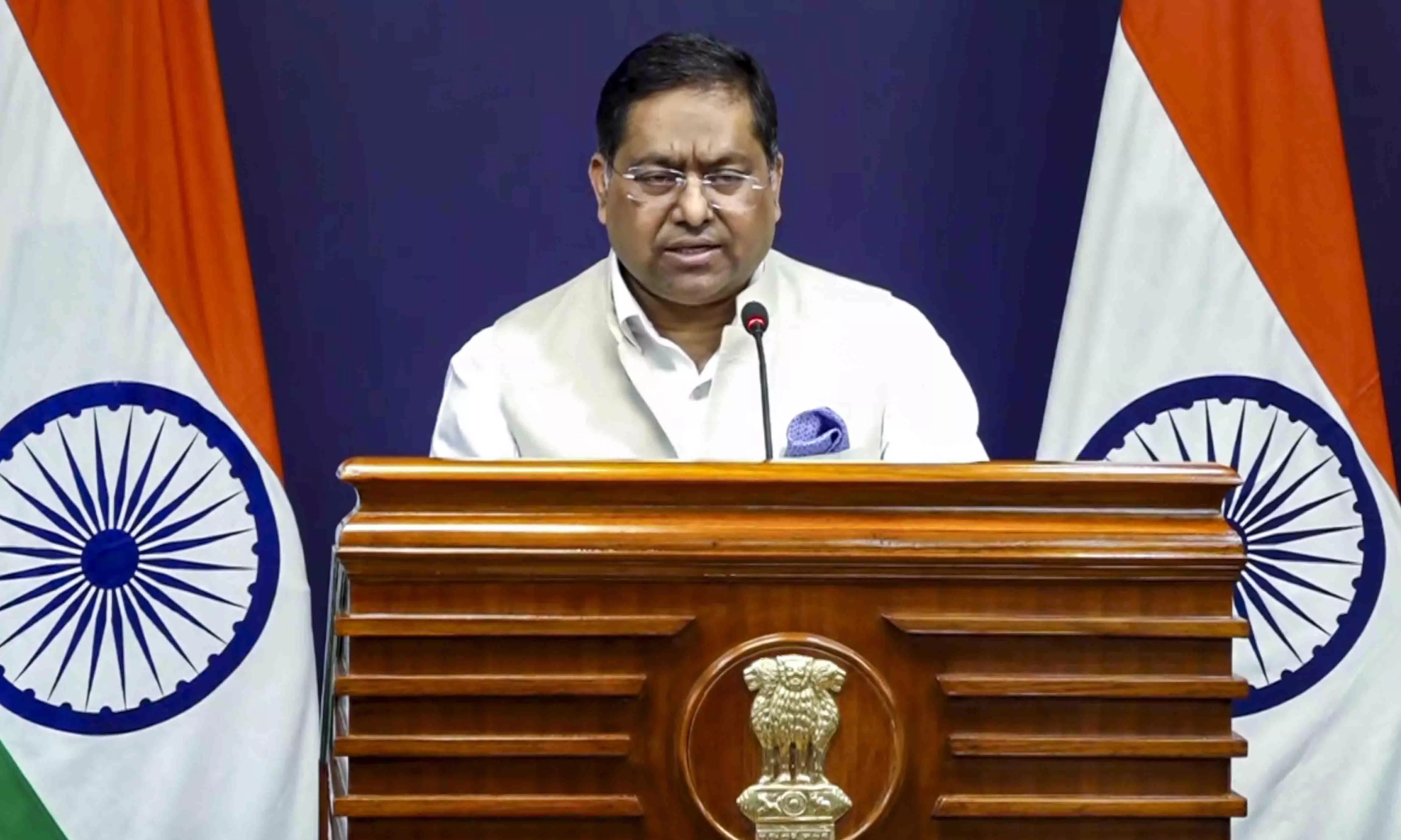


New Delhi: India on Wednesday welcomed the two-week ceasefire between the US and Iran and called for unimpeded freedom of navigation and flow of commerce through the Strait of Hormuz, while hoping that lasting peace will return to West Asia.
New Delhi said it continuously advocated that dialogue and diplomacy are essential to bring an early end to the hostilities. The conflict was triggered by US-Israeli strikes against Iran on February 28.
India's reaction came hours after Iran and the US agreed on the conditional ceasefire that included the opening of the Strait of Hormuz, the strategically key waterway between the Persian Gulf and the Gulf of Oman that handles roughly 20 per cent of global oil and LNG (Liquefied Natural Gas).
"We welcome the ceasefire reached and hope that it will lead to a lasting peace in West Asia. As we have continuously advocated earlier, de-escalation, dialogue and diplomacy are essential to bring an early end to the ongoing conflict," External Affairs Ministry spokesperson Randhir Jaiswal said.
"The conflict has already caused immense suffering to people and disrupted global energy supply and trade networks."
"We expect that unimpeded freedom of navigation and global flow of commerce would prevail through the Strait of Hormuz," he said.
Jaiswal said India hopes that the "development" in West Asia will also encourage peace efforts in Ukraine.
The announcement on the ceasefire resulted in a fall in the global crude oil prices and a rally in stock markets.
Global oil and gas prices had surged after Iran virtually blocked the Strait of Hormuz. The move severely impacted energy supplies to countries around the world including India.
In a social media post, Trump said the US had agreed to "suspend the bombing and attack of Iran for a period of two weeks" provided Iran agreed to reopen the Strait of Hormuz.
"We agreed to the provisional ceasefire because we have already met and exceeded all military objectives," he said.
The announcement on the ceasefire came amid growing outrage over Trump's ultimatum to Iran that "a whole civilisation will die tonight" if Tehran does not reopen the key waterway.
Iranian Foreign Minister Abbas Araghchi said the movement of ships through the Strait will be allowed under Iranian military supervision.
"If attacks against Iran are halted, our powerful armed forces will cease their defensive operations," he said.
"For a period of two weeks, safe passage through the Strait of Hormuz will be possible via coordination with Iran's Armed Forces and with due consideration of technical limitations," Araghchi said.
Both the US and Iran mentioned Pakistan's role in arriving at the conditional ceasefire.
In Islamabad, Pakistan Prime Minister Sharif said the US and Iran have agreed to come to Islamabad on April 10 to hold negotiations to settle all disputes.
"With the greatest humility, I am pleased to announce that the Islamic Republic of Iran and the United States of America, along with their allies, have agreed to an immediate ceasefire everywhere, including Lebanon and elsewhere, effective immediately," he said.
The prime minister expressed hope that the proposed "Islamabad Talks" would help achieve sustainable peace and stability in the region.
In his remarks, Jaiswal said India has always been in favour of peace.
"We welcome all steps that lead to peace and stability. We hope that this development in West Asia will also encourage peace efforts in Ukraine," he said.
Jaiswal said ensuring safety, security and welfare of the large Indian community in the West Asian region remains India's "highest priority".
The spokesperson also made a mention of the fresh advisory issued by the Indian embassy in Tehran urging Indians to expeditiously exit the country.
"We are given to understand that we have around 7,500 Indian nationals who continue to remain in Iran. As of Tuesday, 1,864 Indians, including 935 students and 472 fishermen, exited through Armenia and Azerbaijan," he said.
To a question on the transit of ships through the Strait of Hormuz, he said India is closely following the developments.
"We have been in touch with Iran and several other countries and stakeholders to ensure the unimpeded transit of our ships. As a result of our efforts, we've had several of our ships which have crossed the Strait of Hormuz," he said.
India is in touch with its partners and other stakeholders to serve its interests, he said, adding there is no discussion with Iran on paying any fee.
There were reports that Iran would collect a fee for allowing ships to transit through the Strait of Hormuz.