India, US agree on trade deal; tariffs on Indian goods cut to 18%: Trump
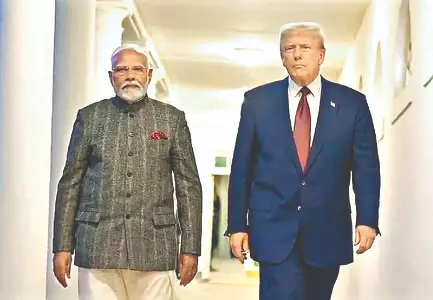


New Delhi: India and the United States on Monday announced a new trade deal under which Washington will reduce tariffs on Indian goods to 18 per cent, while New Delhi agreed to gradually lower its tariffs and non-tariff barriers on US products, following a phone call between Prime Minister Narendra Modi and US President Donald Trump. The agreement, described by both leaders as a major step forward in economic ties, comes alongside recent Union Budget measures that make it easier for American companies to invest in India, particularly in data centres, aviation and nuclear energy.
Trump said Washington would “effective immediately” reduce its reciprocal tariff on Indian products from 25 per cent to 18 per cent, a rate that follows a sharp hike to 50 per cent that came into effect on August 27 but had not been uniformly applied across all product lines. The new level places India marginally ahead of several South and Southeast Asian exporters, including Vietnam, Bangladesh and Pakistan, which currently face US duties of around 19 per cent, though still above the 10 to 15 per cent range enjoyed by the European Union, the United Kingdom, Japan and South Korea.
Modi, responding on X, thanked Trump and framed the tariff cut as a win for Indian exporters. “Wonderful to speak with my dear friend President Trump today. Delighted that Made in India products will now have a reduced tariff of 18%. Big thanks to President Trump on behalf of the 1.4 billion people of India for this wonderful announcement,” he said.
In a broader reflection on the relationship, Modi added, “When two large economies and the world’s largest democracies work together, it benefits our people and unlocks immense opportunities for mutually beneficial cooperation.” He described Trump’s leadership as “vital for global peace, stability, and prosperity” and said India “fully supports his efforts for peace,” noting that he looked forward to taking the partnership to “unprecedented heights”.
Posting on his Truth Social platform, Trump said, “Out of friendship and respect for Prime Minister Modi and, as per his request, effective immediately, we agreed to a Trade Deal between the United States and India, whereby the United States will charge a reduced Reciprocal Tariff, lowering it from 25% to 18%. They will likewise move forward to reduce their Tariffs and non-tariff barriers against the United States, to zero.”
He added that Modi had committed to “buy American” at a much higher level, including “over USD 500 billion” worth of US energy, technology, agricultural products, coal and other goods. Trump also claimed that India had agreed to curb purchases of Russian oil and instead increase imports from the United States and “potentially, Venezuela,” a move he linked to efforts to end the Russia-Ukraine war. “This will help END THE WAR in Ukraine, which is taking place right now, with thousands of people dying each and every week,” he wrote.
The trade announcement dovetails with a series of policy moves in India’s Union Budget for 2025-26 that directly address longstanding US demands for greater market access, particularly in digital infrastructure and strategic industries. Finance Minister Nirmala Sitharaman announced a tax holiday running until 2047 for any foreign company that provides cloud services to global clients using data centre facilities located in India, a measure that is expected to benefit major American technology firms seeking to expand their footprint in the country.
US negotiators had previously sought tax breaks, affordable access to land, energy and water, and duty exemptions on select imports to make India a more attractive hub for data centre investments. With the Budget provisions in place, the government has effectively acted on one of Washington’s central requests in the broader trade dialogue.
Private investment in India’s artificial intelligence and data infrastructure sector is projected to surge as a result. Union IT Minister Ashwini Vaishnaw said last month that such investments could double from last year’s USD 70 billion by the end of the current financial year, FY26, driven in part by global tech companies building large-scale computing facilities in the country.
Beyond digital infrastructure, the Budget also cleared the way for deeper US engagement in India’s energy and aviation markets. Customs duties have been eliminated on aircraft components and Maintenance, Repair and Operations inputs, a move that benefits American aerospace manufacturers and engine suppliers, given the US’s dominant position in global aviation.
In the nuclear sector, the government proposed zero customs duty on nuclear-generation equipment, absorber rods and project imports for all registered nuclear plants until 2035, signalling long-term certainty for foreign suppliers. This complements the passage of the Sustainable Harnessing and Advancement of Nuclear Energy for Transforming India Act, 2025, known as the SHANTI Act, which for the first time opens the operations side of India’s tightly regulated nuclear power sector to private players, a reform that had been high on Washington’s agenda.
India has also been steadily increasing its energy imports from the United States in recent years and has shown greater willingness to lower tariff barriers in talks with the UK and the European Union, a stance that now appears to be reflected in its commitments to Washington as well.
On the domestic front, Sitharaman unveiled measures aimed at strengthening the textile sector, including capital support for machinery in industrial clusters and a targeted scheme to improve the availability of input materials, addressing a longstanding productivity bottleneck.
While the deal was presented by both leaders as a breakthrough, neither side released a detailed legal text or timeline for how India would phase out its tariffs and non-tariff barriers to zero, leaving implementation to future negotiations between trade officials.