India-Russia ties among 'steadiest' globally: Jaishankar
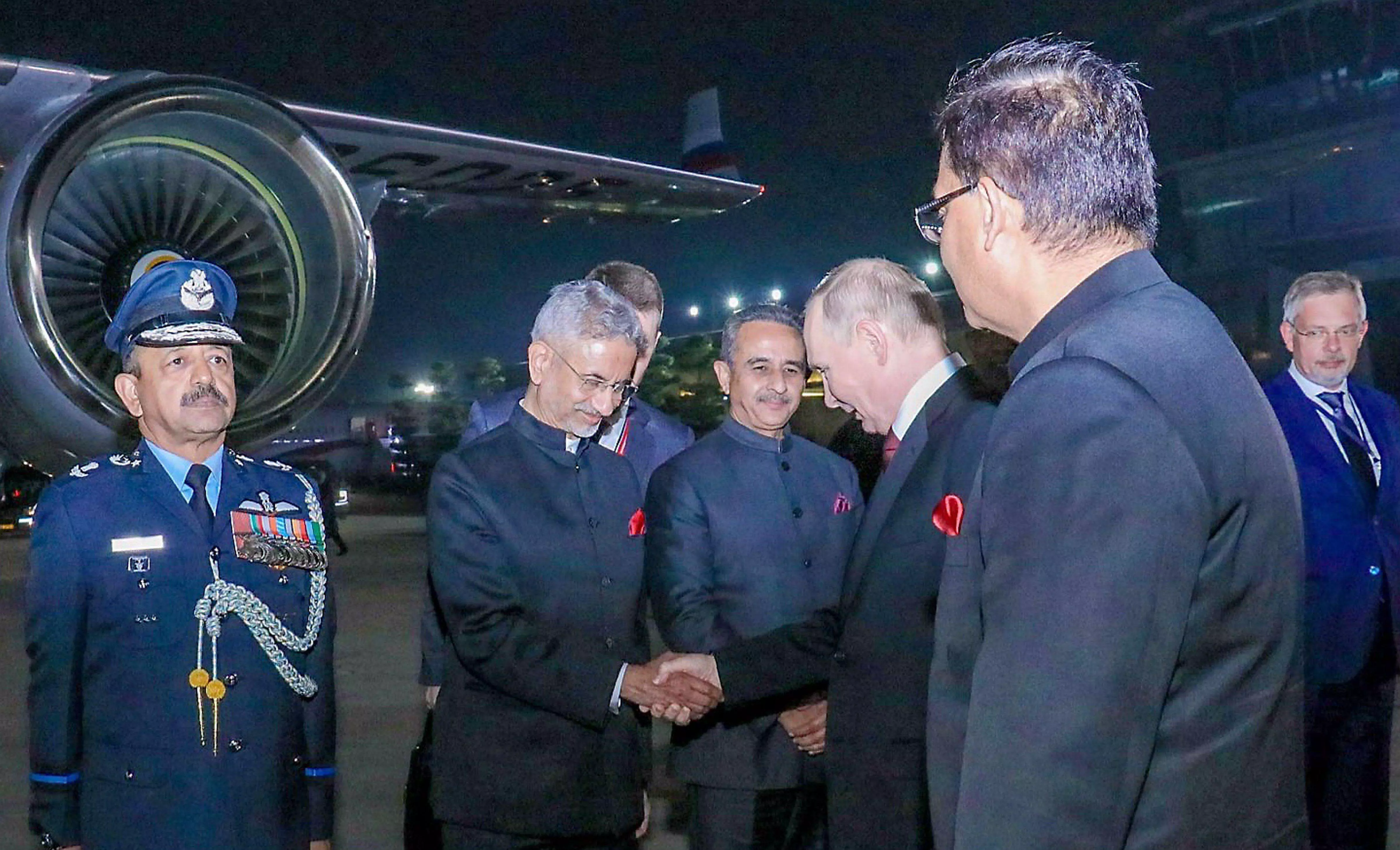


New Delhi: The India-Russia partnership has been among the "steadiest big relationships" in the last 70-80 years and President Vladimir Putin's visit to New Delhi was about "reimagining" the ties with a focus on economic engagement, External Affairs Minister S Jaishankar said on Saturday.
In an interactive session, he also disagreed with views that Putin's visit could complicate India's negotiations with the US on a bilateral trade agreement.
"No, I disagree with you. I think everybody knows that India has relations with all the major countries in the world," Jaishankar said at the Hindustan Times Leadership Summit.
"I think for any country to expect to have a veto or a say in how we develop our relations with others is not a reasonable proposition."
Jaishankar was asked if Putin's two-day visit to New Delhi that focused largely on significantly enhancing the economic dimension of India-Russia ties will have a bearing on the negotiations with the US for the proposed trade deal.
"Because remember, the others can expect the same. I think we've always made it very clear that we have multiple relationships. We have a freedom of choice," he said.
"We talk about what is called strategic autonomy and that continues and I cannot imagine why anybody would have reason to expect the contrary," he added.
The external affairs minister acknowledged that the focus of the Trump administration has been on trade and noted that India's approach in navigating it is totally driven by national interests.
"I think clearly right now trade is the most important issue there. We have, it's clearly very central to the thinking in Washington, much more than it was to earlier administrations, which is something which we have recognized and we are prepared to meet," he said.
"But we are prepared to meet it on reasonable terms. I mean, for those of you who think that diplomacy is about pleasing somebody else I'm sorry, that's not my view of diplomacy. I mean, to me, it is about defending our national interests," he said.
The India-US relations are going through possibly the worst phase in the last two decades after Washington imposed a whopping 50 per cent tariff on Indian goods, including 25 per cent levies for New Delhi's procurement of Russian crude oil.
The two sides are currently holding negotiations for the proposed a trade deal "We believe that there can be a landing point for our respective trade interests. Obviously, that is something which will be negotiated hard because it has an implication for livelihoods in this country," he said.
"At the end of the day, for us the interests of the workers and the farmers and the small business and the middle class matters. When we look at a trade agreement with a country like the US, you have to be extremely judicious about your position, about what you put on the table," he said.
On President Putin's two-day trip to India, Jaishankar said for a "big" and "rising" country like India, it is important to maintain good cooperation with as many important players as possible in the world in line with freedom of choice.
"I think if you look at India-Russia, the world has seen a lot of ups and downs in the last 70-80 years. I've said this before and I'll say it again, India, Russia have actually been among the steadiest big relationships, big power or big country relationships in the world," he said.
"Even Russia's own relationship with China or US or Europe has had its ups and downs. Our relationships with many of these countries have had it too," he added.
In any relationship, Jaishankar noted, it is natural that some aspects of it develop and some kind of don't keep up.
"In the case of Russia, what had happened for a variety of reasons, I think they visualized the West and China as their primary economic partners. We visualised perhaps the same."
"So the economic side of the relationship had somehow not kept pace. You can see that in the numbers."
Putin's visit in many ways was about reimagining the relationship, he said.
"It was about building dimensions and facets which it lacked or didn't have in enough measure. if I were to pick two or three big takeaways, for me, the mobility agreement where Indians would now much more seamlessly find work opportunities in Russia was one big outcome."
The understanding on a joint venture on fertilisers was another major take away, according to Jaishankar.
"We are the world's second biggest fertiliser importer after Brazil. It's a recurring issue that we have. And also because the fertilizer sources have been very unstable. They've turned on and turned off the tap. So we had an agreement to create an important substantial joint venture on fertilizers," he said.
On India's ties with China, Jaishankar said the key point that New Delhi made was that peace and tranquillity in the border areas is a prerequisite for good relations and it is being maintained and is being built upon.
"But it's not like that was the only issue in the relationship. There were many other issues, some of which predated Galwan. So there are issues about trade, there are issues about investment, there are issues about competition, about subsidies, about fairness, about transparency," he said.
"These are real issues as well. We are trying to work our way through some of it. Some of it is easier, some of it is harder," he added.
To a question on Pakistan Army Chief Field Marshal Asim Munir, Jaishankar said much of India's problem emanates from the military of that country and even referred to its support for terror groups.
Like there are good terrorists and bad terrorists, there are good military leaders and apparently not-so-good ones, he said, seen as a reference to Munir.
"I think for us, the reality of the Pakistani army has always been and much of our problems actually emanate from them. When you look at the terrorism, when you look at the training camps, when you look at the sort of a policy of almost ideological hostility towards India, where does that come from? It comes from the army," he said.
Jaishankar said India and Pakistan should not be hyphenated at all.
"Look at the state of Pakistan. See the differentials and the capabilities and frankly the reputation on either side. We should not get over obsessed and hyphenate ourselves with them. There is a challenge, there are issues that we'll deal with," he added.
On Bangladesh, the external affairs minister said India is a well wisher of that country.
"We think as a democratic country, any democratic country likes to see the will of the people ascertained through a democratic process."
"I'm quite confident that whatever comes out of the democratic process would have a balanced and mature view about the relationship and, hopefully things would improve," he said.
Asked if former Bangladesh prime minister Sheikh Hasina will continue to stay in India, he said: "She came here in a certain circumstance and I think that circumstance clearly sort of is a factor in what happens to her. But again, that is something which she has to make up her mind."