India rolls out red carpet for Putin
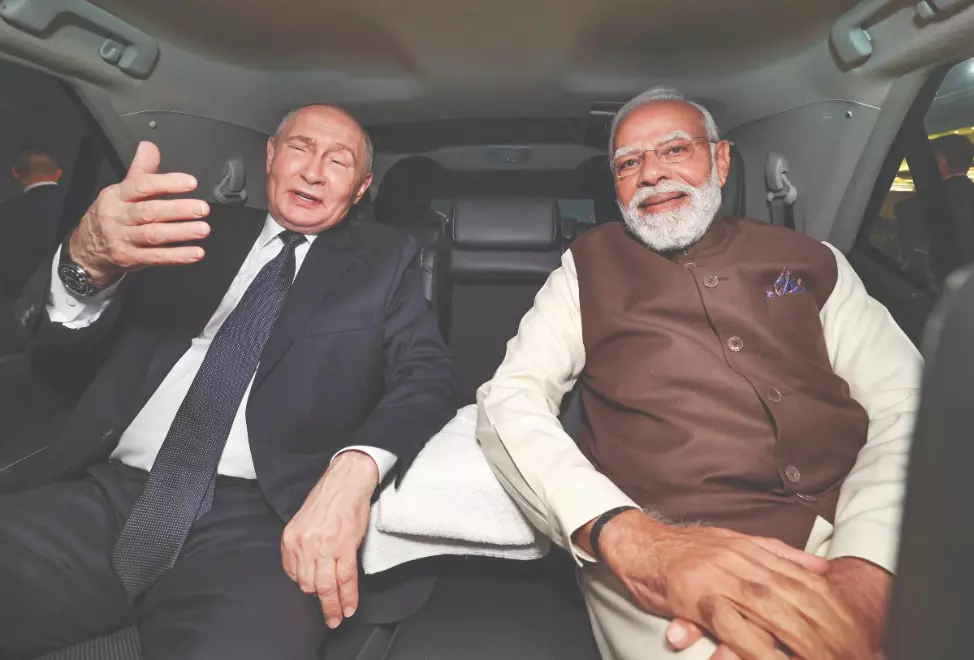


NEW DELHI: In a rare diplomatic gesture and a departure from normal practice, Prime Minister Narendra Modi personally received Russian President Vladimir Putin with a warm hug and handshake on the red carpet upon his arrival at Delhi’s Palam airport on Thursday evening.
India views President Putin’s visit as a reaffirmation of one of its oldest and most resilient strategic partnerships. This is his first trip to India since 2021 and coincides with the 25th anniversary of the India Russia strategic partnership. Several key agreements are expected during the summit.
PM Modi’s gesture underscored the significance New Delhi is attaching to the visit. Putin was welcomed with a cultural performance as he exited the airport before the two leaders left together in the same car for Lok Kalyan Marg, the Prime Minister’s official residence in the capital. The moment echoed their joint ride in Putin’s car during the SCO Summit in Tianjin, China, reflecting their personal rapport.
Soon after receiving President Putin, PM Modi posted photographs of their meeting on X and wrote, “Delighted to welcome my friend, President Putin, to India. Looking forward to our interactions later this evening and tomorrow. India Russia friendship is a time tested one that has greatly benefitted our people.”
Putin’s visit aims to further deepen defence ties as India faces increasing pressure from the United States to slow down its purchase of Russian oil.
Putin is accompanied by Defence Minister Andrei Belousov, with possible deals on fighter jets and air defence systems likely to be discussed. The visit is expected to reinforce a nearly seven decade relationship that has held firm despite a fractious geopolitical environment.
Modi hosted a private dinner for Putin, reciprocating the hospitality extended to him during his visit to Moscow in July last year. The closed-door meeting allowed the leaders to discuss various issues away from public view. Their conversation will set the tone for the 23rd India-Russia summit on Friday, which aims to strengthen economic, defence, and technology ties at a time when Western capitals are closely watching the engagement. Putin’s visit also comes amid a rapid downturn in India US relations.
The formal elements of Putin’s visit, including a ceremonial welcome and a tri services guard of honour at Rashtrapati Bhavan, will take place on Friday. PM Modi will also host a working lunch for Putin and his delegation at Hyderabad House, the summit venue.
The two sides are expected to sign several agreements to bolster cooperation in areas ranging from trade to academia. They will also address a business forum focused on attracting investment and boosting Indian exports to Russia.
Ahead of Putin’s arrival, Kremlin spokesperson Dmitry Peskov said the summit agenda includes steps to shield bilateral trade from US pressure and sanctions, cooperation on small modular reactors in the nuclear energy sector, and the expansion of defence cooperation. Russian hardware accounts for 36 per cent of India’s armed forces inventory.
After the summit, Putin will launch the new India channel of a Russian state run broadcaster before attending a state banquet hosted by President Droupadi Murmu. He is expected to depart India around 9 pm on Friday.
India is facing a 50 per cent tariff imposed by the US on several Indian goods, including a 25 per cent levy linked to New Delhi’s procurement of Russian crude oil. The impact of US sanctions on India’s oil purchases is likely to feature in the talks. Peskov said India’s crude imports from Russia may dip “for a brief period” due to Western sanctions but added that Moscow is working to maintain supplies.
India’s annual procurement of goods and services from Russia totals around USD 65 billion, while Russia’s imports from India amount to roughly USD 5 billion. Officials said New Delhi is also seeking enhanced cooperation in the fertiliser sector, with Russia supplying three to four million tonnes to India each year.
Ahead of the summit, the defence ministers of both countries held wide ranging talks focusing on India’s plan to procure additional batches of S 400 missile systems and other critical hardware. The S 400 systems proved highly effective during Operation Sindoor.
In October 2018, India signed a USD 5 billion deal with Russia to buy five units of the S 400 air defence systems, despite US warnings of possible sanctions under the Countering America’s Adversaries Through Sanctions Act (CAATSA).
Peskov said discussions may also include the possibility of Russia supplying Su 57 fighter jets to India. India is in the process of acquiring a batch of fifth generation jets, with contenders including Dassault Aviation’s Rafale, Lockheed Martin’s F 21, Boeing’s F/A 18, and the Eurofighter Typhoon.
India and Russia have an annual summit mechanism under which the Indian Prime Minister and the Russian President meet to review bilateral ties. So far, 22 summits have been held alternately in India and Russia. Modi visited Moscow for last year’s summit in July.
Hours before his arrival, President Putin said PM Modi “is not one to give in to pressure”, referring to US tariffs linked to India’s oil trade with Russia. “India is a great power, not an English or British colony,” he said in an interview with India Today.
Putin highlighted the long-standing defence and trade partnership and noted that more than 90 per cent of bilateral transactions now take place in national currencies, reducing reliance on the US dollar. Asked about Western attempts to curb India-Russia oil trade, he said, “The world has seen that it cannot talk to India the way it used to 77 years ago. India is a great power, not an English or British colony, and everyone will have to take that into account.”
He also referred to Modi’s focus on indigenous manufacturing, saying, “Take, for example, his famous pitch ‘Make in India’. It has a practical dimension, including for our bilateral relations.”
“When we meet, he always says, ‘Let’s do this, let’s do that, let’s look at this area and that.’ I can list them all. Therefore, we have a lot of practical areas of cooperation,” Putin said.