India, EU seal ‘mother of all deals’
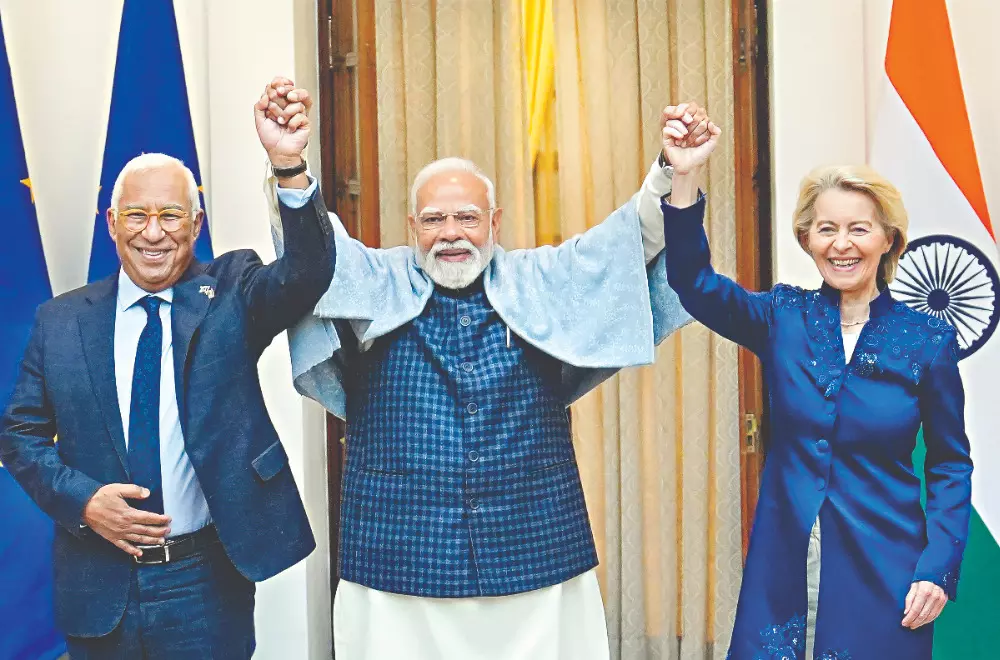


New Delhi: India and the European Union on Tuesday announced the conclusion of negotiations on a long-pending free trade agreement, capping nearly two decades of talks and paving the way for one of the most expansive trade pacts ever negotiated by either side. Branded by leaders as the “mother of all deals”, the agreement is set to create a combined market of around two billion people spanning India, the world’s fourth-largest economy, and the 27-member European Union, the second-largest economic bloc.
Together, India and the EU account for roughly 25 per cent of global gross domestic product and about one-third of global trade, estimated at nearly $33 trillion. Officials said the agreement will significantly lower trade barriers, deepen economic integration and anchor a broader strategic partnership at a time of heightened global trade uncertainty.
Announcing the outcome after summit-level talks in New Delhi with European Commission President Ursula von der Leyen and European Council President Antonio Costa, Prime Minister Narendra Modi said India had concluded the largest free trade agreement in its history. “This is not merely a trade agreement; it is a new blueprint for shared prosperity,” Modi said, adding that the pact would expand opportunities for farmers, small enterprises, manufacturers and service providers while strengthening supply chains and investment flows.
Under the agreement, over 93 per cent of Indian goods exported to the EU will eventually receive zero-duty access, with the bloc committing to tariff concessions covering 99.5 per cent of trade value. On the first day of implementation, duties will be eliminated on 90 per cent of Indian goods, while levies on another three per cent will be phased out over seven years. Average EU tariffs on Indian products, already relatively low at about 3.8 per cent, will be reduced to around 0.1 per cent.
Sectors expected to gain immediately include textiles and apparel, leather and footwear, marine products, chemicals, plastics and rubber, base metals, gems and jewellery, furniture, toys and sports goods. These products currently face duties ranging from zero to as high as 26 per cent in the EU. Indian exports from these sectors were valued at about $35 billion in 2024, with duties on $33.5 billion worth of shipments to be removed on entry into force of the pact. Commerce and Industry Minister Piyush Goyal described the agreement as a strategic breakthrough, saying it provides unprecedented market access for more than 99 per cent of India’s exports by value into the $20 trillion EU market. He noted that Indian textile exports, currently around $7 billion annually to the EU, could rise to $30–40 billion after implementation, helping India compete more effectively with countries such as Bangladesh that already enjoy duty-free access.
In return, the EU will gain duty-free access for 93 per cent of its goods over a ten-year period in India. New Delhi will eliminate duties on 30 per cent of European goods on the first day of implementation and extend concessions gradually to cover 97.5 per cent of trade value over time. Key European exports benefiting from tariff reductions include automobiles, wines and spirits, beer, olive oil, processed foods, fruit juices, kiwis and pears, machinery, electrical equipment, aircraft and spacecraft, medical devices, chemicals, plastics, iron and steel, and pharmaceuticals. Many of these items currently attract import duties ranging from 33 per cent to as high as 150 per cent.
Automobiles were among the most sensitive areas in the negotiations. India agreed to a quota-based liberalisation that will see duties on certain imported European cars fall gradually from as high as 110 per cent to 10 per cent, with an annual quota of 250,000 vehicles. According to the European Commission, Europe exported motor vehicles worth 1.6 billion euros to India in 2024. A commerce ministry official said the effective threshold under the agreement is vehicles priced at 15,000 euros, or about Rs 15 lakh, at the port of entry, after which additional taxes, freight, insurance and registration costs would add Rs 10–12 lakh to the final consumer price. For electric vehicles, duty concessions will begin from the fifth year of the agreement, with rates initially set between 30 per cent and 35 per cent depending on the segment.
Wine imports will also see significant changes. Duties on high-value wines will be reduced from 150 per cent to 20 per cent over seven years, while no concessions will apply to wines priced below 2.5 euros. European exporters estimate the overall tariff cuts could save up to four billion euros annually.
India has excluded dairy products, including cheese, as well as soya meal and cereals from tariff concessions. The EU, for its part, has protected its sugar, beef, meat and poultry sectors. India also secured quota-based duty-free access for table grapes, with concessions covering 85,000 tonnes, or roughly $100 million, of exports to a market where the EU imports about $1.4 billion worth annually.
Beyond goods, the agreement includes wide-ranging commitments on services and mobility. The EU has opened 144 of its 155 services sub-sectors to Indian firms, while India has opened 102 sub-sectors to European providers. Areas of strength for India include information technology and IT-enabled services, professional services, education, financial services, tourism and construction. Officials said the pact also establishes a predictable framework for business mobility, short-term travel and temporary movement of professionals, with provisions related to student mobility and post-study work visas.
Chapters on digital trade, technical barriers to trade, sanitary and phytosanitary measures and intellectual property rights are included, though energy, critical minerals and government procurement remain outside the scope of the agreement. On the EU’s Carbon Border Adjustment Mechanism, the pact does not grant India specific exemptions but ensures that any flexibilities extended to other countries will automatically apply to Indian exporters, alongside commitments on technical cooperation and financial assistance to meet emerging carbon requirements.
The announcement came amid rising global trade tensions, with India facing steep tariffs from the United States and the EU itself under threat of new duties. European Commission President von der Leyen said the deal sent a strong signal that cooperation remains the best response to global challenges. “We are creating a market of two billion people,” she said, adding that the agreement would create jobs and reduce strategic dependencies.
European Council President Costa said the agreement was among the most ambitious ever concluded and would reinforce a rules-based economic order, while also underpinning closer security and defence cooperation. Alongside the FTA, India and the EU signed pacts on defence collaboration and talent mobility and adopted a comprehensive strategic agenda for the next five years. Formal signing of the trade agreement is expected within five to seven months following legal review, with officials expressing confidence that it could enter into force during 2026 or early 2027. Once implemented, bilateral trade in goods, currently about $136 billion, is projected to exceed $200 billion within three to four years, while services trade could rise from $80–85 billion to around $125 billion over the same period.