India, Canada seal $2.6 bn uranium deal, aim to finalise trade pact in 2026
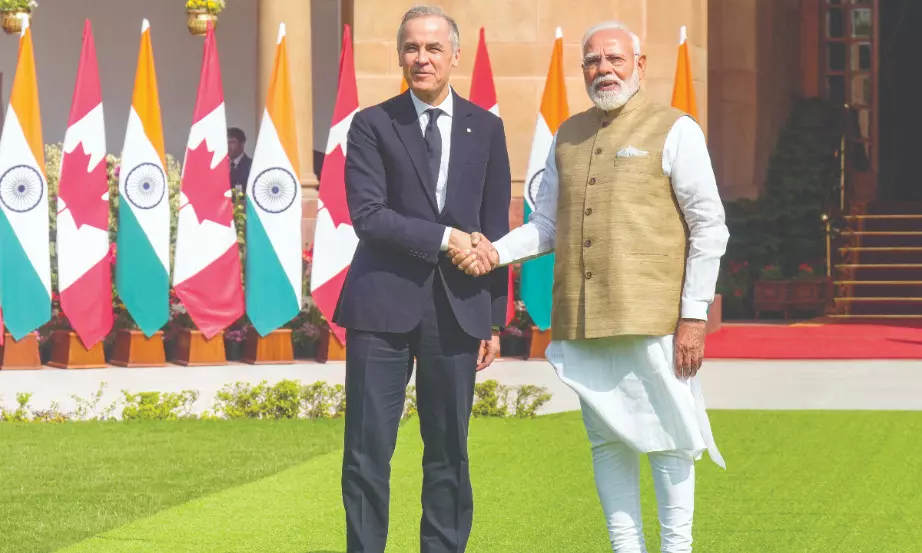


New Delhi: Amid escalating volatility in the global energy sector driven by geopolitical tensions, supply chain disruptions, and shifting energy demands, India and Canada took a significant step on Monday by signing a long-term Uranium supply agreement valued at $1.9 billion between Cameco Corporation and the Department of Atomic Energy. This landmark deal signals a recalibration in their bilateral relationship, underscoring the strategic importance of energy cooperation.
It was announced during the first official visit to India by the Canadian Prime Minister, Mark Carney. It marks a reset in the relationship between the two countries, which took a downturn in 2023. The uranium supply deal is the centrepiece of the reset in relations between the two countries. It was announced along with a comprehensive joint statement outlining the renewed Strategic Partnership between the two countries.
The uranium supply deal involves supplying 22 million pounds of uranium concentrate to India between 2027 and 2035. It includes the supply of 11,000 tonnes of uranium concentrate to India. It will be used to fuel India’s civilian nuclear reactors. It aligns with the Indian government’s plan to achieve a nuclear capacity of 100 GW by 2047, which is eleven times the current nuclear capacity. India’s uranium production capacity is insufficient to meet the increasing energy demands.
Prime Minister Narendra Modi stated that the two countries are planning to move ahead with a Comprehensive Economic Partnership Agreement (CEPA). Once this is accomplished, the scope of trade between the two countries may increase significantly. Both the leaders finalised an ambitious roadmap of cooperation to shore up ties including taking bilateral annual trade to over $50 billion by 2030.
Another area of cooperation, as mentioned by Canadian PM Carney, is energy. India is expected to increase its energy demand twofold by 2040, and the government has set a target of adding 500 gigawatts of renewable energy capacity by the end of this decade, along with increasing the share of natural gas in the energy mix of the country. A new Strategic Energy Partnership has been announced, aiming to increase energy trade between the two countries significantly. “Canada is in a position to pitch in. We are a reliable supplier of responsibly produced LNG and essential minerals for clean tech and nuclear energy,” said the Canadian prime minister. In a complicated world, cooperation between the world’s biggest democracy and a key member of the G7 may significantly enhance the resilience of the global economy, according to a statement by the leaders of the two countries. Energy security and diversification are now core elements of this partnership. The leaders of the two countries are moving ahead to strengthen the India-Canada Strategic Energy Partnership and welcome the relaunch of the Ministerial Energy Dialogue during India Energy Week 2026, together with a Joint Action Plan. The areas that will be included in the cooperation include clean and conventional energy, civil nuclear, and critical minerals, with a focus on affordability, sustainability, and long-term growth. The growing stature of Canada as a supplier of heavy oil and its ambitions to be a major player in the export market for liquefied natural gas (LNG) were major topics for discussion. The goal is to produce 50 million tonnes annually of LNG by 2030, with a possibility of reaching 100 million tonnes annually by 2040. India, which is the third-largest oil consumer and fourth-largest importer of LNG, signalled its desire for Canada to be its supplier, and discussions are underway for a deal that will be India’s first long-term LPG supply contract with Canada.
The two countries have signed a Memorandum of Understanding for Critical Minerals Cooperation and welcomed India’s support for the G7 Critical Minerals Action Plan, which seeks to develop a diversified and secure supply chain for clean energy technologies and advanced manufacturing. The other MoU signed is for Clean Energy Cooperation, which outlines an institutional framework for collaboration in clean energy technologies, including solar, wind, bio-energy, small hydro, and energy storage technologies. An India-Canada Renewable Energy and Storage Summit is planned for 2026.
Among the 62 outcomes, climate cooperation will include areas like biodiversity conservation, climate resilience, and fighting plastic pollution, along with carbon capture, utilisation, and storage. India welcomed Canada’s decision to pursue its membership in the International Solar Alliance and its decision to upgrade its participation in the Global Biofuels Alliance as a Full Member. Carney also announced the development of a Canada-India Talent and Innovation Strategy, which will include new university collaborations in areas like artificial intelligence, life sciences, and digital technologies. Education and talent mobility have also been recognised as key pillars for the new relationship. The leaders have agreed to expand joint and dual-degree programs, enable offshore Canadian campuses in India, and revitalise the Joint Working Group on Higher Education.
The MoU between the All India Council for Technical Education and MITACS will expand the Globalink Research Internship program by allowing around 300 Indian undergraduates to participate annually in research internships in Canada.
Technology cooperation is set to receive a new injection with the relaunch of the Joint Science and Technology Cooperation Committee. With over three decades of successful collaboration between the Canadian Space Agency and the Indian Space Research Organisation, the two countries are set to implement joint initiatives in atmospheric sciences, space robotics, human spaceflight, and quantum communications. Additionally, the two countries will look to utilise artificial intelligence in aerospace technology and artificial intelligence diagnostic tools for remote healthcare delivery.
The relationship between us on security and defence will become stronger through periodic formal dialogues on various areas of mutual concern, including combating violent extremism, terrorism, organised crime, cybercrime, and trafficking. The new Maritime Security Partnership will comprise defence material cooperation, supply chain resilience, and joint defence exercises. The choice of Canada to establish a Defence Attaché in India, as well as India’s choice to accredit its Defence Attaché in Washington DC to Canada, is likely to strengthen institutional relationships.
On the economic side, leaders are optimistic that a Comprehensive Economic Partnership Agreement will provide a strong foundation for the relationship between the two nations. With the Terms of Reference signed and formal negotiations underway, the two leaders are committed to concluding the talks by the end of 2026. The goal is to increase trade between the two nations to CAD 70 billion by 2030. The revitalised dialogue between trade and investment ministers, the relaunching of the India-Canada CEO forum, and the upcoming dialogue between finance ministers for an economic and financial dialogue are all geared to give a new impetus to bilateral trade and commerce. These will help strengthen ties in areas like instant payments, cross-border remittances, and fintech development.
“This isn’t just about renewing a relationship. It’s about growing a valued relationship with new ambition, focus, and foresight—a relationship between two confident nations charting our own course,” the Canadian Prime Minister said. In the Indo-Pacific, Modi emphasised the significance of a free, open, and inclusive Indo-Pacific region, and that the two countries would continue discussing regional stability and other global challenges. The joint statement issued by the leaders reflects their confidence that the initiatives will help rebuild trust, generate long-term economic benefits, and contribute to regional stability and global resilience.