India and Russia unveil 5-year strategic roadmap; Modi calls for peaceful end to Ukraine war
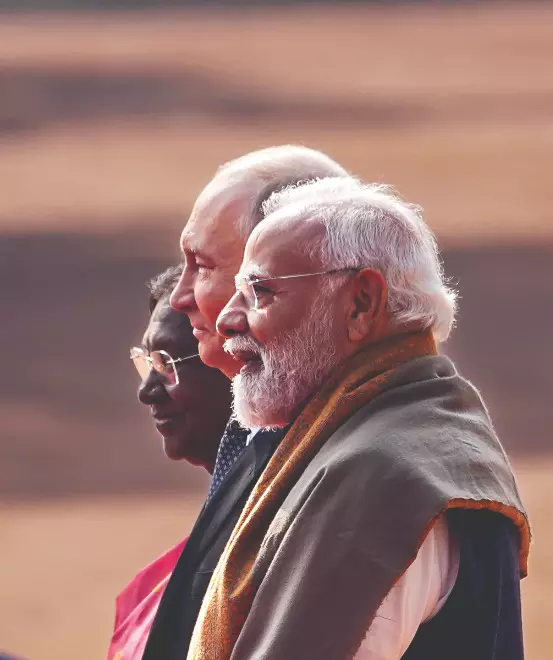


New Delhi: India and Russia on Friday reaffirmed the strength and future of their Special and Privileged Strategic Partnership as the 23rd India-Russia Annual Summit concluded here during Russian President Vladimir Putin’s two-day State visit.
After attending a banquet in his honour at the Rashtrapati Bhavan hosted by President Droupadi Murmu, Russian President Vladimir Putin concluded by saying that the Indian phrase “Go Together, Grow Together” truly reflects the nature and character of India-Russia relations.
President Murmu appreciated Putin’s support and personal commitment to the India-Russia Special and Privileged Strategic Partnership. Her office added that both leaders expressed confidence that the longstanding friendship between India and Russia would continue to prosper in the years ahead.
PM Modi reiterated that “India is on the side of peace’’ amid the Ukraine war. The leaders reviewed trade ties, with Modi expressing confidence that the Rs. 100-billion target will be achieved ahead of schedule. At the India-Russia Business Forum, Modi urged Russian firms to “Make in India’’.
The two leaders underlined that the relationship was based on mutual trust, respect for core national interests, and strategic convergence, affirming that India and Russia, as major global powers, “share responsibility for maintaining global peace and stability based on equal and indivisible security.” They noted that despite a complex and uncertain international environment, bilateral ties have remained resilient, sustained by regular high-level political engagement.
Trade, investment, and economic cooperation became a centrepiece at the summit as both sides vowed to achieve USD 100 billion in bilateral trade by 2030. The leaders confirmed their commitment to expanding balanced, diversified trade, increasing India’s exports, and promoting high-technology cooperation.
They welcomed the adoption of the “Programme 2030” for strategic economic cooperation and acceleration of work on the proposed India-Eurasian Economic Union Free Trade Agreement. Negotiations on a bilateral investment protection agreement will also be intensified.
During the discussions, both sides stressed the need to remove trade barriers, improve connectivity, ensure smooth payment systems, and resolve insurance issues. They agreed to further bilateral settlements using national currencies and to increase interoperability among payment and financial messaging platforms, including central bank digital currencies.
The two leaders reviewed the broad-ranging high-level engagements since the last summit. They emphasised the comprehensive reform of the UN Security Council to expand permanent membership for India and more representative global governance structures. Cooperation within the G20, BRICS and SCO was reaffirmed, with Russia expressing full support for India’s BRICS Chairship in 2026.
Energy cooperation remained a key pillar of the partnership. The two sides continued collaboration in the exploration and refining of oil and gas, petrochemical technologies, LNG and LPG infrastructure, coal gasification, and nuclear energy.
On space, the two sides declared that ISRO and Roscosmos will deepen cooperation in human spaceflight programmes, satellite navigation, planetary exploration, and rocket engine development.
Military and defence cooperation remained another key pillar of the relationship. The leaders welcomed the outcomes of the 22nd session of the India-Russia Inter-Governmental Commission on Military and Military-Technical Cooperation, noting a renewed emphasis on joint research and development, co-development, and co-production.
Regular military exercises under “INDRA,” defence minister engagements, and service-to-service exchanges will continue. Russia agreed to support local manufacturing in India of spares and components for Russian-origin defence equipment, including for exports to friendly third countries.
The leaders also welcomed the steps taken to ensure long-term fertiliser supplies to India and discussed joint ventures in the fertiliser sector. Agreements on skilled workers were signed between the two nations to enhance workforce mobility.
In the field of transport and connectivity, as well as Arctic cooperation, the leaders pledged to develop efficient transport corridors with a primary focus on the International North-South Transport Corridor, the Chennai–Vladivostok Maritime Corridor and the Northern Sea Route. An MoU about specialist training for polar shipping was inked during the summit. Cooperation between the railways of the two countries for mutually beneficial technology exchange was also reaffirmed.
Both India and Russia agreed to enhance engagement in the Russian Far East and Arctic regions in sectors such as agriculture, energy, mining, pharmaceuticals, maritime transport, and diamonds. Russia recognised India’s increasing role as an observer in the Arctic Council and appreciated its participation in the International Arctic Forum.
The joint statement also underlined that in the field of science, technology, and digital cooperation, the two countries will deepen collaboration in critical and emerging technologies, including artificial intelligence, digital security, protection of critical infrastructure, and law-enforcement technologies.
At the summit, PM Modi and President Putin strongly condemned the Pahalgam terror attack in India during April 2025 and the Crocus City Hall attack in Moscow during March 2024. They reaffirmed a zero-tolerance policy toward terrorism, including cross-border terrorism. The leaders called for strong action against UN-designated terror groups, denial of safe havens, combating terror financing and online radicalisation, and early adoption of the Comprehensive Convention on International Terrorism. They also reaffirmed support for the Delhi Declaration on countering the misuse of emerging technologies by terrorists.
Regarding Afghanistan, both sides emphasised counter-terrorism cooperation and humanitarian assistance within the Moscow Format. In the Middle East, the two sides urged restraint, civilian protection, international law compliance, active dialogue on the Iran nuclear issue, and sustainable peace in Gaza.
President Putin invited PM Modi to pay a visit to Russia in 2026 on the occasion of the 24th India-Russia Annual Summit.